How Austin's parks rank nationally


Add Axios as your preferred source to
see more of our stories on Google.
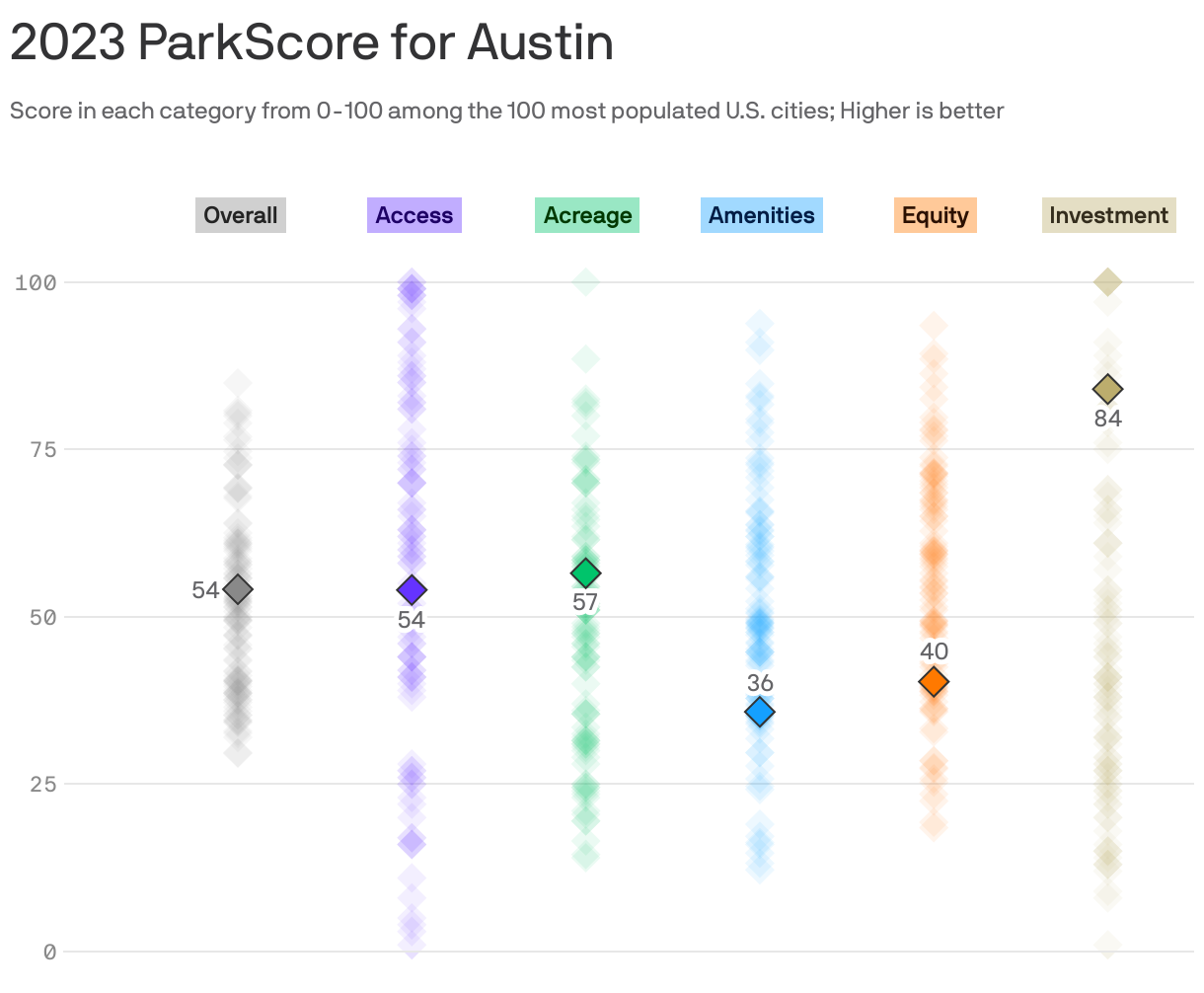
Austin ranks 41st among the 100 largest U.S. cities for its public parks, per the latest report from the Trust for Public Land (TPL), a pro-parks nonprofit.
- The group rates cities on a variety of metrics, including the percentage of residents who live near a park, the share of city land reserved for parks, parks investment and more; cities are then awarded a "ParkScore."
Why it matters: For play, for health, for picnics, parks are key to our peace of mind.
- They were especially crucial during the throes of the pandemic as a way to get outside while keeping distance.
The big picture: At a national level, parks spending still hasn't recovered to pre-Great Recession levels, per TPL officials.
- But that statistic is largely driven by the country's biggest cities — by contrast, many midsize cities are increasing their parks spending.
- The current fiscal year budget for Austin's Parks and Recreation Department is $114 million — up $8 million from the previous year — with a five-year plan to spend $224.4 million on capital projects, from reviving East Austin's Parque Zaragoza Bathhouse to rehabilitating South Austin's Dittmar Recreation Center.
- In 2018, Austin voters approved a $149 million bond measure to pay for parkland acquisition and city pool repairs, among other things.
Reality check: Not every city park is a multi-acre Olmstedian masterpiece — yet even diminutive "pocket parks" and community garden lots confer physical, mental and social benefits.
- "If there's a pocket park with no sports facilities at all, but I walked 12 minutes to get there and I walk 12 minutes home, I've got my 24 minutes of moderate activity for that day," says Howard Frumkin, TPL senior vice president and director of the Land and People Lab.
Of note: 70% of Austin residents live within a 10-minute walk of a park, slightly under the 100 largest U.S. cities' average of 76%.
Zoom in: Austin gets relatively high marks in the new rankings for its number of splash pads and dog parks but gets low grades for its number of basketball hoops, playgrounds and rec centers.
- The city was ranked 39th nationally last year.
What they're saying: "The ranking on the TPL report reflects Austin's investment in the parks system and underscores the need to continue to invest in green spaces as our city expands," Kanya Lyons, a spokesperson for Austin's Parks and Recreation Department, tells Axios.
Between the lines: Residents in low-income neighborhoods have access to 39% less park space per person than those in the average Austin neighborhood and 55% less than those in high-income neighborhoods.