Texas congressional maps get failing grade

Add Axios as your preferred source to
see more of our stories on Google.
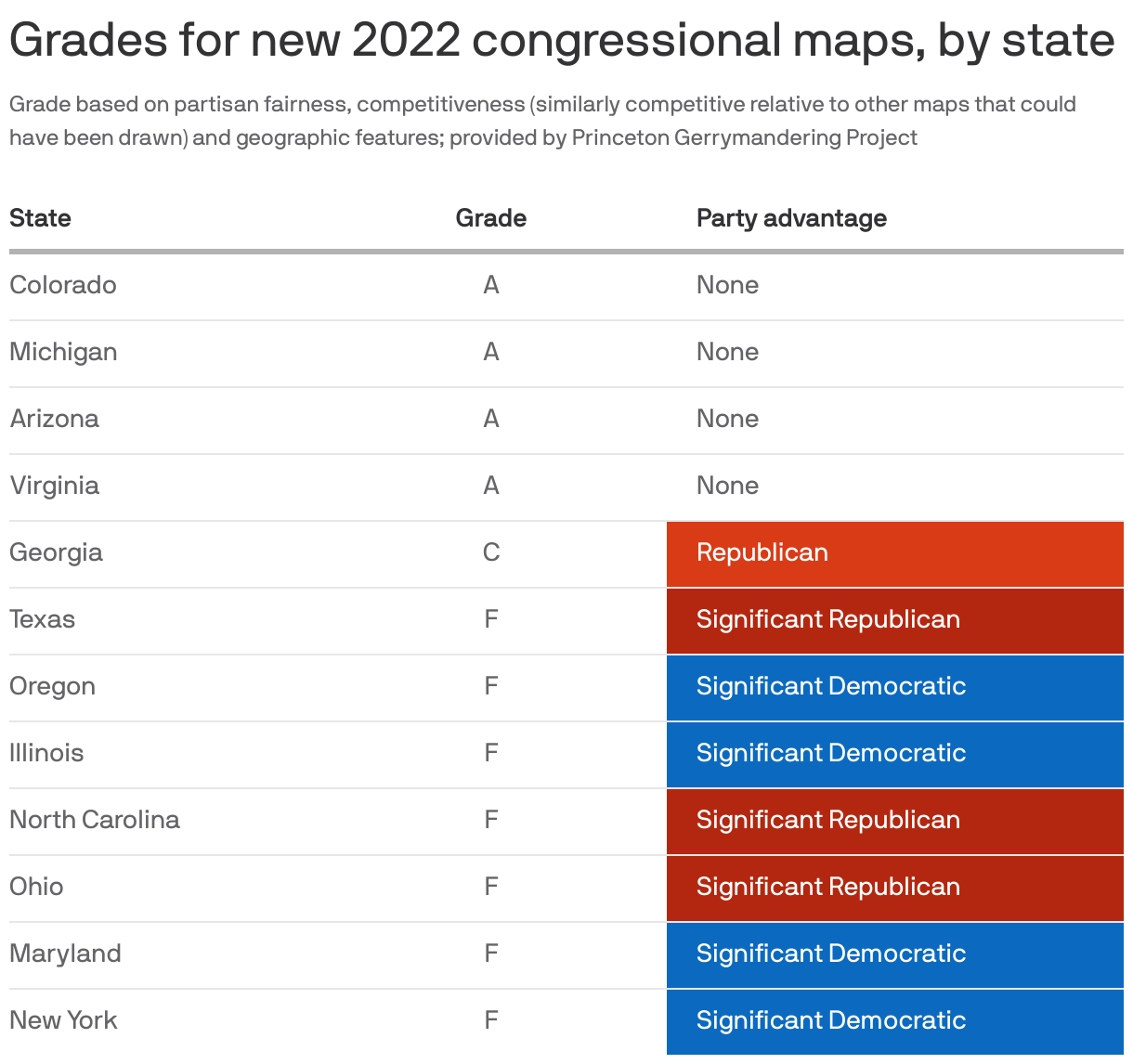
Even as Texans head to the polls, the state's new congressional district map has been graded an "F" by the Princeton Gerrymandering Project and RepresentUs.
Why it matters: The map gives Republicans a significant advantage over Democrats, and the report card found that the districts aren't geographically compact and have "more county splits than typical."
- Translation: This is the equivalent of your teacher writing, "Please come see me" at the top of your test results.
- Early voting is underway in the first election since the maps were redrawn.
Zoom in: As part of the redrawing, Austin actually got a new, safely Democratic congressional seat, one certain to be won by long-time U.S. Rep. Lloyd Doggett.
Yes, but: Texas lawmakers created that congressional district to shore up the re-election chances of a handful of Republican incumbents who occupy gerrymandered districts that take in parts of the city and its suburbs.
The Texas map received "Fs" for partisanship and geographic features, but was graded a "C" for being "similarly competitive relative to other maps that could have been drawn."
- The Department of Justice sued the state, alleging the redrawn maps discriminate against Black and Latino voters. The litigation is pending.
Of note: The grades are based on a variety of factors, including the competitiveness of seats and how many counties are split.