Fauci sees greater China role in COVID-19 spread, one year on

Add Axios as your preferred source to
see more of our stories on Google.
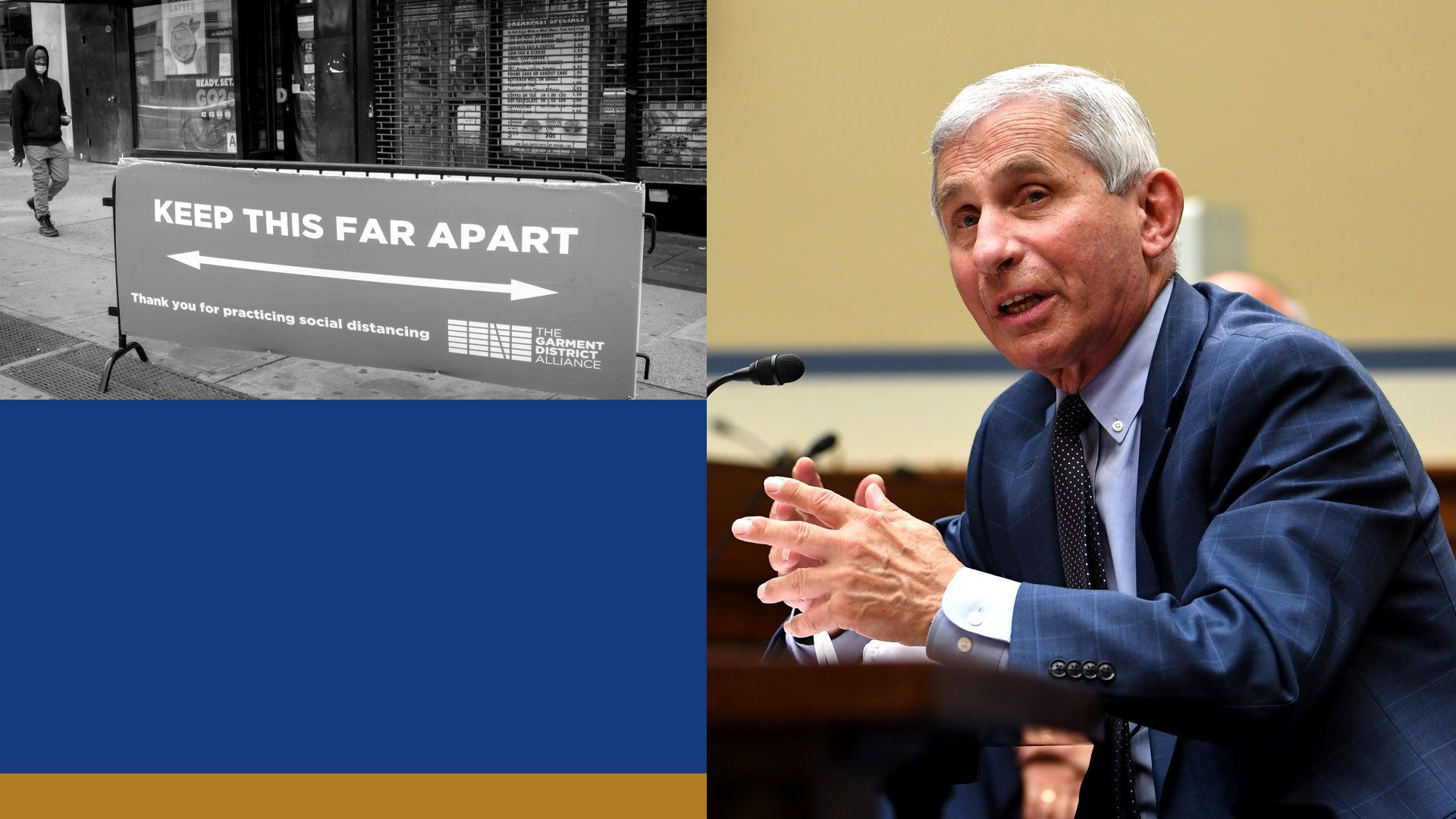
Photo illustration: Eniola Odetunde/Axios. Photos: Ira L. Black (Corbis), Pool/Getty Images
A lack of transparency by Chinese officials — particularly about the novel coronavirus' transmission and the obstruction of a top U.S. scientist from investigating it — played a significant role in allowing COVID-19 to spread outside China, NIAID director Anthony Fauci tells Axios.
The big picture: Axios first spoke with Fauci one year ago this week about the "mysterious pneumonia" in Wuhan, China, which he suspected was a novel coronavirus but was being reported by Chinese health officials as not that infectious.
- "Back then, the lack of full appreciation of the seriousness of what we were dealing in, was [due to] a number of reasons," Fauci says. "Some things were absolutely not known by anybody. And, some things were known by the Chinese and they weren't very transparent about it," he adds, citing their delayed reporting on person-to-person and asymptomatic transmission of the virus.
- Many people outside China "got fooled," he says, because they didn't know the virus causing the pandemic was acting differently from its cousin, SARS-CoV, where people infected with SARS show symptoms.
- If China had revealed its asymptomatic spread earlier, it would have "changed everything" for guidance around masks, social distancing and contact tracing, he says.
China also refused to allow foreign scientists to investigate the virus on the ground "for a considerable period," limiting the ability to see how it was transmitting and to trace its origin, he says.
- When they finally did allow an international group led by the WHO, they still blocked some of those scientists, including one from NIAID, from traveling to Wuhan from Beijing.
- And this week, China delayed travel authorization for a group of WHO-led international scientists planning to investigate the virus origins.
Looking back over the prior year, Fauci and other public health experts say there are some lessons learned...
1) Communication is key.
- "You don't know everything you need to know the first day," and as data accumulate, public health guidelines will evolve, Fauci says.
- Some public health experts say that process could have been explained to the public more clearly, particularly as guidance changed.
- "The key here is not that we didn't know what to do, but there were barriers that prevented that, whether they be political or other," says Tara Kirk Sell, senior scholar at Johns Hopkins Center for Health Security. "The CDC has this guidance called Crisis & Emergency Risk Communication. It's science-based and works well, but we didn't [use] it."
2) Misinformation and disinformation is hugely damaging.
- These were "incredibly powerful in this pandemic," says Sell, adding they can affect people's health and national security. "We really need a national strategy to combat this."
3) "Political divisiveness is a big hindrance to an adequate public health response," Fauci says.
- "You get people who are making decisions about their own behavior based on political considerations, as opposed to an objective evaluation of the public health threat," Fauci adds.
- "Public health has always been political, but it's never really been as partisan as it's been this time around. Partisanship in public health has been really incredibly dangerous in this pandemic," says Carlos del Rio, distinguished professor of medicine at Emory University School of Medicine.
Science advances in vaccine technology are the biggest bright spot this year, Fauci says.
- Developing and then administering a safe and effective vaccine in 11 months is "a monumental accomplishment. It's just historic in its proportion," Fauci says.
- "Rebuilding trust in science is a priority and I'm hoping the vaccines will do that.[cut: I think we need to continue to communicate what an incredible achievement that has been, and the fact that these vaccines did not come out of nowhere. Vaccines came from the years of research in mRNA technology and other things,]" Sell adds.
The bottom line: The pandemic has demonstrated that "the unimaginable can happen" Fauci says. But, he hopes "we're very, very much back to normal a year from now."
