Feb 27, 2017 - Economy
Exclusive: Spicer arranged CIA, GOP intelligence push-back

Add Axios as your preferred source to
see more of our stories on Google.
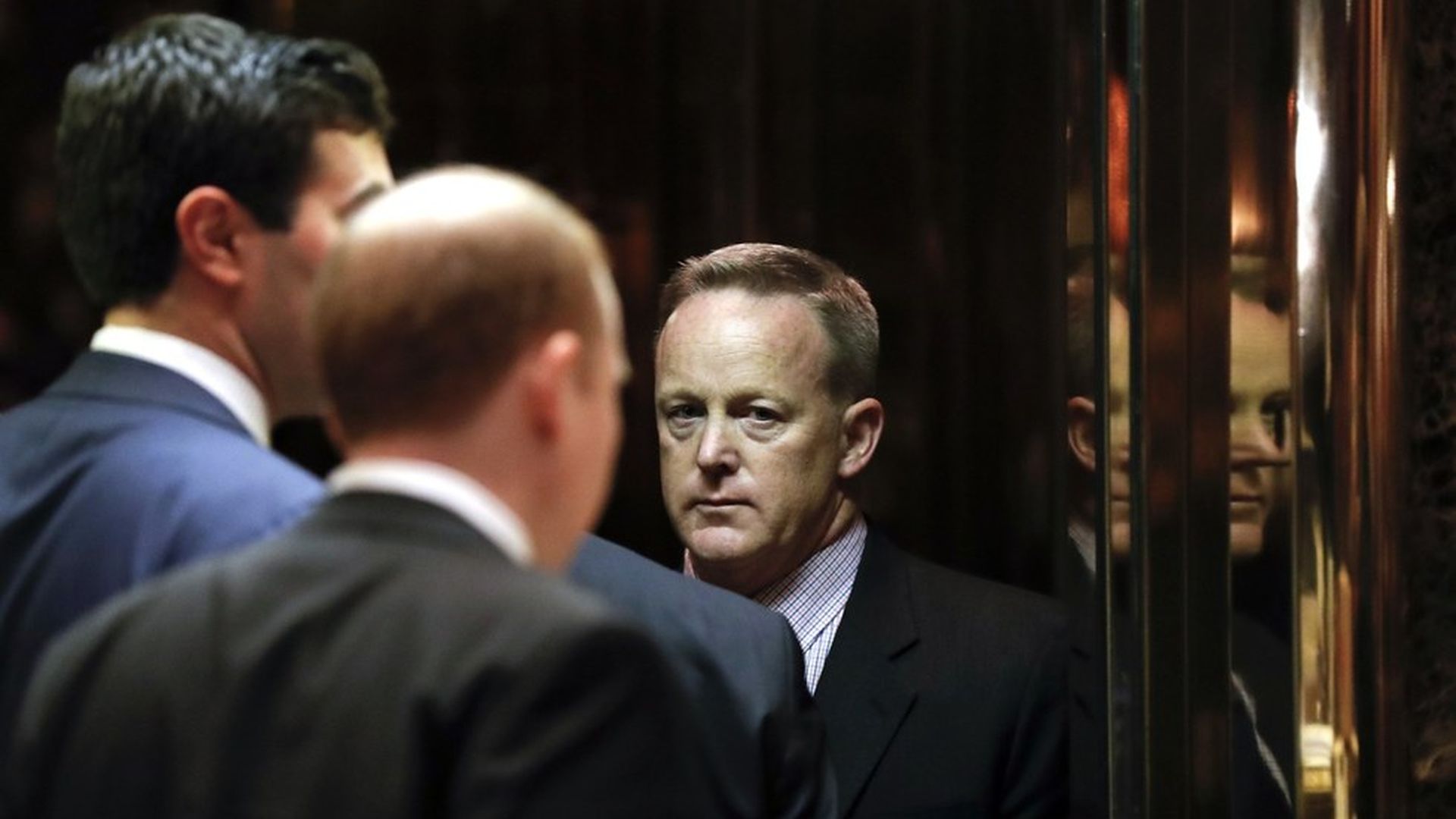
Carolyn Kaster / AP
White House Press Secretary Sean Spicer personally picked up the phone and connected outside officials with reporters to try to discredit a New York Times article about Trump campaign aides' contact with Russia, then remained on the line for the brief conversations, Axios has learned. Ten key points:
- Why it matters: The new details show how determined the West Wing was to rebut a front-page Times report on Feb. 15 that Trump campaign aides "had repeated contacts with senior Russian intelligence officials in the year before the election."
- Who was involved: The officials reached by Spicer were CIA Director Mike Pompeo and Senate Select Intelligence Committee Chair Richard Burr (R-N.C), according to a senior administration official. The reporters were from The Washington Post and The Wall Street Journal, the official said. Spicer provided reporters' phone numbers to House Intelligence Committee Chair Devin Nunes (R-Calif.), who offered to make the calls himself, according to the official: "He was in and out of an event."
- When did this happen? On Feb. 15, when the two-column lead of the Times print edition, which Trump reads carefully, declared: "Trump Aides Had Contact With Russian Intelligence: U.S. Officials Tell of a Flurry of Phone Calls Intercepted Before the Election." An FBI official had volunteered privately to the White House that the story was "B.S." (but used the full word). When the FBI didn't immediately agree to tell that to the press, the White House tried to find other officials who would convey that idea to inquiring reporters.
- What the White House was thinking: Spicer declined to comment. The official said Spicer didn't know at the time whether an investigation of Trumpworld contacts with Russia was underway, and was trying to make sure the connections were made before evening deadlines. "We'd been getting incoming all day," the official said. "Ironically, the White House was actually encouraging people with direct knowledge of the accuracy of the Times story to discuss it with other reporters."
- The backdrop: Top White House officials tell us they're authentically confident that the Russia smoke won't lead to fire, and are even happy to have their opponents distracted by the issue. "For over six months, we have heard about these alleged contacts with Russia," the official said. "And yet, … with all the leaks have have come out, there's no 'there' there."
- What was said on the calls: Pompeo and Burr told the journalists that the Times story wasn't true but provided no details, frustrating the competing reporters, according to the official: "Both of them said: All I can tell you is the story is not accurate."
- What we don't know: Our sources weren't sure exactly how many calls were made, or which official talked to which reporter.
- Why this is unusual: Intelligence officials from the Obama administration said it's rare for the CIA director to talk directly to a single journalist – that in the past, the director usually was held in reserve to talk to a publisher or executive editor in a case where a news organization was contemplating publishing something that could harm national security.
- What we knew before: The Washington Post reported the pushback operation on Friday night under the headline: "Trump administration sought to enlist intelligence officials, key lawmakers to counter Russia stories."
- The reaction: Some Democrats were already arguing that Russian involvement in the election should be investigated by a special prosecutor or outside, 9/11-style commission, rather than the congressional intelligence committees. George Little, a top CIA and Pentagon spokesman under President Obama, told us: "It's doubtful that Congress can conduct an objective and independent investigation into ties between this White House and the Russian government if it is collaborating so closely on media pushback with the White House press secretary."
