Navarro memos warning of mass coronavirus death circulated in January


Add Axios as your preferred source to
see more of our stories on Google.
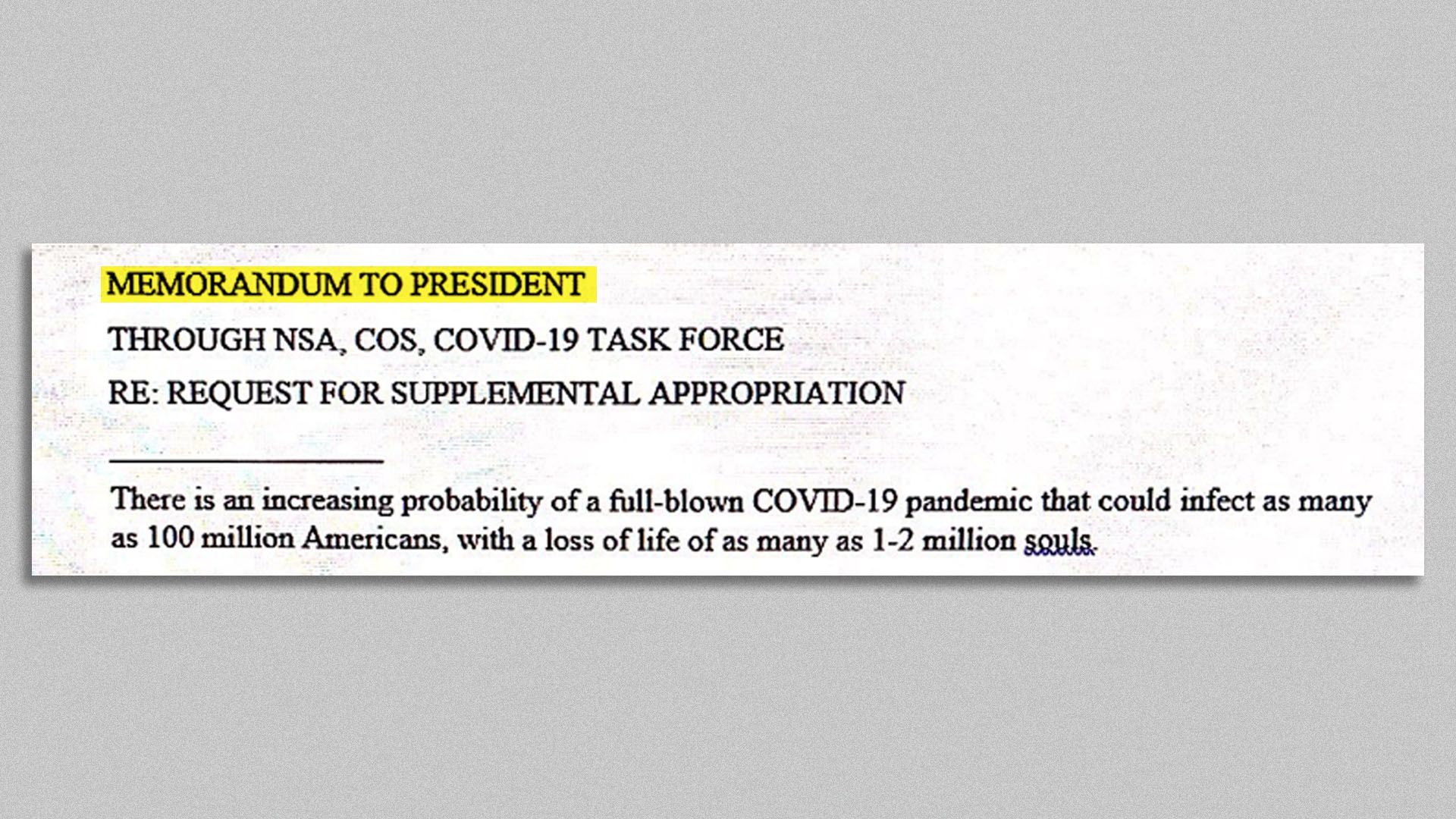
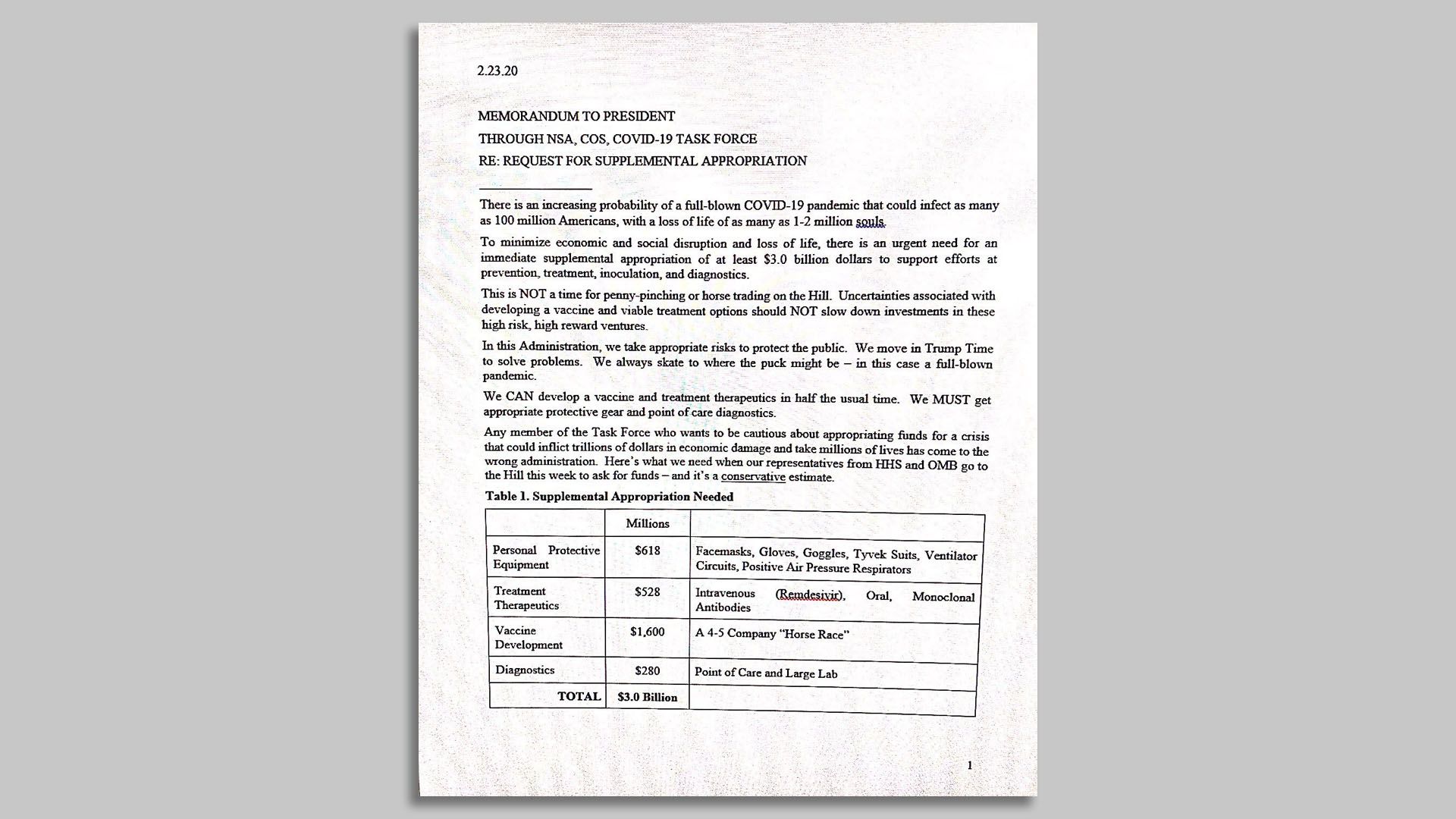
Image from a Feb 23rd memo to President Trump
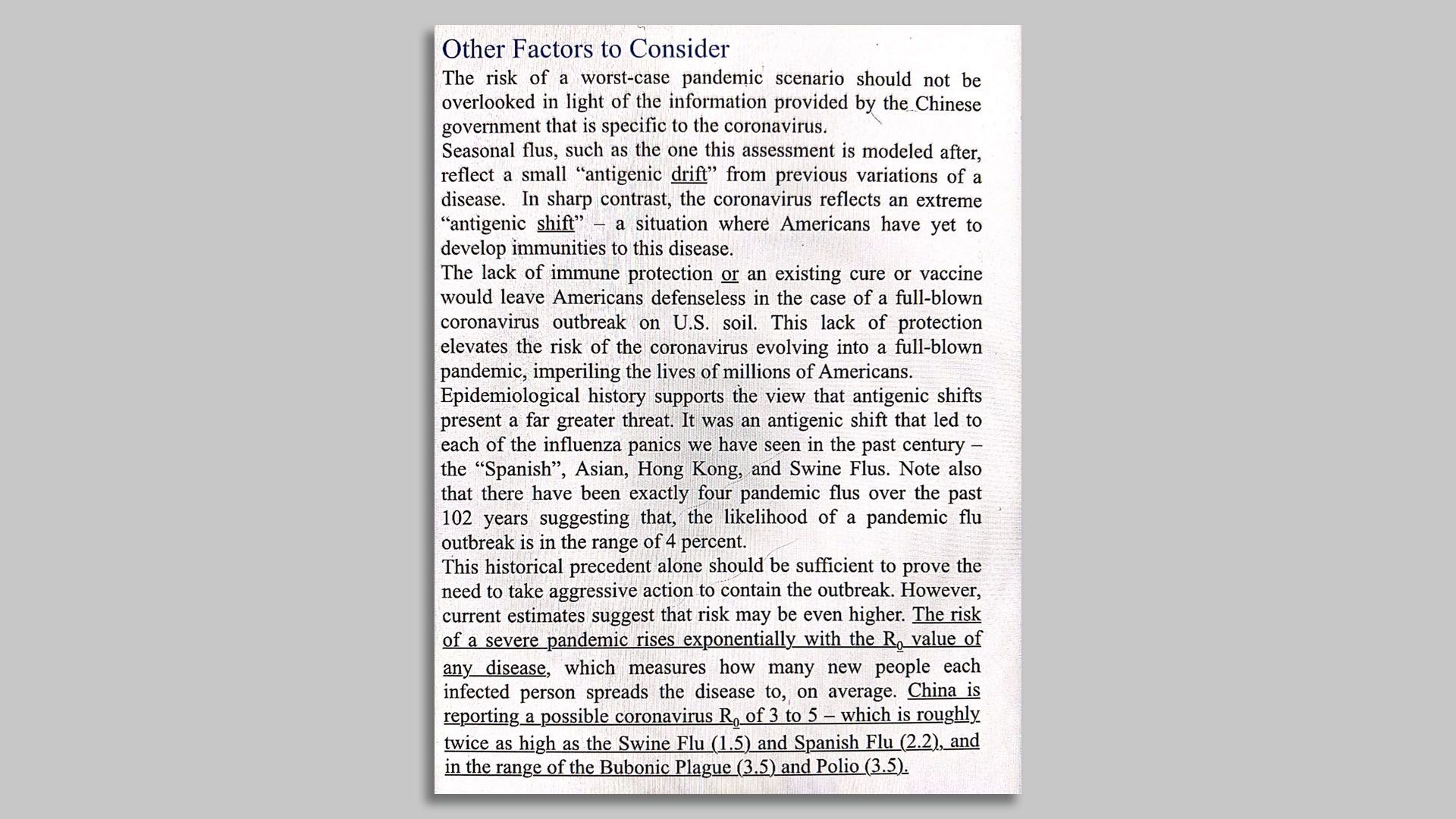
In late January, President Trump's economic adviser Peter Navarro warned his White House colleagues the novel coronavirus could take more than half a million American lives and cost close to $6 trillion, according to memos obtained by Axios.
The state of play: By late February, Navarro was even more alarmed, and he warned his colleagues, in another memo, that up to 2 million Americans could die of the virus.
- Navarro's grim estimates are set out in two memos — one dated Jan. 29 and addressed to the National Security Council, the other dated Feb. 23 and addressed to the president. The NSC circulated both memos around the White House and multiple agencies.
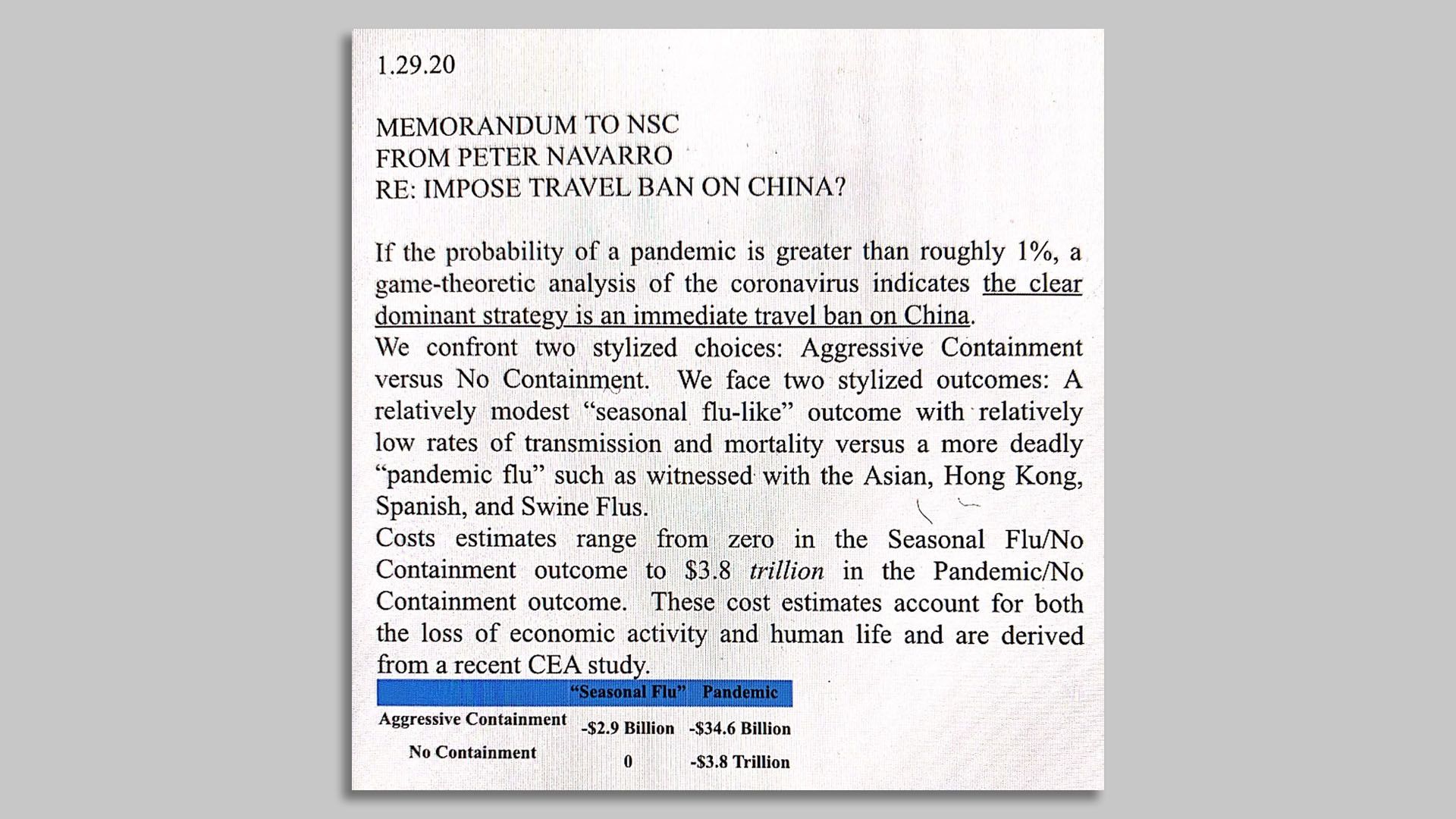
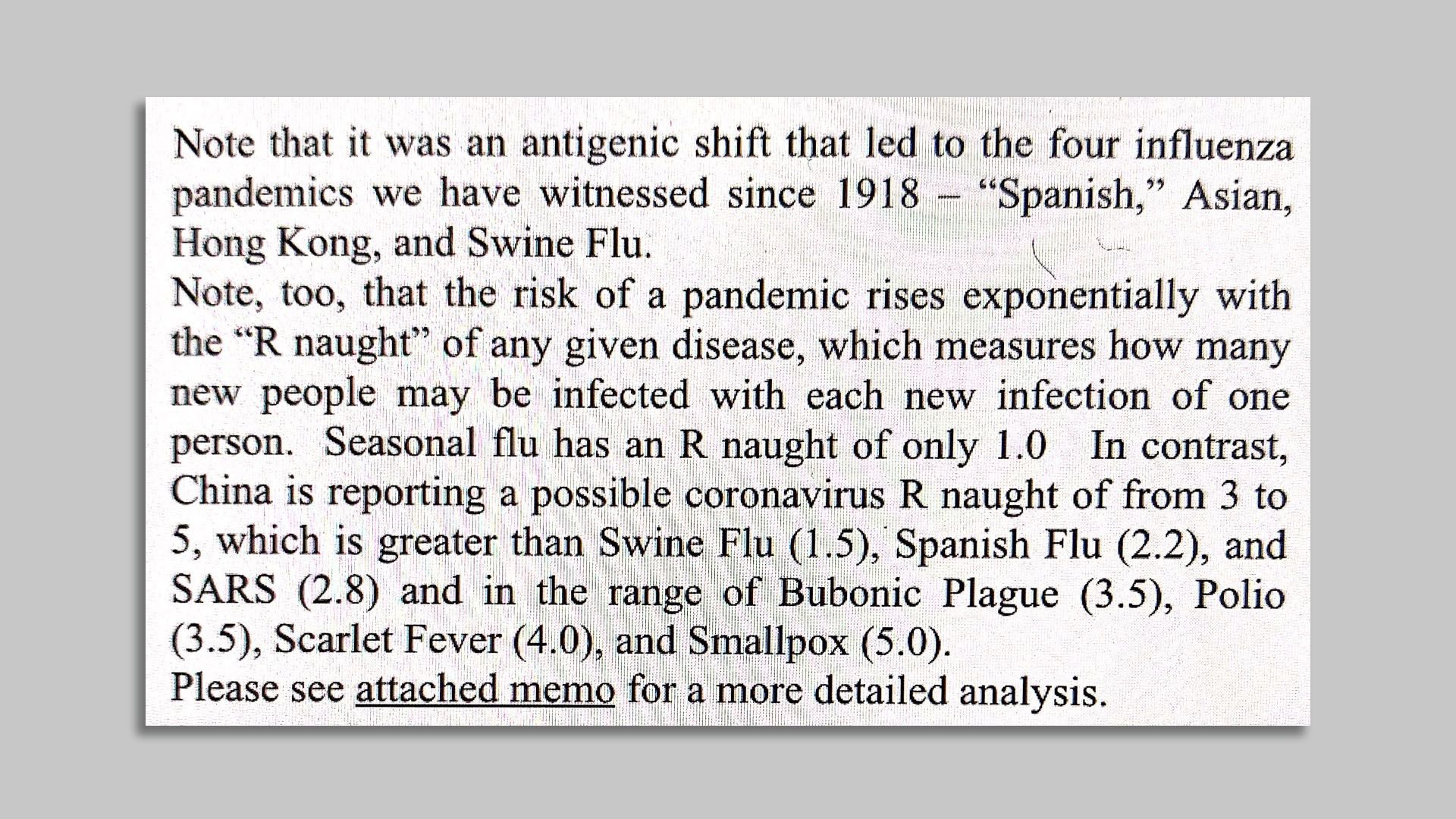
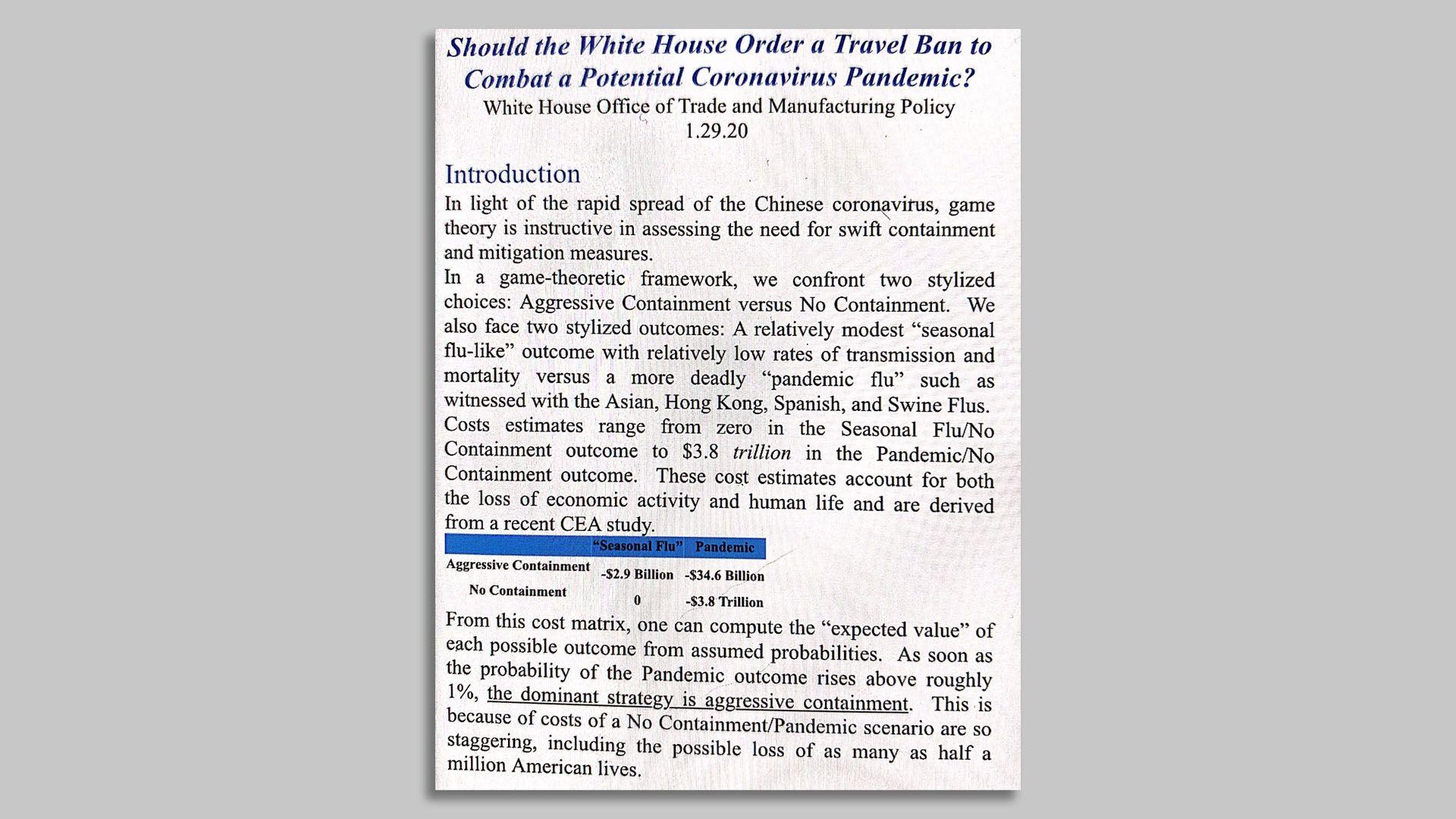
- In the first memo, which the New York Times was first to report on, Navarro makes his case for "an immediate travel ban on China."
- The second lays the groundwork for supplemental requests from Congress, with the warning: "This is NOT a time for penny-pinching or horse trading on the Hill."
Why it matters: The president quickly restricted travel from China, moved to delay re-entry of American travelers who could be infected, and dispatched his team to work with Congress on stimulus funds.
- But Trump was far slower to publicly acknowledge the sort of scenarios Navarro had put in writing.
One senior administration official who received Navarro's memos said at the time they were skeptical of his motives and thus his warnings: “The January travel memo struck me as an alarmist attempt to bring attention to Peter’s anti-China agenda while presenting an artificially limited range of policy options."
- "The supplemental memo lacked any basis for its projections, which led some staff to worry that it could needlessly rattle markets and may not direct funding where it was truly needed."
Navarro declined to comment for this story.
Former White House chief strategist Steve Bannon defended Navarro's motives, calling the memos "prophetic" and saying Navarro was forced to put his concerns in writing because "there was total blockage to get these facts in front of the President of the United States."
- The "naivete, arrogance and ignorance" of White House advisers who disagreed with Navarro "put the country and the world in jeopardy," Bannon said, adding that Navarro was sidelined from the task force after the memo.
- "In this Kafkaesque nightmare, nobody would pay attention to him or the facts."
The Jan. 29 memo set out two stark choices: "Aggressive Containment versus No Containment."
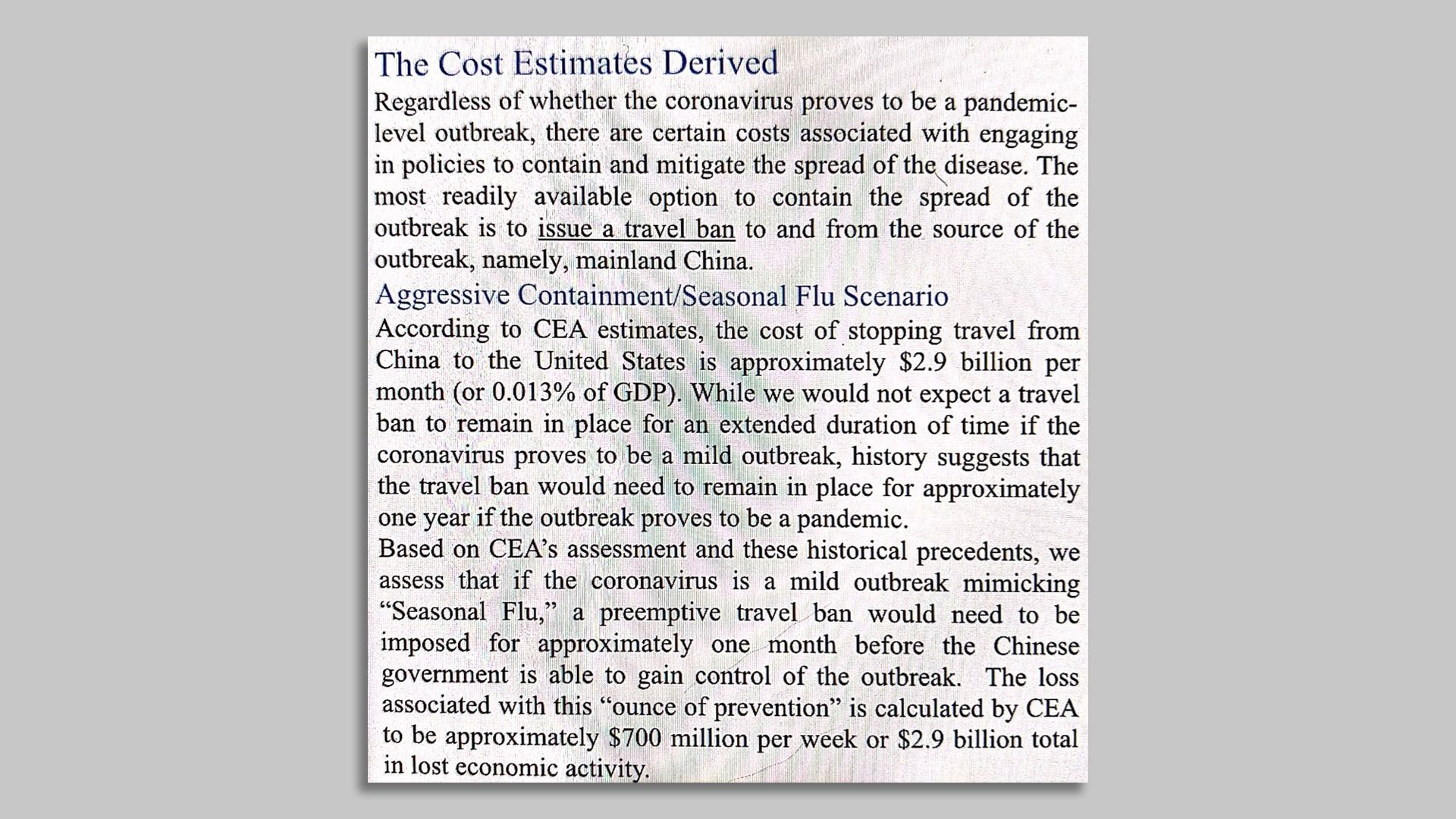
- Navarro compared cost estimates for the choices and wrote that the Council of Economic Advisers' estimates for stopping travel from China to the U.S. would be $2.9 billion per month. If the virus turned out to be a pandemic, that travel ban could extend 12 months and cost the U.S. $34.6 billion.
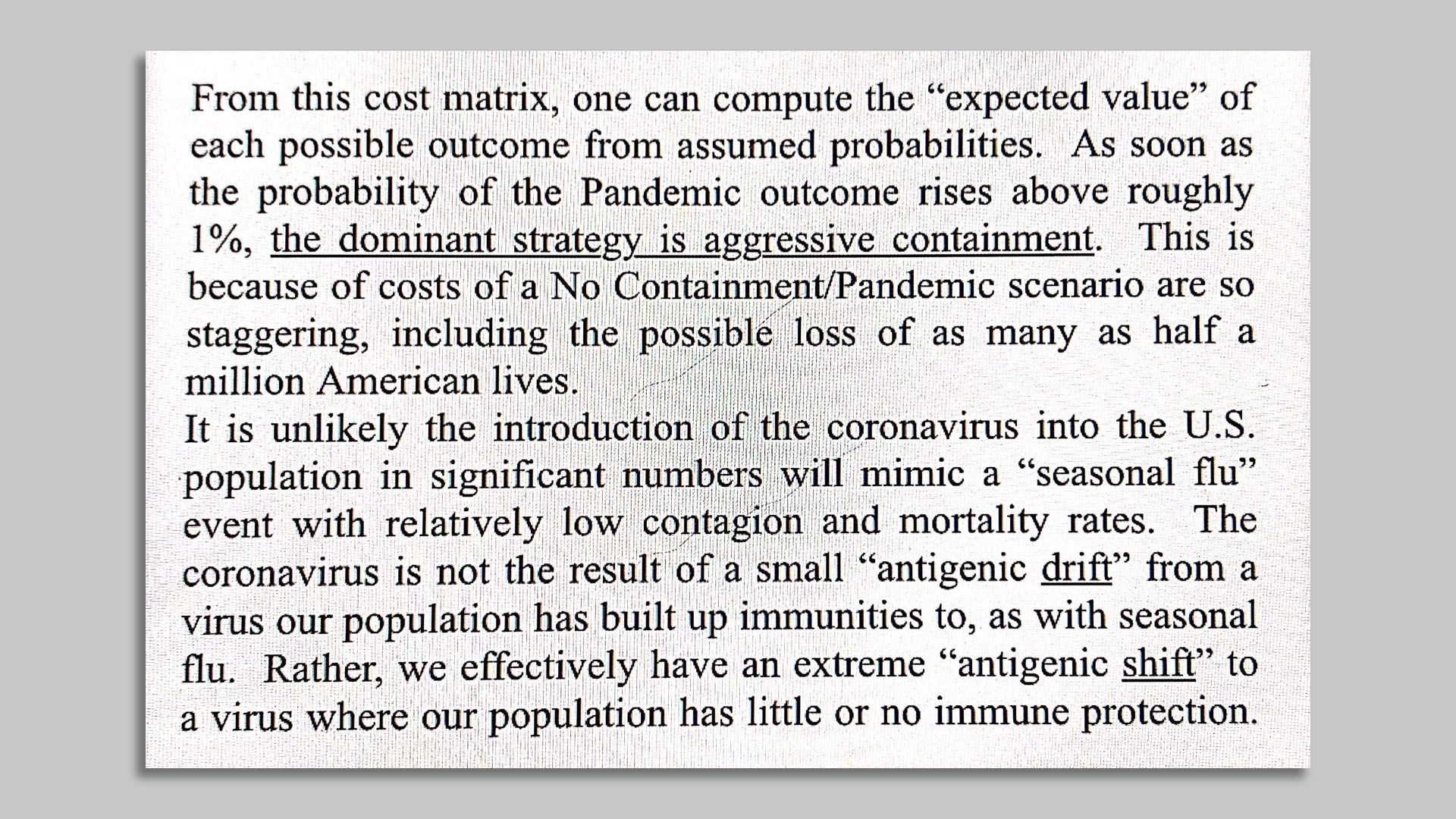
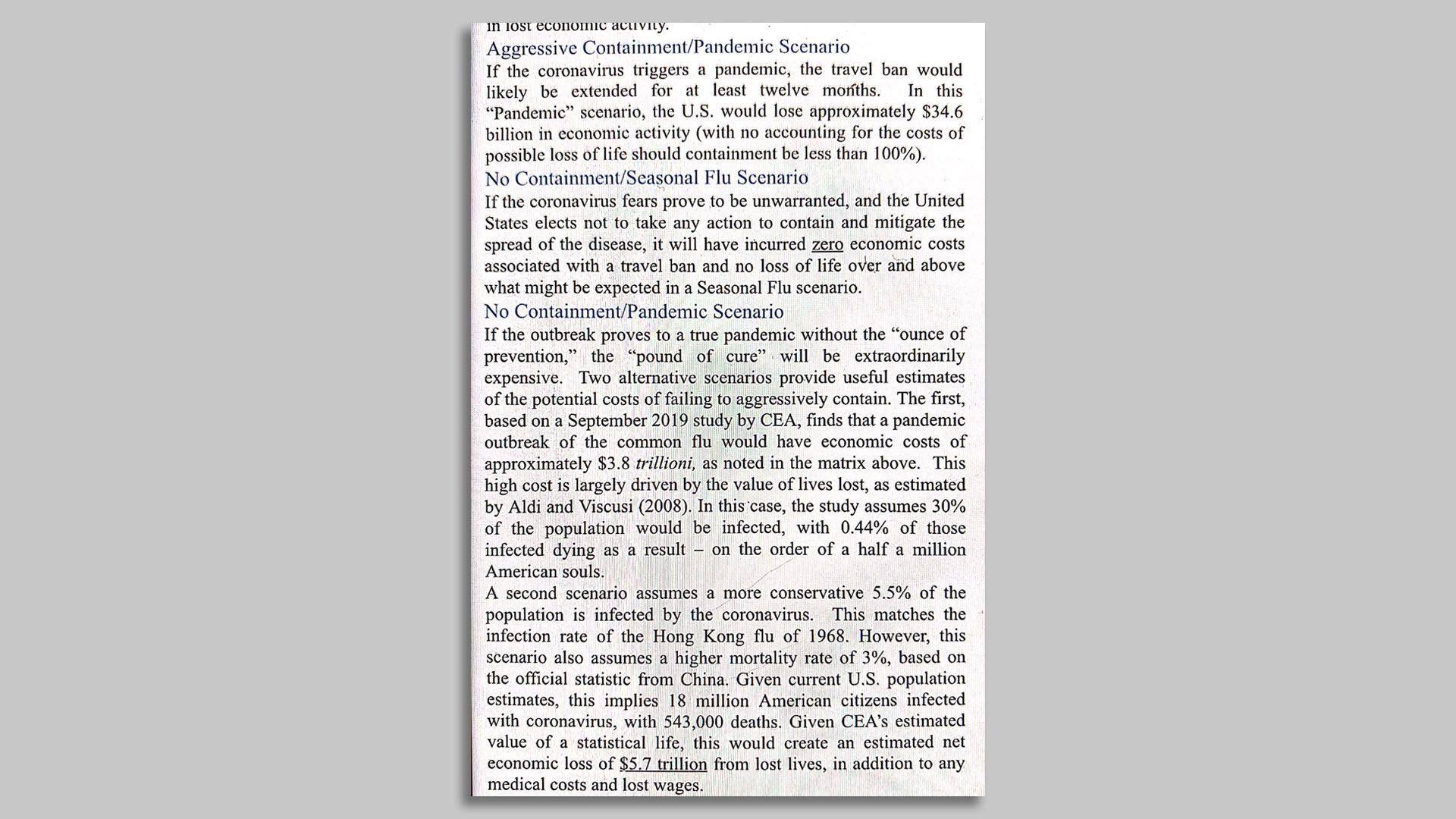
- Doing nothing (the "No Containment" option) could range from "zero economic costs" to $5.7 trillion depending on the lethality of the virus.
- On the high end, he estimated a scenario in which the coronavirus could kill 543,000 Americans.
The Feb. 23 memo did not advertise its author as did the first, but it was written by Navarro and distributed to numerous officials through the NSC. It was titled as a memorandum to the president via the offices of the national security adviser, chief of staff and COVID-19 task force, and the subject line described it as a request for supplemental appropriation.
- It began: "There is an increasing probability of a full-blown COVID-19 pandemic that could infect as many as 100 million Americans, with a loss of life of as many as 1-2 million souls."
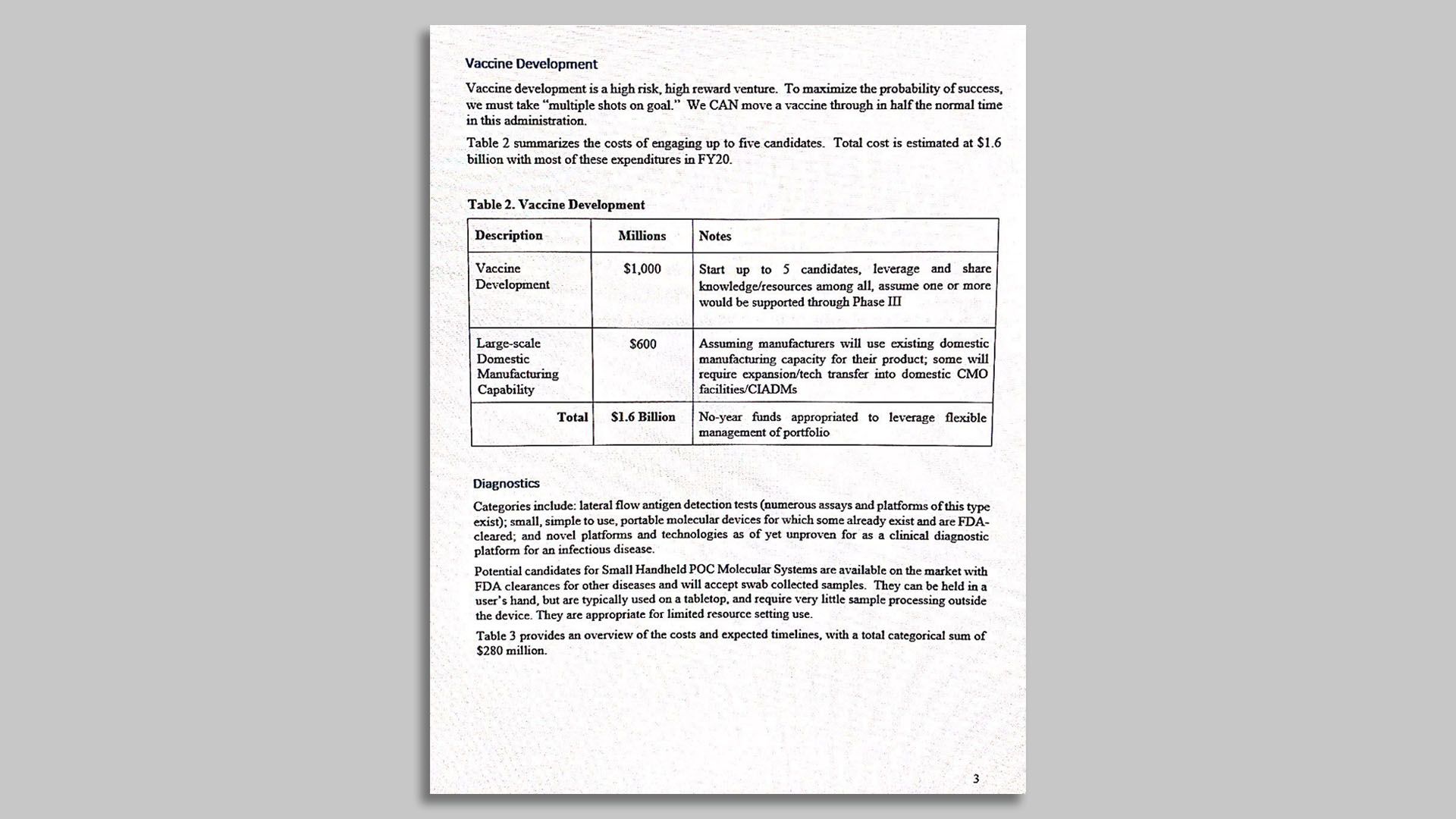
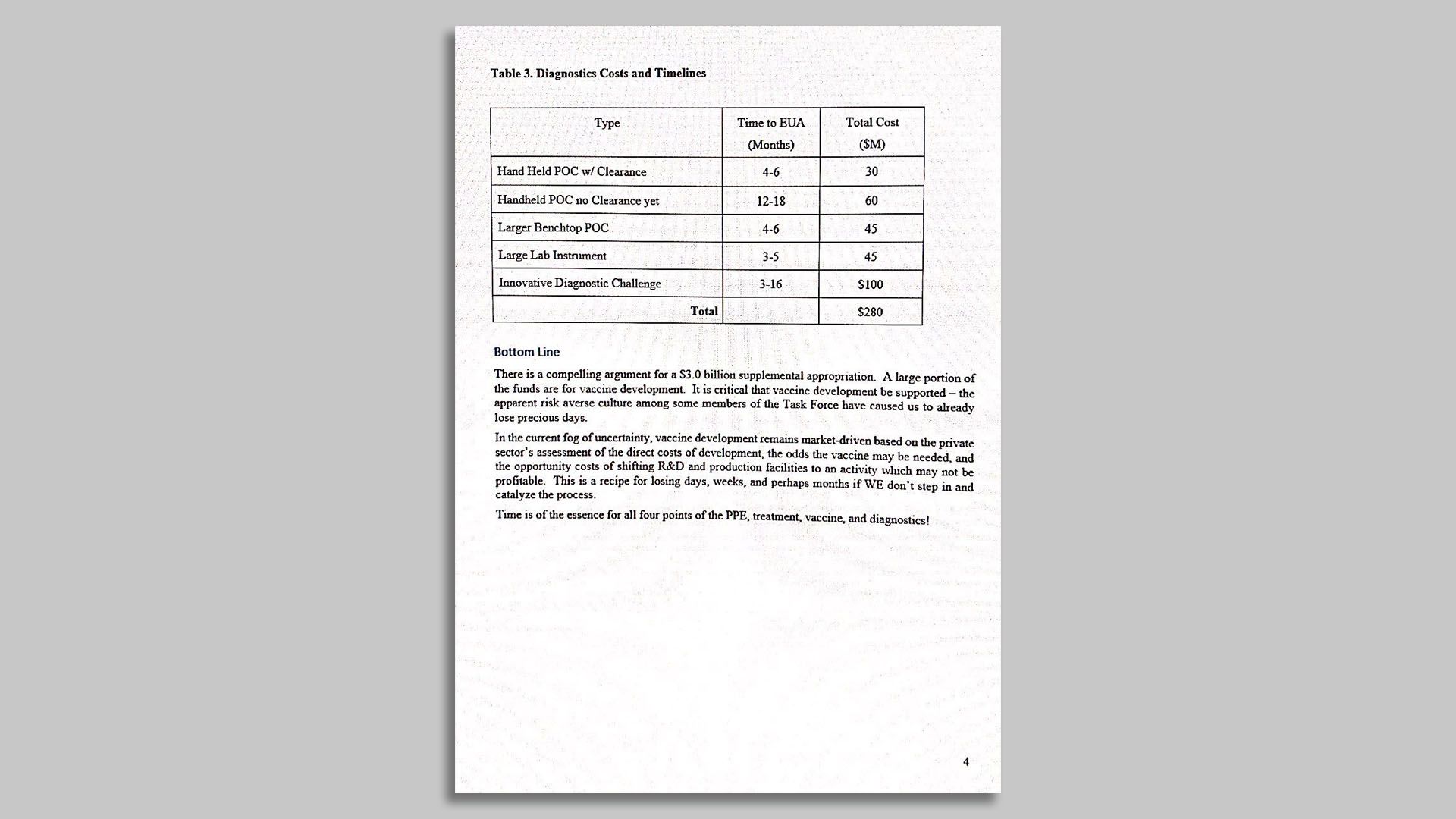
- He called for an "immediate supplemental appropriation of at least $3 billion" to support efforts at prevention, treatment, inoculation and diagnostics.
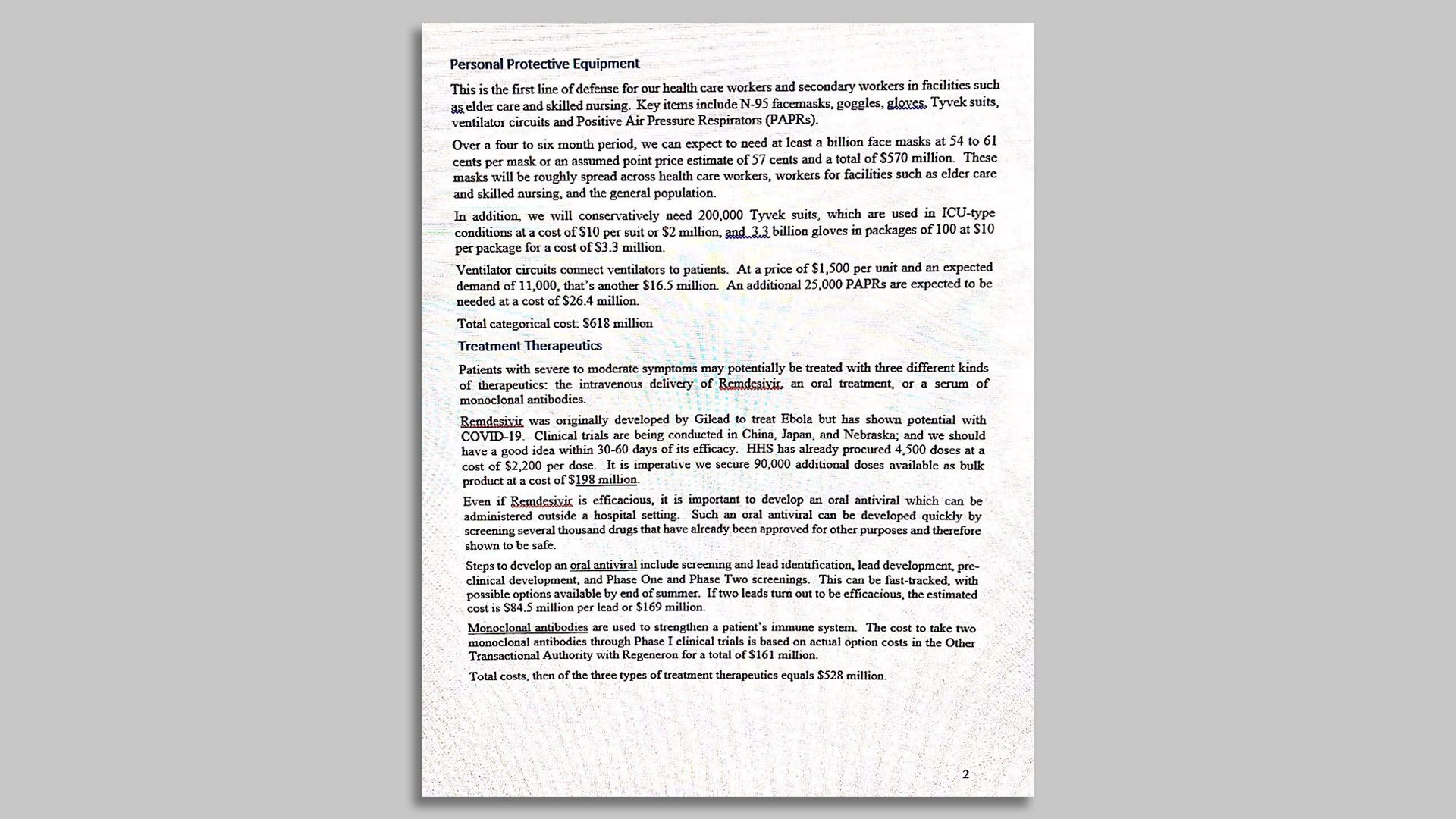
- He described expected needs for "Personal Protective Equipment" for health care workers and secondary workers in facilities such as elder care and skilled nursing. He estimated that over a four-to-six-month period, "We can expect to need at least a billion face masks, 200,000 Tyvek suits, and 11,000 ventilator circuits, and 25,000 PAPRs (powered air-purifying respirators)."
Navarro clashed this past weekend with Anthony Fauci, the director of the National Institute of Allergy and Infectious Diseases, over how widely to promote the use of malaria drug hydroxychloroquine to treat the coronavirus.
- But the January and February memos reveal a more substantial advocacy on his part, with detailed health and economic calculations meant to grab and hold the president's attention.
- Politico first reported in late February about the existence of memos from Navarro to White House officials, while their details had not been published.
Our thought bubble: Axios' health care editor Sam Baker says Navarro's concern about the severity while acknowledging the speculative nature of modeling viruses was largely correct.
- "These memos place a very big emphasis on banning travel specifically from China —which, of course, Trump did," Baker says. But by Jan. 29, there were confirmed cases in 15 countries, including the U.S.
- "This is not to say they're a bad idea, only that this is why public-health experts don't lean as heavily on travel restrictions. People come into the U.S. from a lot of places, and with two globalized countries, simply stopping people coming in from Wuhan was not bad but it shouldn't be shocking that it was insufficient."
Flashback: "It's going to have a very good ending for us," Trump said of the coronavirus in a speech on Jan. 30.
- In a Feb. 24 tweet, he said it was "very much under control" and that the stock market is "starting to look very good to me."
- The World Health Organization declared it a pandemic on March 11.
- On March 17, the president said, "I've felt it was a pandemic long before it was called a pandemic."
Subscribe to Mike Allen's Axios AM to follow our coronavirus coverage each morning from your inbox.
