Denver offers competing plan for policing year after protests

Add Axios as your preferred source to
see more of our stories on Google.
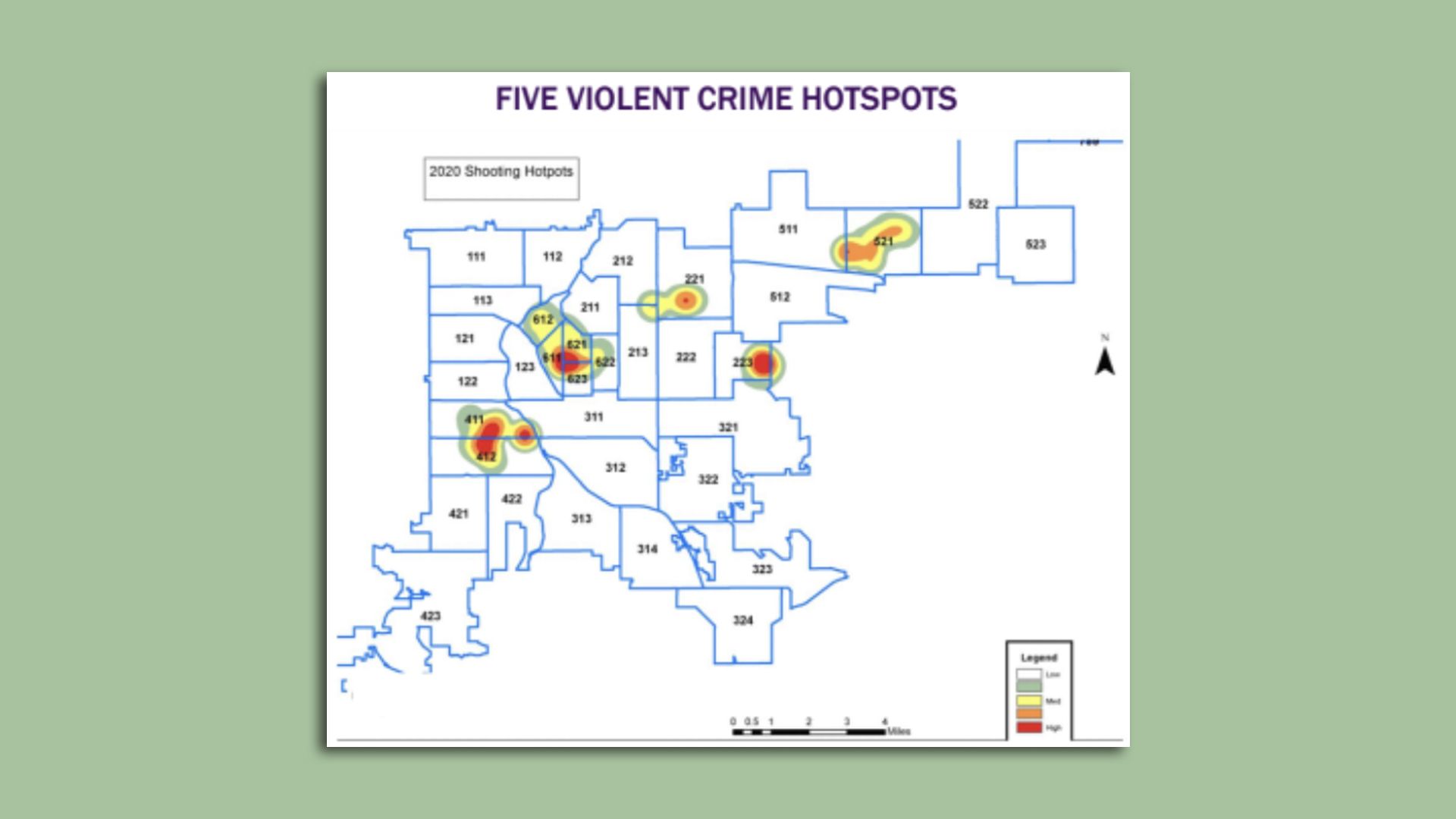
A map of Denver showing hot spots for shootings in 2020. Image: Denver Police Department.
Mayor Michael Hancock's administration outlined a new vision Monday to combat rising crime rates in Denver "without overpolicing."
Why it matters: The blueprint represents an alternative to a plan released by a resident-led task force Friday that calls for a non-law-enforcement approach to public safety.
- It comes a year after George Floyd's death in Minneapolis prompted Black Lives Matter protests and demands to address systemic problems in policing across the country.
Details: Unlike the task force's guidance, Hancock's approach is spearheaded by police, focusing on five areas — mostly lower-income and more-diverse communities — that account for a disproportionate amount of violent crime.
- The areas include: South Federal Boulevard and West Alameda Avenue; Colfax Avenue and Broadway; East Colfax Avenue and North Yosemite Street; East 47th Avenue and North Peoria Street; and Martin Luther King Jr. Boulevard and North Holly Street.
- It calls for more high-visibility foot patrols, community collaborations and a new division dedicated to making sure Denver's public safety agencies are continuously working to improve their operations.
Of note: Hancock and other city officials would not commit to implementing any of the task force's 112 recommendations after pulling out of talks with the group this year.
- The report's authors didn't respond to the mayor's proposal, but city council member Candi CdeBaca told the Denver Gazette she supports implementing the task force recommendations.
- Police chief Paul Pazen refused to answer a question about whether the city's plans would require additional officers.
Between the lines: The data-driven and cross-agency approach to crime is not new in Denver, and neither are the geographic areas in question. But the increase in violence — which officials blame on the pandemic — is getting more attention at City Hall.
- In 2020, killings increased 47%, and aggravated assaults rose 63% citywide, compared with the three-year average, the police chief said.
- In 2021, the crime rates are continuing to increase over the average.
The big picture: In response to recent calls for reform, Hancock said the city's Police Department changed its use-of-force policies and increased the number of social services officials who respond to 911 calls.
- "We will continue to work against racism and crime," he said. "We have to keep our streets and our neighborhoods safe. We can and we must do both."