Global democracy rating hits new low

Add Axios as your preferred source to
see more of our stories on Google.
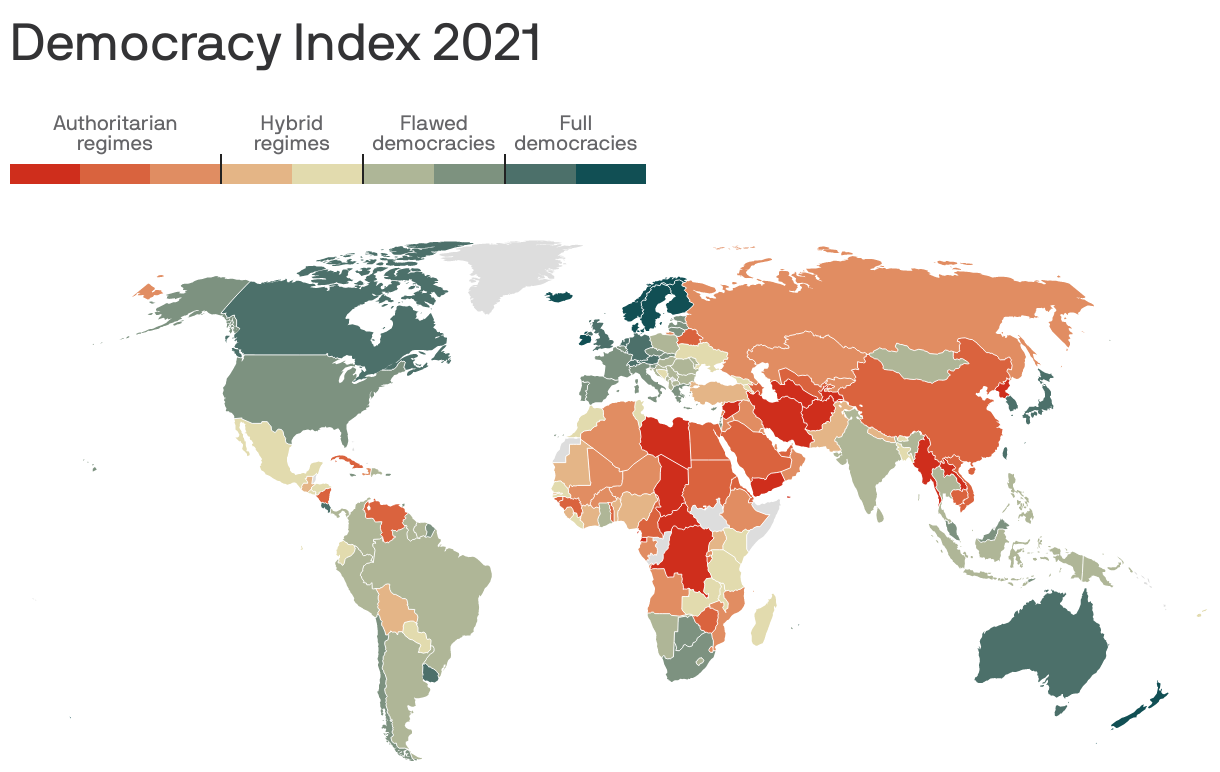
An annual global democracy index dropped to its lowest score since tracking began in 2006, with just 45.7% of the world's population living in a democracy of some sort.
Why it matters: At his inaugural "Summit for Democracy" in December, President Biden cast the global advance of authoritarianism as "the defining challenge of our time." He pledged to spend up to $424 million over the next year on democratic renewal initiatives.
The big picture: The average global score in the Economist Intelligence Unit's 2021 Democracy Index fell from 5.37 to 5.28 — the largest annual drop since 2010, after the global financial crisis.
- The index ranks countries on a scale of 1-10, based on 60 indicators grouped into five categories: electoral process and pluralism, functioning of government, political participation, political culture and civil liberties.
- 120 countries, or 71.8%, registered a decline or stagnation in their average score in 2021.
Zoom in: Ongoing political polarization during Biden's first year in office contributed to a democratic decline in the U.S., branded a "flawed democracy" that saw its score drop from 7.92 to 7.85.
- Canada, which has been gripped by anti-mandate protests over the last several weeks, fell out of the top 10 due to pandemic-related restrictions and the ensuing political backlash.
- The top five countries for democracy are Norway (9.75), New Zealand (9.37), Finland (9.27), Sweden (9.26) and Iceland (9.18).
- The bottom five are Syria and the Central African Republic (tied at 1.43), Democratic Republic of Congo (1.40) North Korea (1.08), Myanmar (1.02) and Taliban-controlled Afghanistan (0.32).
Go deeper: Read the full report.
