The costs of Facebook's free speech


Add Axios as your preferred source to
see more of our stories on Google.
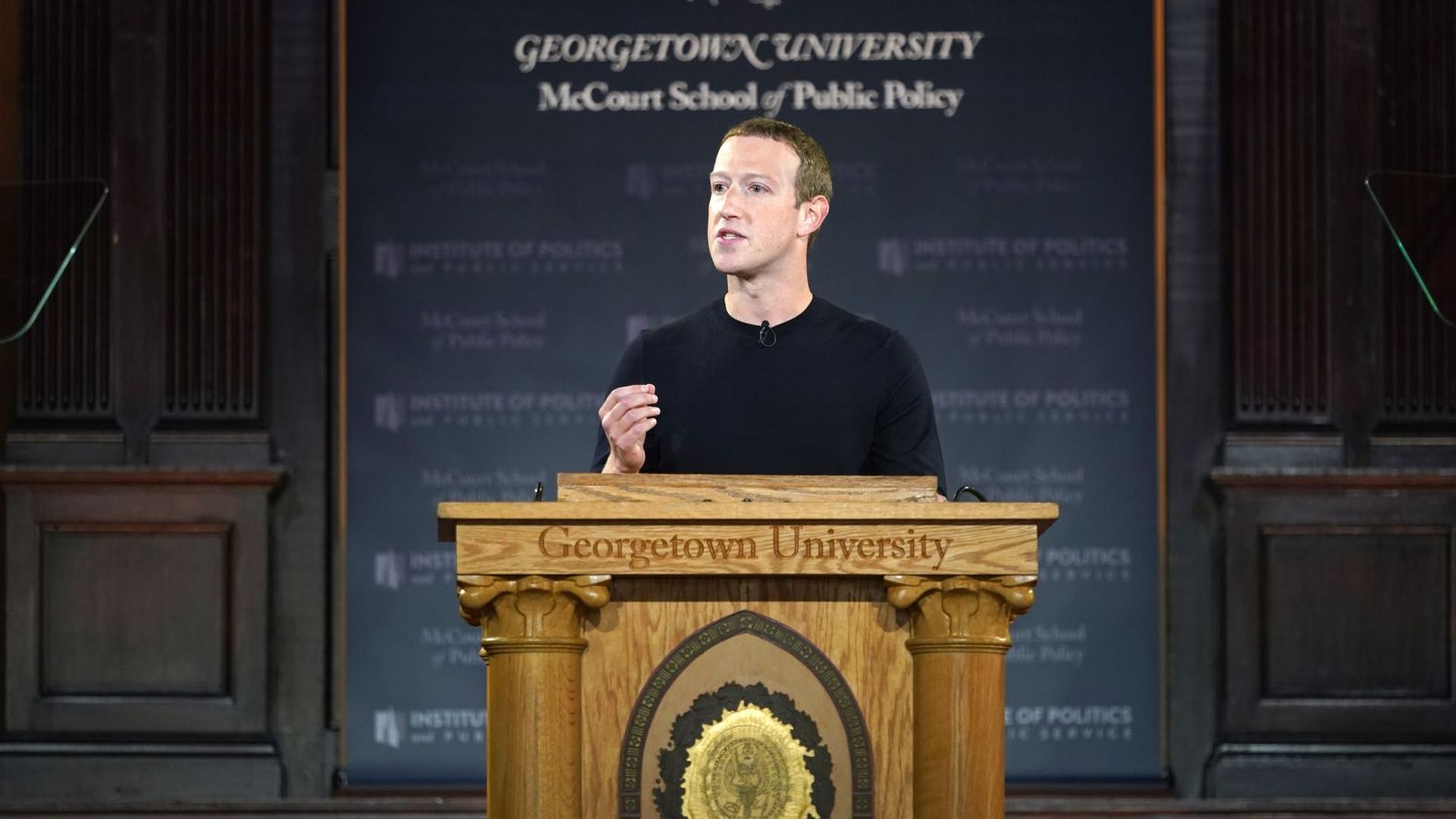
Photo: Riccardo Savi/Getty Images for Facebook
Mark Zuckerberg made an impassioned plea on behalf of free speech Thursday. Then a lot of free speech came back at him.
Driving the news: Speaking at Georgetown University, Facebook's CEO defended the company's decision to continue to post political ads — including some by President Trump's campaign — that make demonstrably false claims.
Zuckerberg's arguments:
- Tech companies shouldn't decide what politicians can and can't say in a democracy.
- If Facebook stopped accepting all political ads, as some have advocated, that would only favor incumbents over challengers.
- Doing so would also create a slippery-slope situation, as Facebook would try to draw a clean line between campaign ads and other politically charged issue ads.
In making his case, Zuckerberg cited everyone from the Founding Fathers to Dr. Martin Luther King Jr. But while Zuckerberg argued it was the powers that be who had the most to gain by limiting speech on Facebook, civil rights leaders, including King's daughter, spoke out most loudly against Zuckerberg's position.
"I heard #MarkZuckerberg's 'free expression' speech, in which he referenced my father. I'd like to help Facebook better understand the challenges #MLK faced from disinformation campaigns launched by politicians. These campaigns created an atmosphere for his assassination."— Bernice King
What they're saying:
- Color of Change president Rashad Robinson: "Mark Zuckerberg made clear today that he is not only doubling down on a business model that corrupts our democracy, but also fundamentally lacks an understanding of how civil rights, voter suppression, and racism actually function in this country. Under the guise of protecting voice and free expression, Facebook, as in prior elections, is giving Trump and the right-wing a free pass to spread lies, hate and misinformation on the platform."
- Vanita Gupta, CEO of the Leadership Conference on Civil and Human Rights: "For more than a year, we have worked in good faith with Facebook to develop robust policies to combat voter suppression. But Facebook's policy exempting politicians' content from the company's Community Standards and its fact-checking program undermines all of that progress and will do irreparable damage to our democracy. While we can all agree that free expression is core to our democracy, fair elections must be as well."
Between the lines: Zuckerberg has also faced intense criticism from the right for supposed censorship of its views. His appeal to the ideal of free expression is aimed at both ACLU liberals and libertarian conservatives, but it ducks key arguments of Facebook critics:
- Facebook isn't neutral turf on which good ideas will naturally prevail over bad ones, John Stuart Mill-style. It's an advertising-driven business whose design deliberately promotes its own peculiar idea of "engagement."
- Pre-social media, being "engaged" meant you were committed to a cause. Now it means having your attention seized by something that makes you click. That warps the shape of public debate in ways that Zuckerberg didn't address.
- Facebook's system for targeting ads — like YouTube's personalization algorithms — allows both politicians and disinformation agents to create deepening tunnels of lies that radicalize sympathetic users more effectively than any previous media form, creating a novel problem that Zuckerberg's historical analogies didn't cover.
The other side: In a pre-speech interview, Zuckerberg told Axios' Mike Allen Facebook has a responsibility to "design systems that can help expose the diversity of ideas, and that don't encourage polarizing content and clickbait and things like that. And we take that very seriously."
Our thought bubble: Things look different from Facebook's ivory tower than from other vantage points.
- Even after the sobering experience of 2016's election interference on his platform, many of Zuckerberg's arguments start from an assumption of good intentions.
- Zuckerberg will keep "giving people a voice," Facebook-style, and he's certain that doing so will make the world better — even as evidence to the contrary keeps piling up around him.
Go deeper:
