Car owners pay dearly for tech they don't use

Add Axios as your preferred source to
see more of our stories on Google.
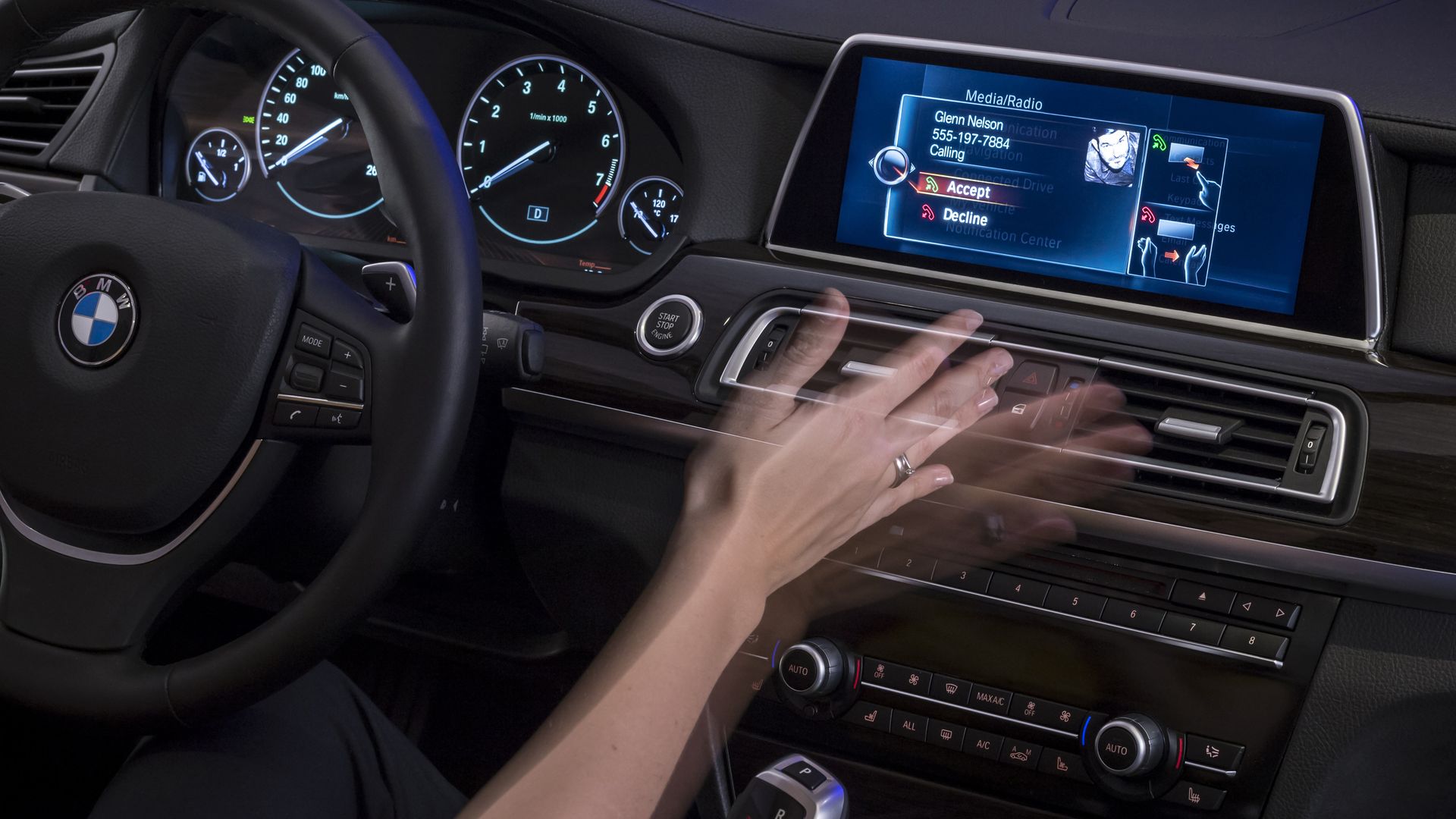
BMW's gesture control technology is hard to master for many drivers, who say they just don't need it. Photo: BMW
Technology can be a big seller in new cars, but it turns out that many digital features go unused — assuming owners even know their car has them.
Why it matters: High-tech features are driving up vehicle prices. But if consumers don't use them — or are frustrated because the stuff doesn't work properly — then both automakers and car buyers are wasting their money.
Driving the news: For more than 1 in 3 advanced technologies, most owners didn't even use the feature during the first three months of ownership, a J.D. Power tech study found.
- Usually, owners say it's because they don't need the feature, but sometimes it's because they don't know about it or find it difficult to use.
BMW's gesture control technology is a great example. It's supposed to let you wiggle a finger or wave your hand to perform tasks like adjusting the radio volume or answering a call — as opposed to touching a screen or button.
- But the tech had the lowest overall satisfaction score in J.D. Power's annual U.S. Tech Experience Index for the second year in a row, with owners reporting 41 problems — meaning complaints — per 100 vehicles.
- My thought bubble: I drove a BMW X6 last year that had gesture control as part of a $2,300 Premium package. I concur with BMW owners. It was easier to just use the buttons.
Other built-in technologies often go unused, despite big investments by automakers to add them. Some examples:
Digital marketplace: General Motors was the first to equip millions of cars with an in-car commerce platform called Marketplace that lets you order food, make restaurant and hotel reservations, and find gas stations from your dashboard.
- But 61% of owners say they've never used their car's digital marketplace, and 51% said they don't need it.
Driver/passenger communications: Honda, Hyundai and Toyota are among carmakers that let drivers talk more easily with rear-seat occupants via a microphone or camera.
- 52% say they've never used the system, and 40% say they don't need it. (Who needs a mic when you can just turn around and yell at your kids?)
Between the lines: Consumers are more likely to use emerging technology if the car dealer does a good job of demonstrating how it works, J.D. Power found.
- But a lot of car salespeople aren't fully trained to explain all the features of the cars they sell — and often buyers don't ask, aren't interested, or can't take it all in.
- Some dealers encourage buyers to schedule a follow-up visit to the dealership for a refresher.
- When a buyer does get a lesson from their dealer about how to use an advanced feature, they use it more, the study found.
- Examples of these features include "safe exit assist technology" — which warns parked drivers to wait for traffic before opening the door — and trailer assistance technology, which helps drivers maneuver a boat or RV, for example.
- Yes, but: Owners are more than twice as likely to learn about such technology from an outside source (71%) than from a dealer (30%), the study found.
What car owners love: cameras, cameras and more cameras.
- The top-rated technologies all provide an extra set of eyes: backup cameras with trajectory guidance, rear-view mirror cameras that enhance visibility, and 360-degree ground view cameras.
- Electric vehicle owners also love one-pedal driving technology — which allows a driver to lift their foot off the accelerator to slow or stop without having to brake.
The bottom line: In-car technology has to be simple to use — and well-explained to the driver ahead of time — or it's not worth the money.
