Baltimore wrestles with aerial surveillance

Add Axios as your preferred source to
see more of our stories on Google.
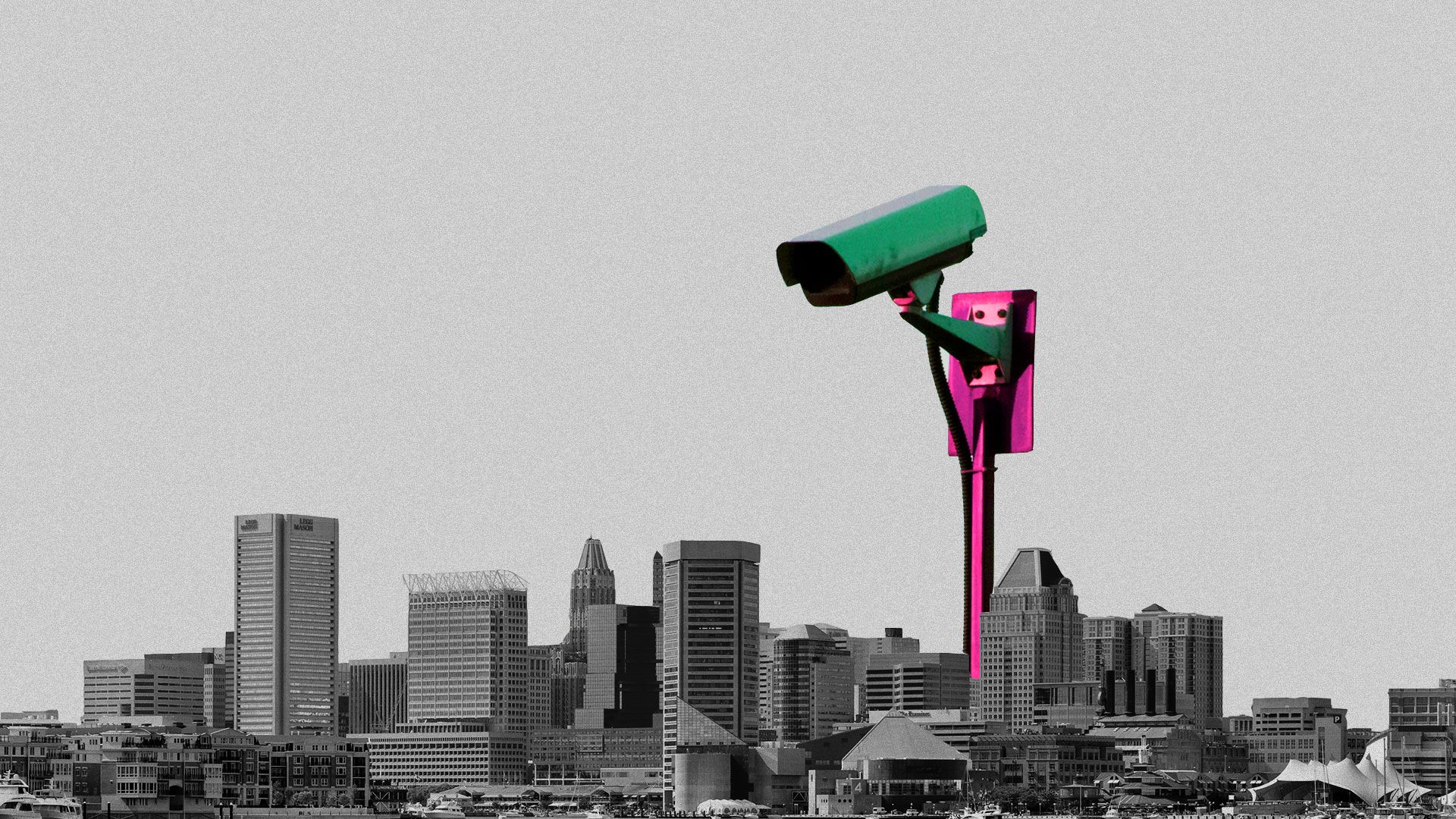
Illustration: Aïda Amer/Axios
With a surge of violent crime plaguing the streets of Baltimore, some residents whose lives have been upended by murder are pushing for a drastic measure: citywide surveillance.
Why it matters: Americans have historically valued privacy over security and generally reject the idea of being monitored by anyone, especially law enforcement.
- But record-setting homicide rates in Baltimore — not to mention national attention on the city's problems following President Trump's recent Twitter insults — may test that mindset.
Baltimore's surveillance saga began in 2016, when a company called Persistent Surveillance Systems (PSS) embarked on a quiet pilot project with the city's police force to test the firm's wide-area surveillance technology.
How it works: From a plane flying overhead, powerful cameras capture aerial images of the entire city. Photos are snapped every second, and the plane can be circling the city for up to 10 hours a day.
- "It's like Google Earth Live meets TiVo," said Ross McNutt, the company's CEO, via Skype when Axios asked for a demonstration of the technology.
- When a 911 call is received, police relay location information to analysts watching the footage in real time. Those analysts can zoom in just enough to make out the movement of vehicles and people near the scene of a crime.
- Using time stamps and a lot of mouse-clicks, analysts track the movements of cars and people — which look like pixelated shapes on the screen without any visible identifying features — and can tell police where suspects may have fled.
- Officers can then tap into other technologies, like street-level security cameras, to piece together clues.
The problem: The police department kept the project secret, and it ended abruptly when it was revealed by media reports.
- The incident came amid heightened tensions between the public and law enforcement, only a year after the 2015 death of Freddie Gray, who died while in police custody.
- PSS also pitched the service as a way to keep police officers accountable.
- The system's effectiveness is largely untested, and pilot projects have been too short to assess impact on crime reduction.
- The ACLU called it "the technological equivalent of putting an ankle GPS monitor on every person in Baltimore" and a "cynical attempt to profit off the city's trauma."
Violent crime has continued to soar. Baltimore has had more than 300 homicides for 4 years in a row. In 2018, the number hit 342, a record per capita rate for the city and well above other major metros with more than 500,000 people.
Through June of this year, more than 150 people have been killed — a 17% increase over the same period last year, per the Baltimore Sun.
- Two of those losses devastated the family of Archie Williams, whose 15-year-old nephew and 24-year-old cousin were killed recently.
- Williams, 39, is among those pushing to bring PSS back to the city. Sacrificing privacy to save lives, he said, is a "no brainer."
- "If you live in this city, you have to be concerned," he told Axios. "We can use technology to nip this in the bud, or sit here and watch people die."
State of play: McNutt has held 58 community meetings in the city in the past two years to demonstrate the technology and try to ease people's concerns — but reactions have been mixed.
- Former Baltimore Mayor Catherine Pugh had said she would consider bringing the program back if the community supported it. She resigned in May.
- But new Mayor Bernard C. "Jack" Young, who had scheduled a hearing on the issue last year when he served as City Council President, isn't interested in reviving the surveillance program.
- "At this time, that is not something Mayor Young is looking at as part of the crime fighting strategy for Baltimore," emailed Young's press secretary, James Bentley.
- The Baltimore Police Department did not respond to requests for comment.
The big picture: While the legal landscape around real-time surveillance is shifting, finding the balance between privacy and law enforcement comes down to community conversations, said Kelsey Finch, senior policy counsel at the Future of Privacy Forum.
And while some people may generally be comfortable with sensors on cars or streetlights, seeing planes or drones flying overhead can feel much more threatening.
- "That sense that you can see it and it's watching you can evoke much more visceral privacy concerns than other technologies that might actually have the same impacts," Finch said.
That visceral reaction is exactly what will help deter crime, McNutt said.
"We want to be public and visible in what we're doing. We want someone who's thinking about breaking the law to look up and see that airplane and decide not to do it."
Go deeper:
- This Bloomberg video shows how the technology works.
- Pro Publica journalist and Baltimore resident Alec MacGillis takes a deeper look at the city's struggle with violent crime.
