Sign up for our daily briefing
Make your busy days simpler with Axios AM/PM. Catch up on what's new and why it matters in just 5 minutes.
Catch up on the day's biggest business stories
Subscribe to Axios Closer for insights into the day’s business news and trends and why they matter
Sign up for Axios Pro Rata
Dive into the world of dealmakers across VC, PE and M&A with Axios Pro Rata. Delivered daily to your inbox by Dan Primack and Kia Kokalitcheva.
Sports news worthy of your time
Binge on the stats and stories that drive the sports world with Axios Sports. Sign up for free.
Tech news worthy of your time
Get our smart take on technology from the Valley and D.C. with Axios Login. Sign up for free.
Get the inside stories
Get an insider's guide to the new White House with Axios Sneak Peek. Sign up for free.
Catch up on coronavirus stories and special reports, curated by Mike Allen everyday
Want a daily digest of the top Denver news?
Get a daily digest of the most important stories affecting your hometown with Axios Denver
Want a daily digest of the top Des Moines news?
Get a daily digest of the most important stories affecting your hometown with Axios Des Moines
Want a daily digest of the top Twin Cities news?
Get a daily digest of the most important stories affecting your hometown with Axios Twin Cities
Want a daily digest of the top Tampa Bay news?
Get a daily digest of the most important stories affecting your hometown with Axios Tampa Bay
Want a daily digest of the top Charlotte news?
Get a daily digest of the most important stories affecting your hometown with Axios Charlotte
Want a daily digest of the top Nashville news?
Get a daily digest of the most important stories affecting your hometown with the Axios Nashville newsletter.
Want a daily digest of the top Columbus news?
Get a daily digest of the most important stories affecting your hometown with the Axios Columbus newsletter.
Want a daily digest of the top Dallas news?
Get a daily digest of the most important stories affecting your hometown with the Axios Dallas newsletter.
Want a daily digest of the top Austin news?
Get a daily digest of the most important stories affecting your hometown with the Axios Austin newsletter.
Want a daily digest of the top Atlanta news?
Get a daily digest of the most important stories affecting your hometown with the Axios Atlanta newsletter.
Want a daily digest of the top Philadelphia news?
Get a daily digest of the most important stories affecting your hometown with the Axios Philadelphia newsletter.
Want a daily digest of the top Chicago news?
Get a daily digest of the most important stories affecting your hometown with the Axios Chicago newsletter.
Sign up for Axios NW Arkansas
Stay up-to-date on the most important and interesting stories affecting NW Arkansas, authored by local reporters
Want a daily digest of the top DC news?
Get a daily digest of the most important stories affecting your hometown with the Axios DC newsletter.
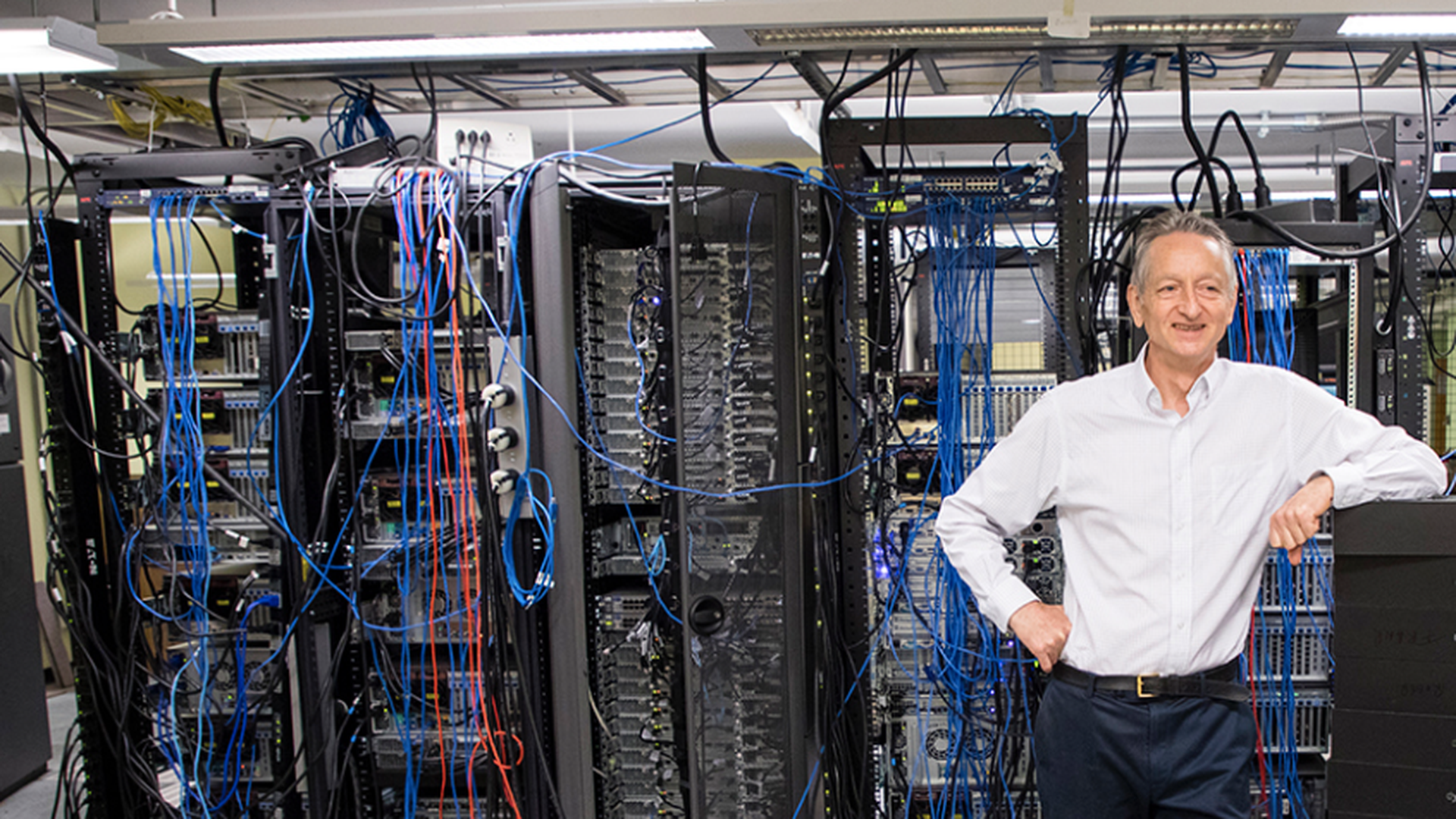
Geoffrey Hinton harbors doubts about AI's current workhorse. (Johnny Guatto / University of Toronto)
In 1986, Geoffrey Hinton co-authored a paper that, three decades later, is central to the explosion of artificial intelligence. But Hinton says his breakthrough method should be dispensed with, and a new path to AI found.
Speaking with Axios on the sidelines of an AI conference in Toronto on Wednesday, Hinton, a professor emeritus at the University of Toronto and a Google researcher, said he is now "deeply suspicious" of back-propagation, the workhorse method that underlies most of the advances we are seeing in the AI field today, including the capacity to sort through photos and talk to Siri. "My view is throw it all away and start again," he said.
The bottom line: Other scientists at the conference said back-propagation still has a core role in AI's future. But Hinton said that, to push materially ahead, entirely new methods will probably have to be invented. "Max Planck said, 'Science progresses one funeral at a time.' The future depends on some graduate student who is deeply suspicious of everything I have said."
How it works: In back propagation, labels or "weights" are used to represent a photo or voice within a brain-like neural layer. The weights are then adjusted and readjusted, layer by layer, until the network can perform an intelligent function with the fewest possible errors.
But Hinton suggested that, to get to where neural networks are able to become intelligent on their own, what is known as "unsupervised learning," "I suspect that means getting rid of back-propagation."
"I don't think it's how the brain works," he said. "We clearly don't need all the labeled data."