Spain ousts Europe's leading left-wing voice

Add Axios as your preferred source to
see more of our stories on Google.
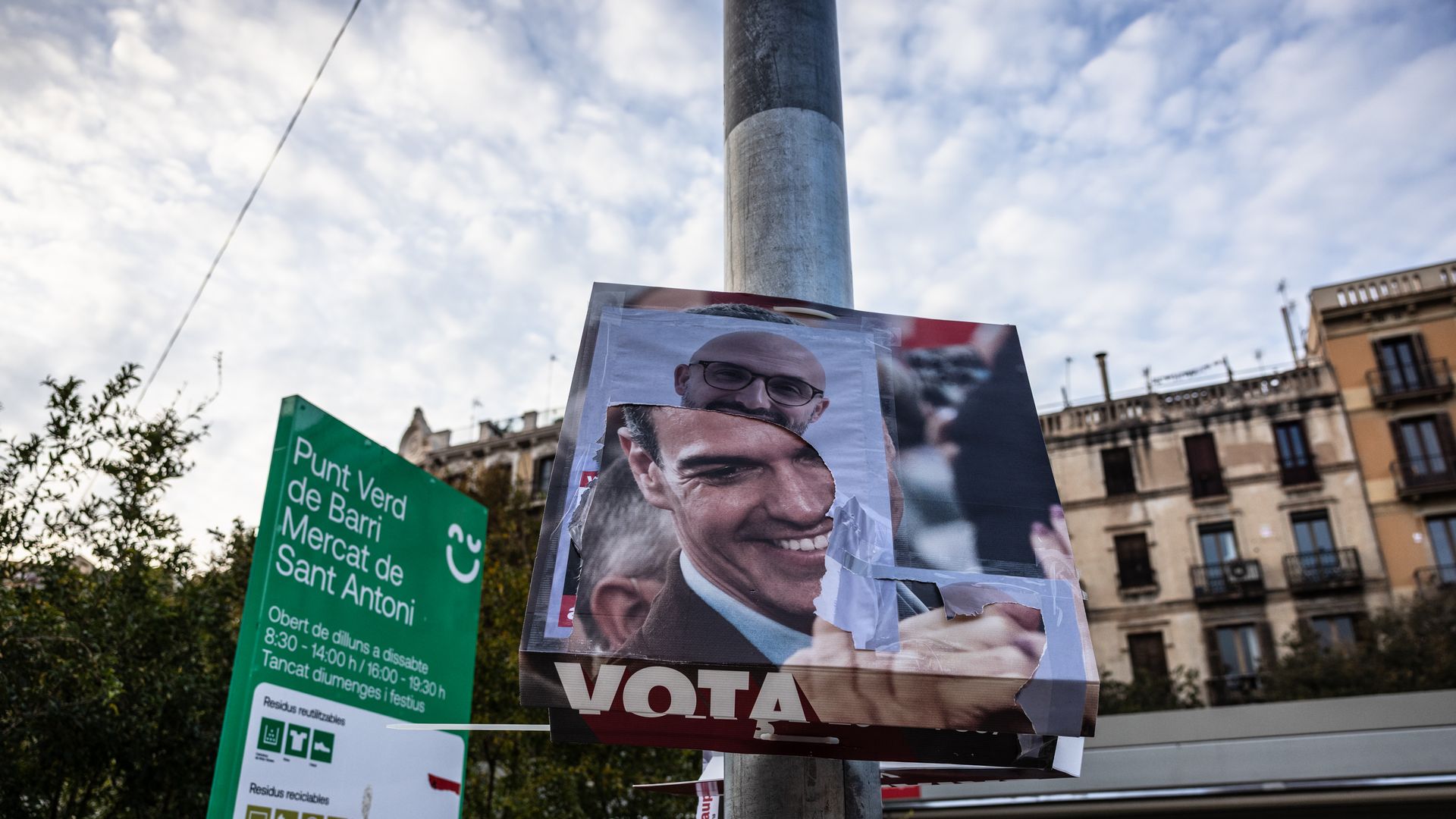
A torn campaign poster for Spanish Prime Minister Pedro Sánchez in Barcelona on Nov. 29, the day of Spain's general election. Photo: Angel Garcia/Bloomberg via Getty Images
Spanish voters defeated Prime Minister Pedro Sánchez on Sunday and set the far right on course to help govern for the first time since Francisco Franco's dictatorship.
Why it matters: For the global left, Sánchez was proof a progressive, pro-immigration party could win elections and run Europe's fastest-growing major economy. He lost anyway, as firewalls against the far right crumble across the continent.
Driving the news: Sánchez conceded defeat Sunday, calling conservative People's Party leader Alberto Núñez Feijóo to congratulate him on his victory, per El País.
- With 93% of the vote counted as of 5:14pm ET, the People's Party was on track to win 133 seats in Spain's 350-seat parliament, followed by Sánchez's Socialists with 116 and the far-right Vox party with 52.
- The two right-wing parties together surpassed the 176 seats needed for an absolute majority. Vox gained 19 seats compared with 2023, while both major parties lost ground.
- If they govern together, it will be Spain's first national government with the far right since Franco's dictatorship.
What they're saying: Trump celebrated Sánchez's defeat Sunday.
- "He did a terrible job. He deserves to lose," Trump told reporters.
Zoom out: Spain is the latest test of Europe's political firewall.
- In Italy, Prime Minister Giorgia Meloni's party, with its post-fascist roots, has governed alongside mainstream conservatives since 2022.
- Far-right parties help govern in the Czech Republic, Finland, Croatia and Slovakia.
- In Sweden, conservative Prime Minister Ulf Kristersson ran alongside the far right, and he's set to win a second term with its tacit support, leaving his minority government reliant on its votes.
In Germany, the far-right Alternative for Germany leads national polls and has begun winning state elections.
- Mainstream parties still refuse to govern with it, but that firewall is fraying.
In France, the far-right National Rally leads polling ahead of April's presidential election.
Yes, but: The far right's rise isn't a straight line.
- In Hungary, voters ousted Viktor Orbán after 16 years in power, handing a landslide victory to the center-right.
- In Denmark, Mette Frederiksen kept her Social Democrats in power, but with the party's worst result since 1903. She's adopted some of Europe's toughest immigration policies.
- In the Netherlands, a cabinet backed by the far right fell in 2025, a new centrist government took its place, and now polls have the progressive left leading.
- In the U.K., the anti-immigration Reform UK party has lost its polling lead but continues to poll well above its 2024 election result.
Between the lines: As center-left counterparts moved to the right on immigration, Sánchez resisted. He governed like a holdover from the center-left of the Obama years: socially liberal, internationalist and openly pro-immigration.
- He recognized a Palestinian state, condemned Israel's war in Gaza as genocide, rejected NATO's 5% defense spending target and barred U.S. forces from using Spanish bases to strike Iran.
The intrigue: The economy didn't save Sánchez's Socialists.
- Spain went from an epicenter of Europe's debt crisis to one of its fastest-growing economies. Its GDP is projected to grow 2.6% this year, more than twice the eurozone's 1.2%.
- But home prices rose 80% and rents 87% between 2015 and 2025, while wages rose just 30%, according to El País.
- Sánchez called the election after parliament rejected his emergency housing measures.
Reality check: Sánchez also had considerable political baggage after eight years in power. Corruption scandals engulfed his inner circle, including his wife and brother.
- Two deadly train crashes killed 115 people this year, with critics blaming his government.
The other side: Vox ran on a Spain-first message, promising mass deportations and preferential access to housing for Spaniards.
Context: Spain's democracy is younger than many of its voters.
- Franco's forces, backed by Hitler and Mussolini, won the Spanish Civil War in 1939, ushering in a dictatorship that lasted until his death in 1975.
- Spain held its first free elections in 1977, adopted a democratic constitution in 1978 and survived an attempted coup in 1981.
- Sánchez invoked that history, filming an ad in front of Pablo Picasso's Guernica, which immortalized the horrors of a 1937 bombing by Franco's fascist allies.
What to watch: France, Italy and Poland will decide in 2027 how willing Europeans are to accept far-right governments.
