America's measles return leaves infants vulnerable

Add Axios as your preferred source to
see more of our stories on Google.
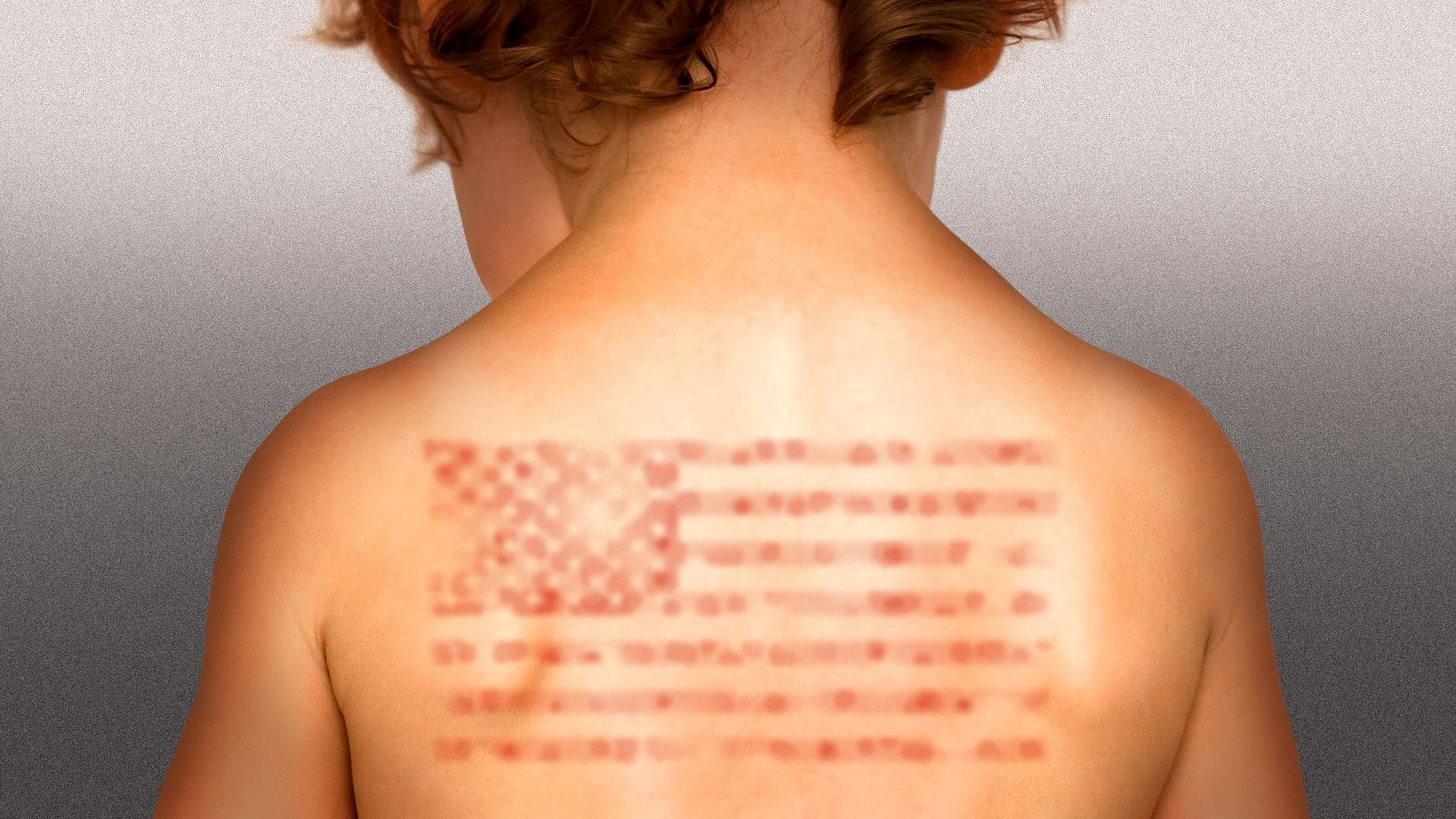
Illustration: Sarah Grillo/Axios. Stock: Getty Images
The loss of the United States' measles elimination status is a particularly worrisome sign for infants in hot spots who are too young to be vaccinated against the disease.
Why it matters: Outbreaks still may be concentrated within certain parts of the country. But infants and other unvaccinated people are living with a continuous threat.
Driving the news: The Pan American Health Organization announced on Tuesday that it revoked the U.S. status after 26 years, as expected.
- That's after state reports of 7,700 cases and 10 deaths since measles first began spreading in Texas early last year, according to the New York Times. (The Centers for Disease Control and Prevention currently reports only nine deaths.)
- Hundreds of people — often unvaccinated children — have been hospitalized.
State of play: The measles-mumps-rubella vaccine is highly effective, meaning the vast majority of cases today occur in people who haven't received an immunization against the disease.
- Just over 1 in 10 of those infected this year were hospitalized, but that jumps to 17% among children under 5 years old, per the CDC.
Between the lines: For most of the population, remaining unvaccinated against measles is a choice, albeit one parents make for their children.
- But for the youngest Americans, receiving a vaccine isn't an option for several months.
- The earliest an infant can receive an immunization against measles is at 6 months, with the official recommendation for most children being a first dose between 12 and 15 months.
- Though infants do receive protective antibodies against measles from their mothers, those gradually decline over their first months of life.
What they're saying: "Most babies don't receive a first measles vaccine until age 1. With measles endemic again, parents can no longer assume grocery stores, airports, churches, or even pediatricians' offices are safe spaces," Jerome Adams, President Trump's first-term surgeon general, posted on X.
- "The community protection we took for granted is gone, and U.S. moms now must live in fear that their babies will be harmed by a completely preventable disease, while they do [everyday] tasks."
- Some experts are raising the prospect of an official three-dose schedule for the MMR vaccine, in which all infants get the earlier dose in addition to the two already recommended.
Details: Infants can receive a dose as early as 6 months if they live in or are visiting places with a high risk of exposure or are traveling internationally.
- "For those under 6 months of age, the best thing we can do is awareness and improve that cocoon and immunity the best that we can," said Elizabeth Murray, a pediatric emergency medicine doctor and a spokesperson for the American Academy of Pediatrics.
- Parents should "make sure whoever you are around or whoever is around your baby is up to date on all of their vaccines," she added.
Zoom in: New research has also documented how measles infections acquired during pregnancy are becoming more common and can have dire consequences.
- Between January 2025 and the end of September this year, 112 cases of measles during pregnancy — almost entirely among unvaccinated women — and 13 cases of congenital measles (meaning a case in a newborn contracted from its mother) were reported to the CDC, according to research published this week in the New England Journal of Medicine.
- Nearly a quarter of the pregnant women were hospitalized for reasons other than labor, and adverse outcomes for babies delivered within 14 days of their mothers developing a measles rash included preterm delivery and admission to intensive care.
- Congenital measles can also result in severe neurologic complications, the report notes.
The bottom line: "We will likely be dealing with measles this year, next year, and the year after," Paul Offit, director of the Vaccine Education Center at Children's Hospital of Philadelphia, wrote on Substack.
- "And, until immunization rates increase, we will continue to see more suffering, more hospitalizations, and more deaths from this entirely preventable infection."
