Islam to become world's largest religion by 2035, Pew says

Add Axios as your preferred source to
see more of our stories on Google.
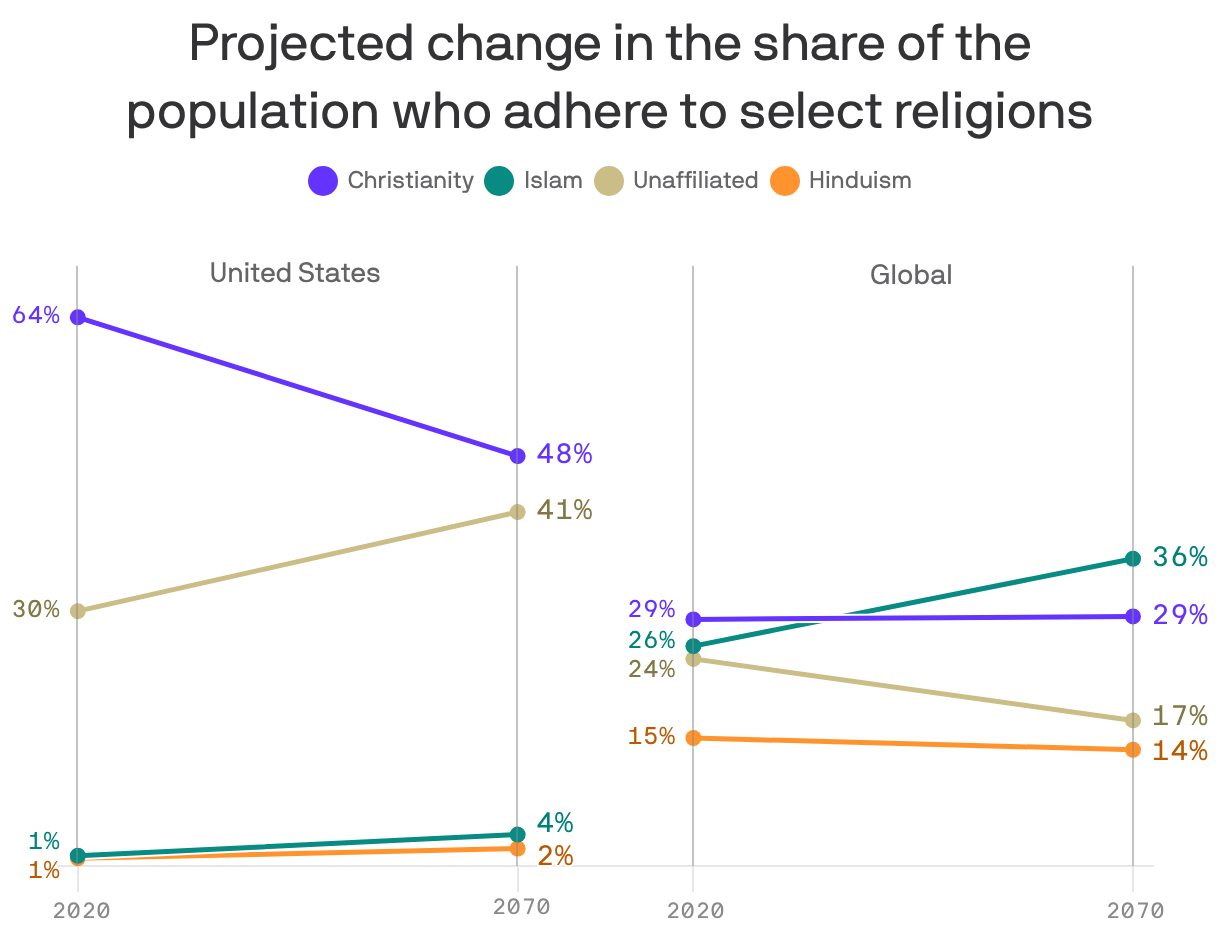
Islam is expected to surpass Christianity as the world's largest religion by 2035, according to Pew Research Center projections released Wednesday.
Why it matters: The shift has less to do with people converting to Islam and more to do with who's having more kiddos, a demographic trend poised to reshape the world's religious makeup as Christianity's center of gravity moves to Africa.
By the numbers: Muslims are projected to gain 1.6 billion people through births exceeding deaths from 2020 to 2070, according to new Pew data released Wednesday.
- Christians are expected to gain 792 million people through natural population change.
- From 2020 to 2025, Muslim women had an average fertility rate of 3.1 children, compared with 2.5 for Christian women.
- For all other women, the average was 1.6.
What they're saying: "These religious figures are driven by demographic change," David Voas, a University College London professor who researches secularization, tells Axios.
- He says the countries growing the fastest — in North Africa, the Middle East, Near East and South Asia — have a relatively high Muslim population, so naturally Islam would eventually be the most populous religion.
Zoom in: The U.S. is expected to lose more Christians than any other country by 2070, even as Christianity grows globally.
- The U.S. had the world's largest Christian population in 2020, at 217 million. By 2070, that number is expected to drop to 174 million.
- Meanwhile, the Democratic Republic of the Congo is expected to have nearly 300 million Christians by 2070, far surpassing the U.S. By then, 54% of the world's Christians are projected to live in sub-Saharan Africa.
- "The center of gravity of Christianity has been shifting towards the global south," Voas says. "Traditionally, we tended to think of Christianity as being a kind of Western religion … but of course Christianity was taken to Africa and around the world, and Africa is now growing faster than anywhere else."
Between the lines: Both Christianity and Islam are expected to lose more followers than they gain through religious switching, including people leaving religion entirely.
- But Christianity's losses will be far larger.
Zoom out: Islam becoming the world's largest religion doesn't necessarily mean a dramatic shift in global political or cultural power, Voas says.
- "I would not see any major change in the balance of either political or cultural power, at least in the medium term," he said, adding that it's possible some will assimilate to the local culture and expectations.
- "There's some wild talk about Europe being taken over by Muslims and so on. That is not going to happen in any foreseeable future."
The bottom line: Islam may soon claim the top spot, but the numbers don't necessarily translate into a seismic shift in global influence.
Go deeper: Tensions erupt in Congress over Republicans' anti-Muslim posts
