The Mississippi Delta helped carry Scott Colom to Senate history

Add Axios as your preferred source to
see more of our stories on Google.
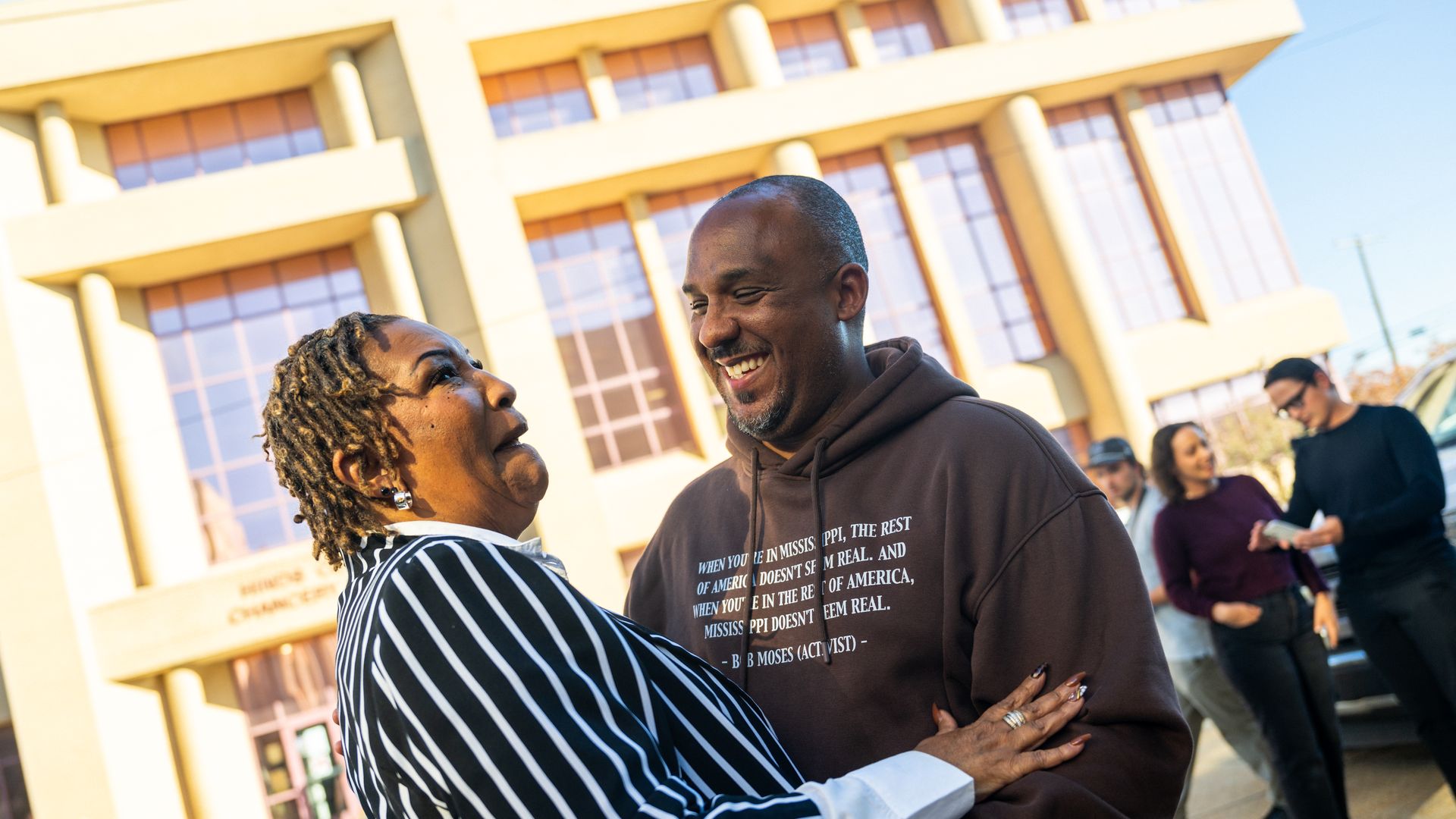
District Attorney and Democratic Senate candidate Scott Colom greets a supporter during the conclusion of a news conference at the Hinds County Sheriff's Office on November 10, 2026 in Jackson, Mississippi. Photo: Brandon Bell/Getty Images
Scott Colom's path to a historic U.S. Senate upset ran through the Mississippi Delta — where Emmett Till was abducted, Fannie Lou Hamer fought for the ballot and the blues became an American art form.
Why it matters: Nearly 150 years after Reconstruction, Mississippi sent a Black American to the U.S. Senate for the first time since 1881. The votes pushing Colom toward that milestone came from communities where Black residents spent generations fighting for the ballot.
Driving the news: The Associated Press projected the race for Colom on Wednesday, handing Democrats a historic upset over Republican Sen. Cindy Hyde-Smith.
By the numbers: An Axios analysis of AP county returns found Colom ahead in 16 of the 18 counties in the Mississippi Delta National Heritage Area.
- Colom collected roughly 100,000 votes to Hyde-Smith's 62,000 — a 38,000-vote advantage.
- In 2020, Democrat Mike Espy carried 15 of those counties by about 25,000 votes, according to Mississippi's certified county returns. Colom's share of the two-party vote climbed from about 56% to 62%.
- Statewide, Colom led Hyde-Smith by about 4,700 votes out of more than 962,000 counted when the AP called the race Wednesday — a margin of roughly half a percentage point.
What they're saying: "Mississippi voters made history because they refused to be intimidated, discouraged, or counted out," NAACP president Derrick Johnson said in a statement.
- Johnson said Mississippi voters showed up despite efforts to remove voters from the rolls.
Zoom in: Colom's electoral map traces some of the most painful and defining chapters of Black American history.
- Coahoma County: Home to Clarksdale and the famed crossroads associated with the legend that bluesman Robert Johnson sold his soul to the devil. Colom led with about 4,700 votes to 1,300.
- Leflore and Tallahatchie counties: Emmett Till was abducted near Money in Leflore County in 1955. His body was recovered from the Tallahatchie River in Tallahatchie County, where an all-white jury acquitted his killers. Colom led by about 4,200 votes in Leflore and 1,300 in Tallahatchie, according to AP returns.
- Sunflower County: Fannie Lou Hamer, who lived in Ruleville, challenged Mississippi's racist voting restrictions. As late as the spring of 1965, only 155 Black residents had registered to vote in the county, according to the Mississippi Department of Archives and History. Colom led with about 5,300 votes to 1,700.
- Washington County: Robert F. Kennedy visited Greenville during his 1967 tour of Delta poverty. 29.4% of Washington County is still in poverty per the Census Bureau's 2020–2024 estimate. Colom led with about 8,700 votes to 2,400.
Zoom out: Colom didn't suddenly turn the Delta blue. Espy won most of it in 2020. But Colom widened the Democratic margin.
- In DeSoto County, which falls within the heritage area but outside the Delta's historic heartland, Colom led by about 3,300 votes. Hyde-Smith won there by roughly 12,100 in 2020.
- Colom also swept the Golden Triangle counties of Lowndes, Oktibbeha and Clay, his home region in northeastern Mississippi. He won all three by double-digit margins and improved on Espy's 2020 performance.
Between the lines: The historical symbolism stretches beyond the Delta.
- Colom led with about 12,100 votes to 9,700 in Forrest County, named for Confederate Gen. Nathan Bedford Forrest, the Ku Klux Klan's first grand wizard.
- Hyde-Smith faced criticism during her 2018 race against Espy after saying she would sit in the front row if invited to a public hanging. She later apologized to those offended.
The bottom line: The region where Black Mississippians fought some of America's fiercest battles for voting rights helped elect the state's first Black U.S. senator in 145 years — and raised a new question.
- Can political representation finally bring economic change to the Delta?
