Scoop: U.S. asks Russia to propose new security agreement with Europe

Add Axios as your preferred source to
see more of our stories on Google.
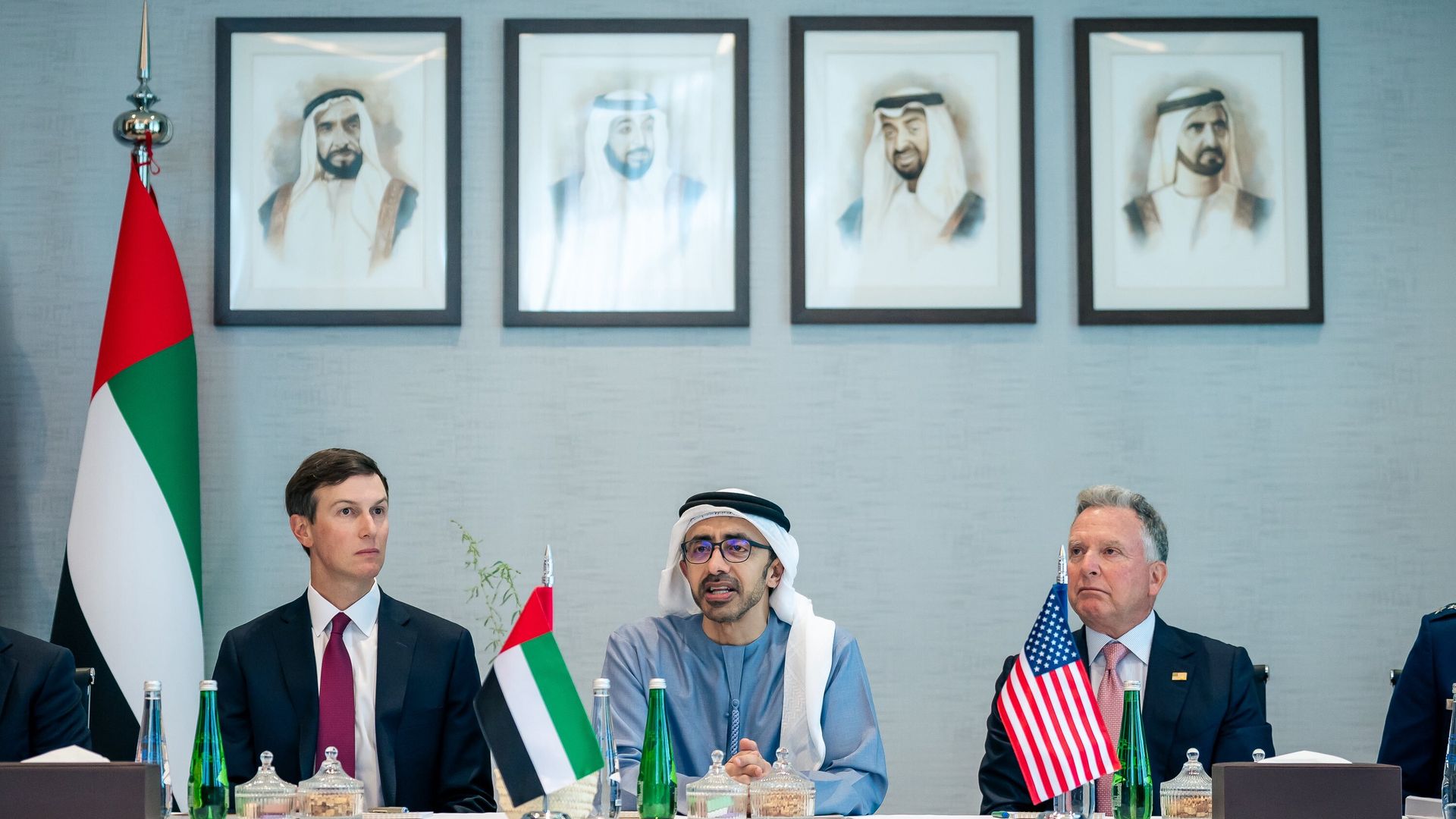
UAE Deputy Prime Minister and Foreign Minister Abdullah bin Zayed Al Nahyan and President Trump envoys Steve Witkoff (R), and Jared Kushner (L) attend trilateral talks on Ukraine in Abu Dhabi on Tuesday. Photo: UAE Foreign Affairs Ministry Office/Handout/Anadolu via Getty Images
The U.S. has asked Russia to submit a new proposal for a future security agreement with Europe that includes Russian steps to ease tension with the continent, two sources with knowledge of the matter said.
Why it matters: For years, Russia has sought a European security deal that limits NATO expansion and scales back its military presence in Eastern Europe. The U.S. has rejected those demands in the past, but now appears open to them in some form as part of a broader agreement to end the war in Ukraine.
- But many European governments are deeply suspicious of the administration's approach.
State of play: President Trump's envoys Jared Kushner and Steve Witkoff will meet with Russian President Vladimir Putin in Moscow on Thursday to reiterate the request. They also want Putin to allow European representatives to join the next round of Russia-Ukraine peace talks, a U.S. official said.
- From Moscow, Kushner and Witkoff are expected to travel to Dublin to meet with Ukrainian President Volodymyr Zelensky on Thursday night.
Catch up quick: The talks on Tuesday and Wednesday were the first time Ukrainian and Russian officials met with U.S. mediators present since February, when they were suspended due to the war in Iran.
- In recent weeks, Witkoff and Kushner met with both Putin and Zelensky, creating a bit of momentum.
- Putin agreed to resume peace talks and release U.S. citizen Stephen Hubbard, who was detained by Russia in 2022. Together with first lady Melania Trump and her team, Witkoff and Kushner also brokered a humanitarian ceasefire in the city of Oleshky.
Driving the news: The talks in Abu Dhabi started on Tuesday with Witkoff, Kushner and commander of the U.S. European Command Gen. Alexus Grynkewich mediating between the Russians and the Ukrainians.
- The parties agreed to a prisoner exchange deal that Kushner and Ukrainian negotiator David Arakhamia said could be the biggest since the war began.
- U.S. and Ukrainian officials said the exact number of prisoners to be released will be decided during meetings with Putin and Zelensky on Thursday.
- Before and after the talks, the U.S. and Ukrainian negotiating teams briefed a delegation of senior diplomats from Germany, the U.K., France, Italy, the EU and NATO.
Behind the scenes: The meetings between the Russians and the Ukrainians on Tuesday were tense and at times emotional, with both sides airing grievances after nine months of not talking directly, according to a source in the room.
- Kushner and Witkoff tried to lower the temperature, telling Russian and Ukrainian negotiators that the goal is to end this round of talks with options for the leaders on both sides.
- Eventually, after each party made its case, the discussion became more constructive, the source said.
- "We had pretty tough discussions," Kushner said at a press conference after the talks concluded on Wednesday.
- "The Russians came with strict directives. It was very hard to soften it, but it ended productively," Arakhamia said.
Zoom in: The U.S. proposal to secure a deal on a new Europe-Russia security architecture as part of an agreement to end the war in Ukraine was a key focus of the Abu Dhabi talks.
- Russian negotiators said Putin launched the invasion of Ukraine because then-President Biden did not reply to his 2021 letter laying out his security concerns, two sources with knowledge of the talks said.
- According to one of the sources, Kushner and Witkoff told the Russians that the world has changed a lot since 2021.
- They proposed that Russia draft a new proposal that includes its security concerns and demands, but also lays out what "symmetrical steps" it's willing to take to de-escalate and reassure Europe that it will not attack in the future.
- Kushner and Witkoff also told the Russians that in order to seriously discuss security issues in Europe, they need to agree to allow European representatives to participate in future peace talks.
- "We told the Russians, they have their desires and fears, but they have to provide different de-escalation and different proposals as well, if they want Europe to be able to receive those proposals in a good way," Kushner said at the press conference.
The other side: So far, Russia has been unwilling to allow Europeans to be part of peace talks with Ukraine.
- "As for the leadership of a number of European countries, they are essentially engaged in a collective deception of the Ukrainian people and contributing to the mass deaths of civilians," Putin adviser Vladimir Medinsky, who headed the Russian delegation, said at a press conference after the talks. "Therefore, I don't understand what can be discussed with them."
- Still, Medinsky said that Russia wants to reach a broader security deal with Europe as part of an agreement to end the war.
- "In Ukraine, an abscess has simply burst. The entire body needs to be treated — a Band-Aid won't do the trick," he said.
What to watch: The Trump administration wants to negotiate a new Europe-Russia security architecture and a Russia-Ukraine peace deal simultaneously. But the implementation of a security arrangement would only happen after a deal to end the war is reached, according to a source familiar with the White House's thinking.
- The president of the European Commission, Ursula von der Leyen, said before the talks in Abu Dhabi that Europe will discuss a new security architecture only after the war in Ukraine ends.
- But two sources with knowledge said European officials who were in Abu Dhabi this week agreed to engage on both tracks simultaneously, while stressing that final decisions on European security architecture would be made only after the war in Ukraine ends.
- The U.S. hopes giving European representatives a seat at the peace talks will make their governments more willing to discuss and agree on a broader security agreement before the war ends.
- "Zelensky won't agree to a deal until he knows what happens next regarding security guarantees and Putin wants to know this, too. This is why the security issue is so important," the source said.
- The source added that the U.S. made it clear to European countries that it would not agree to a security deal with Russia unless Europe and Ukraine are on board. The U.S. also wouldn't give Russia a veto over Europe's security considerations, the source said.
The bottom line: Security will be a key issue at a summit of European leaders in Dublin later this week. European diplomats said the idea of a Russia-Europe security arrangement still faces a lot of resistance and unanswered questions.
