Trump swung between war and diplomacy — then chose a third way

Add Axios as your preferred source to
see more of our stories on Google.
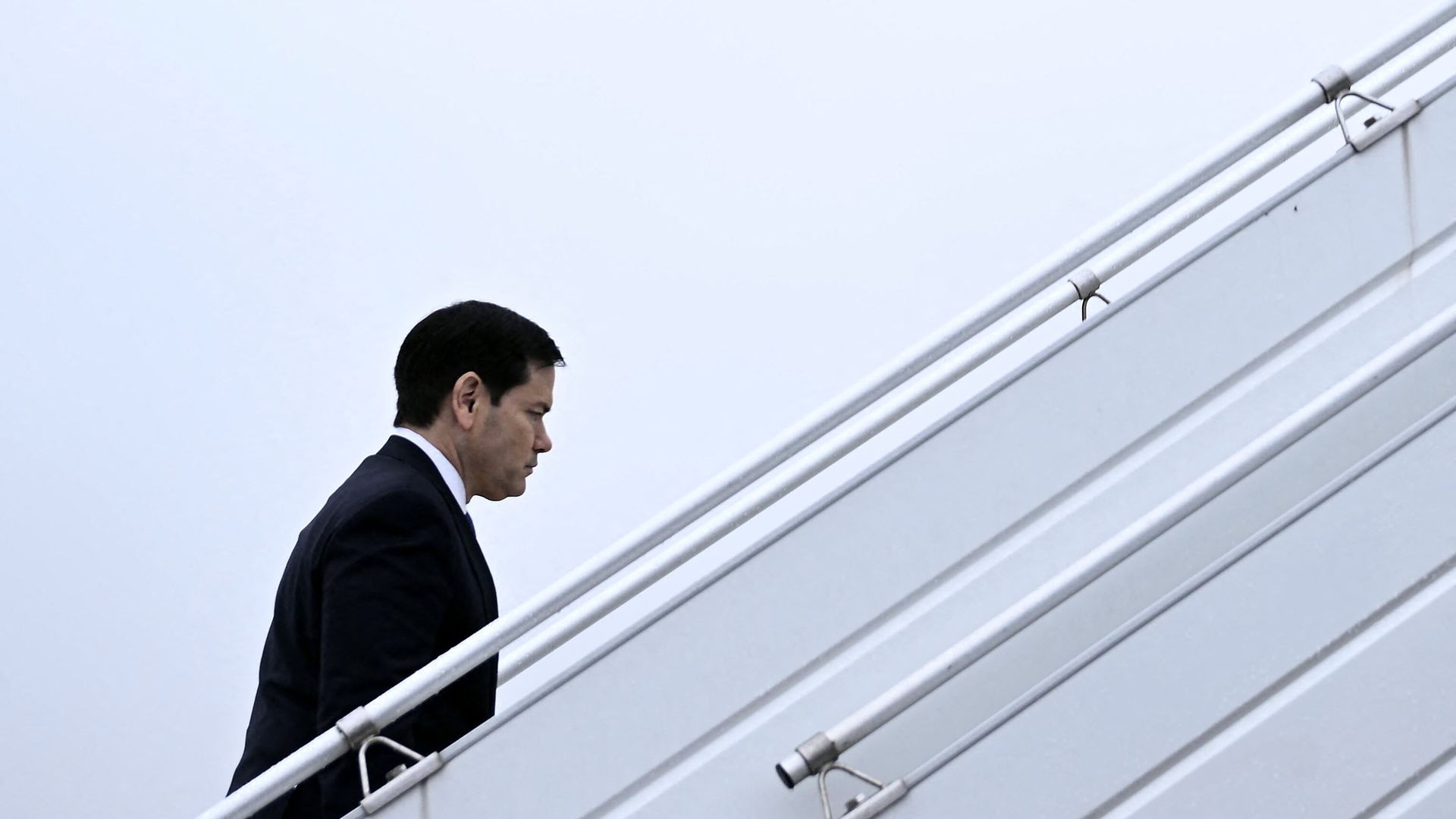
Secretary of State Marco Rubio embarks his plane after attending the G7 foreign ministers summit in Paris on Tuesday. Photo: Brendan Smialowski/AFP via Getty Images
When Secretary of State Marco Rubio met with his G7 counterparts in Paris on Tuesday, he told them that President Trump had considered resuming the war with Iran or cutting a deal — but chose a third option: strangling the Iranian regime, three people who attended the meeting told Axios.
Why it matters: The Iran war has become a political albatross in Trump's second term, costing Republicans dearly in the midterms. For months, the president has alternated between threatening to obliterate Iran and predicting it will capitulate and give him the deal he wants.
- "He's been searching for the solution, but he wasn't sure what's the best way to go," a U.S. official close to Trump said.
- This debate over which course to follow has led to strife between several factions within the top echelon of the administration. Each faction had the support of U.S. allies in the Middle East — namely Israel favoring renewed strikes and most Gulf countries opposing them.
Driving the news: After meeting with the Qatari Prime Minister Sheikh Mohammed bin Abdulrahman Al Thani on Monday, Trump said that a new round of strikes against Iran is "quite unlikely" and "doesn't seem to be necessary."
- Trump said he instead favors continuing the economic crackdown and naval blockade against Iran, in addition to a new operation dubbed "Iron Gate" to cut off land routes that Iran uses to move advanced weaponry and other technology.
Behind the scenes: Rubio explained the U.S. Iran policy in a closed meeting on Tuesday with the foreign ministers of the G7 countries in Paris.
- "The President doesn't just have two options. It's not just return to war or sign a ridiculous peace deal. We won't do a stupid deal. The third option we have is to continue to do what we do now," Rubio said, according to three people in the room.
- Rubio went on to say that the U.S. is imposing devastating costs on Iran's economy, making it harder for it to fund terrorist organizations or rebuild its military. And there's no end date.
- "The President is not under false time pressure, the Iranians are inflicting major damage on their own economy," Rubio said.
The intrigue: U.S. officials say that Rubio was among the members of Trump's national security team who pushed for the strangulation strategy, along with Treasury Secretary Scott Bessent, CIA Director John Ratcliffe and Jared Kushner, Trump's adviser and son-in-law.
- That group opposed the resumption of war, didn't believe Iran's current positions could lead to a deal that serves U.S. interests and lobbied for the third option.
State of play: Rubio is deeply skeptical of a diplomatic breakthrough.
- "Iran would love a deal. The problem is the conditions they continue to place are absurd. Like, they're not even serious right now," he told reporters after the G7 meeting.
- That could change if the Iranians feel more economic pain, he said. "Eventually you have to eat," he said. "Eventually the economic realities penetrate the skull of even the most radical lunatic. So I think as time goes on that will have an impact."
Yes, but: Several U.S. allies — such as Turkey, Iraq and Pakistan — are concerned about Trump's intention to prolong the economic squeeze, a U.S. official said.
- The person said those allies worry that U.S. pressure on them to stop doing business with Iran — including by stopping flights and closing their borders — will create instability in their own countries.
The other side: The course Trump has chosen is completely at odds with the directive Iran's Supreme Leader Mojtaba Khamenei gave his government and the Islamic Revolutionary Guard Corps.
- Khamenei ordered an end to the "no war, no deal" status quo, demanding a clear conclusion to the war. Iran's civilian leadership interpreted this as a green light to negotiate a deal.
- But if the current stalemate continues and pressure on Iran intensifies, the IRGC could see it as a green light for more aggressive attacks in the region in an attempt to break the status quo.
- "Iran has no intention of simply accepting this situation indefinitely," said Danny Citrinowicz, an expert on Iran at the Atlantic Council. "Tehran may conclude that increasing the economic and security costs for Washington and its regional partners is the only way to force a change in American policy."
- He added: "The danger is obvious: Iran escalates, Washington responds, and both sides find themselves in another military confrontation that neither necessarily wanted."
What to watch: Qatar's prime minister briefed the G7 meeting on mediation efforts and his conversation with Trump the previous day.
- Al Thani said he came away from his meeting with Trump believing there's more breathing room for diplomatic efforts.
- The sticking points remain which side will take the first step toward de-escalating and which confidence-building measures the parties will agree to take.
- The Qatari prime minister said he wants to bring in China and European countries as guarantors, to help ease deep Iranian suspicions that Trump will break the agreement and resume the war in a few months.
