Crude oil tumbles aren't helping diesel

Add Axios as your preferred source to
see more of our stories on Google.
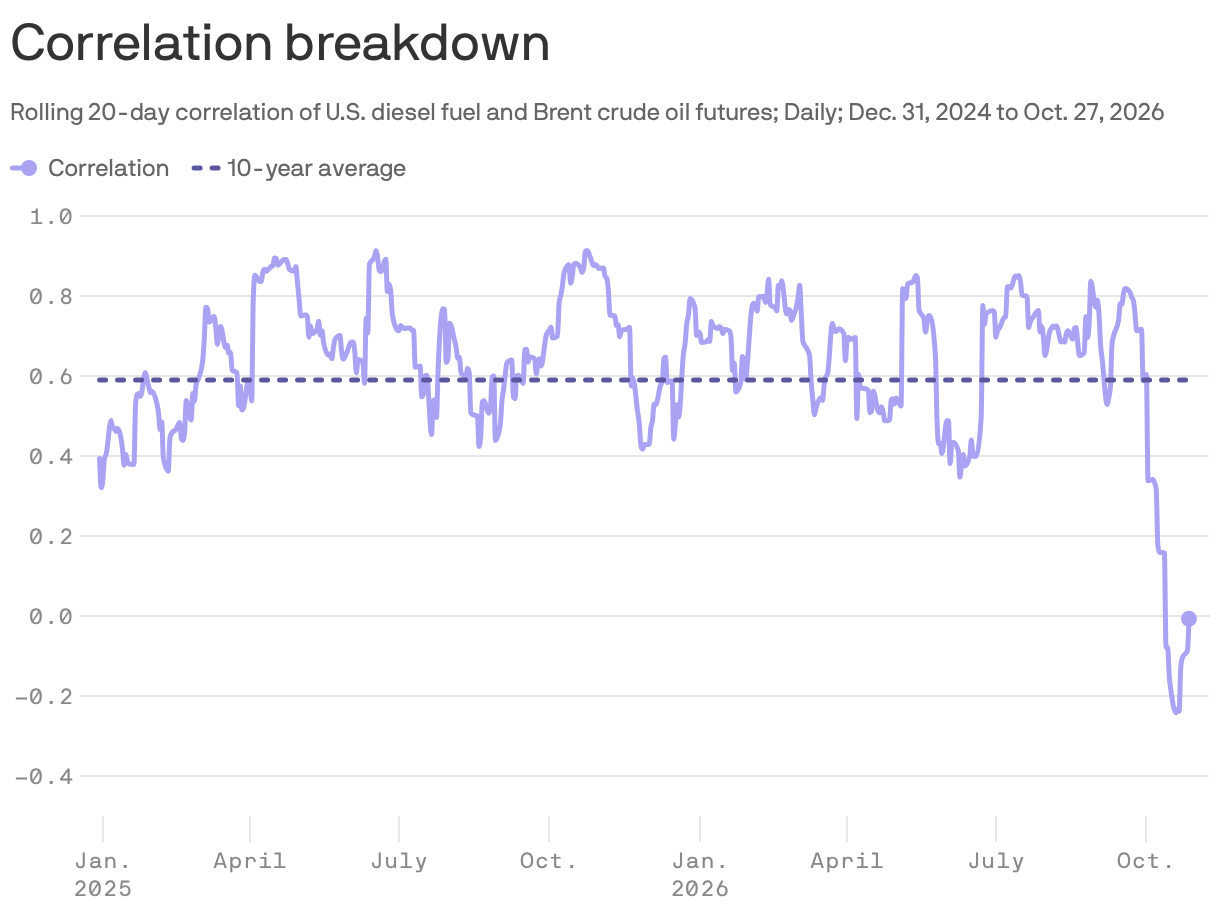
U.S. diesel futures registered a muted response to Monday's tumble in global crude oil prices, with the suddenly politically salient price of the industrial fuel still up more than 100% from the end of 2025.
Why it matters: It shows that the destruction of global refining infrastructure, rather than shortages of crude oil, is the key to soaring diesel costs right now.
By the numbers: Analysts often examine the relationships between different market prices by looking at changes in their correlations: that is, the tendency of the prices of certain assets to rise or fall in lockstep.
- A correlation reading of 1 indicates that the prices always move the same way, while a correlation of -1 indicates that they never move in the same direction.
- You can see in the chart above that the short-term (20-day) rolling correlation of benchmark U.S. diesel futures to futures prices on Brent crude oil — the global petroleum benchmark — has vanished over the last couple months.
Catch up quick: Iran's attacks on refining infrastructure around the Persian Gulf in response to the joint U.S.-Israeli attacks and Ukraine's campaign of drone strikes against Russian refineries have sharply reduced the ability of these two regions to ship diesel to the global market, driving up prices worldwide.
What they're saying: "While global diesel prices have eased from the all-time highs of more than $200 per barrel reached in September, benchmarks remain nearly double the price of crude oil and their pre-crisis levels," analysts at the International Energy Agency wrote in their October oil market report.
- "Record diesel prices are already having broad economic consequences by raising the cost of goods and impacting real incomes, economic activity, and inflation."
What we're watching: The headlines, for any indications about the odds of fierce fighting between the U.S. and Iran to start once again.
