Pre-midterm polls signal youth vote U-turn


Add Axios as your preferred source to
see more of our stories on Google.
The youth vote emerged as a coveted voting bloc in the 2024 election, with the Trump campaign making inroads and seizing on manosphere cultural stars to connect with young Americans. Two years later, polling shows that momentum slowed or reversing.
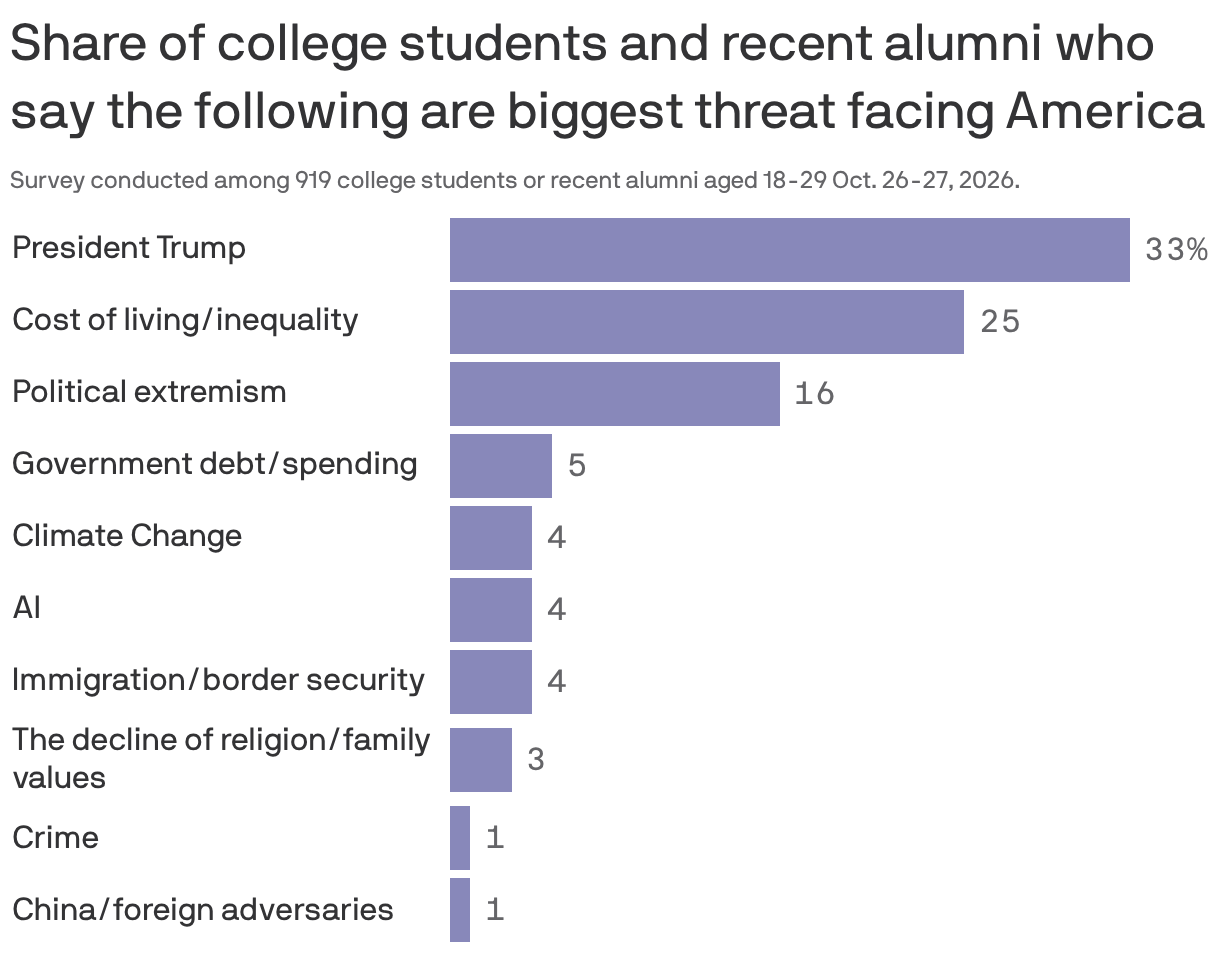
Driving the news: President Trump is cited as the biggest threat facing America today, by college-educated 18-to-29-year-olds in a new Generation Lab poll for Axios. He took the top spot (33%), above cost of living and income inequality (25%), political extremism (16%), government spending (5%), and climate change, AI and immigration/border concerns (each 4%).
- 48% of young college-educated Democrats, 22% of independents and 6% of Republicans called Trump the biggest threat.
- Half of respondents said they're proud to be Americans; about one in five doesn't feel proud and one in three is unsure.
The big picture: A key question for these midterms is whether young Americans will take their political disillusionment and economic anxiety to the ballot box.
- Nonpartisan voter registration platform Vote.org said this week that young voters appear to be driving a "massive Democratic registration surge" ahead of next week's elections, with the biggest registration spike seen in Texas.
- A recently released Harvard Youth Poll of 18-to-29-year-olds found that half of young Democrats say they will definitely vote in November, compared with 34% of young Republicans—a gap that has widened to 16 points in 2026 from five points in 2022. Among young people who say they will definitely vote, 63% describe their congressional vote as opposition to President Trump and his policies.
- But the Generation Lab survey's respondents were divided about how much their vote would matters, with 32% saying a great deal, 31% saying a fair amount and 28% saying a little.
What they're saying: Young Americans have "never known a political system that's actually worked, especially not one that's worked for us," Sam Hiner, the executive director of the Young People's Alliance, tells Axios.
- Trump framed himself as the man to shake up that system. But Hiner says "you very quickly saw ... young people who did vote for Trump in 2024 get alienated" by issues like the war in Iran, the handling of the Epstein files and affordability. "It's a tough time to be a young Republican."
Zoom out: A New York Times/Siena University poll of likely midterm voters published last week found that seven in 10 young voters (ages 18-29) identified as or leaned toward Democrats — a 15-point swing from before the 2024 election.
Yes, but: Younger generations don't always vote with one party, and they report feeling like modern politics doesn't work for them.
- "The reality is that young people are very turned off by both parties," says Rachel Janfaza, a Gen Z researcher and founder of The Up and Up. "They are frustrated by the status quo and looking for change, and so I think that this massive, quick shift is an indication of exactly that."
- In a recent focus group she conducted in connection with the Kettering Foundation, Janfaza observed Gen Z's deep concern about their financial futures: "Looking at their parents who had a house, a family, when they were their age, and young people are ... using 'buy now, pay later' for groceries."
Methodology: The Generation Lab study was conducted Oct. 26-27, 2026, using a nationally representative sample of 919 college students or recent alumni, aged 18-29. The margin of error is +/- 3.23 percentage points.
