After losing his majority, Netanyahu tries to delegitimize election results

Add Axios as your preferred source to
see more of our stories on Google.
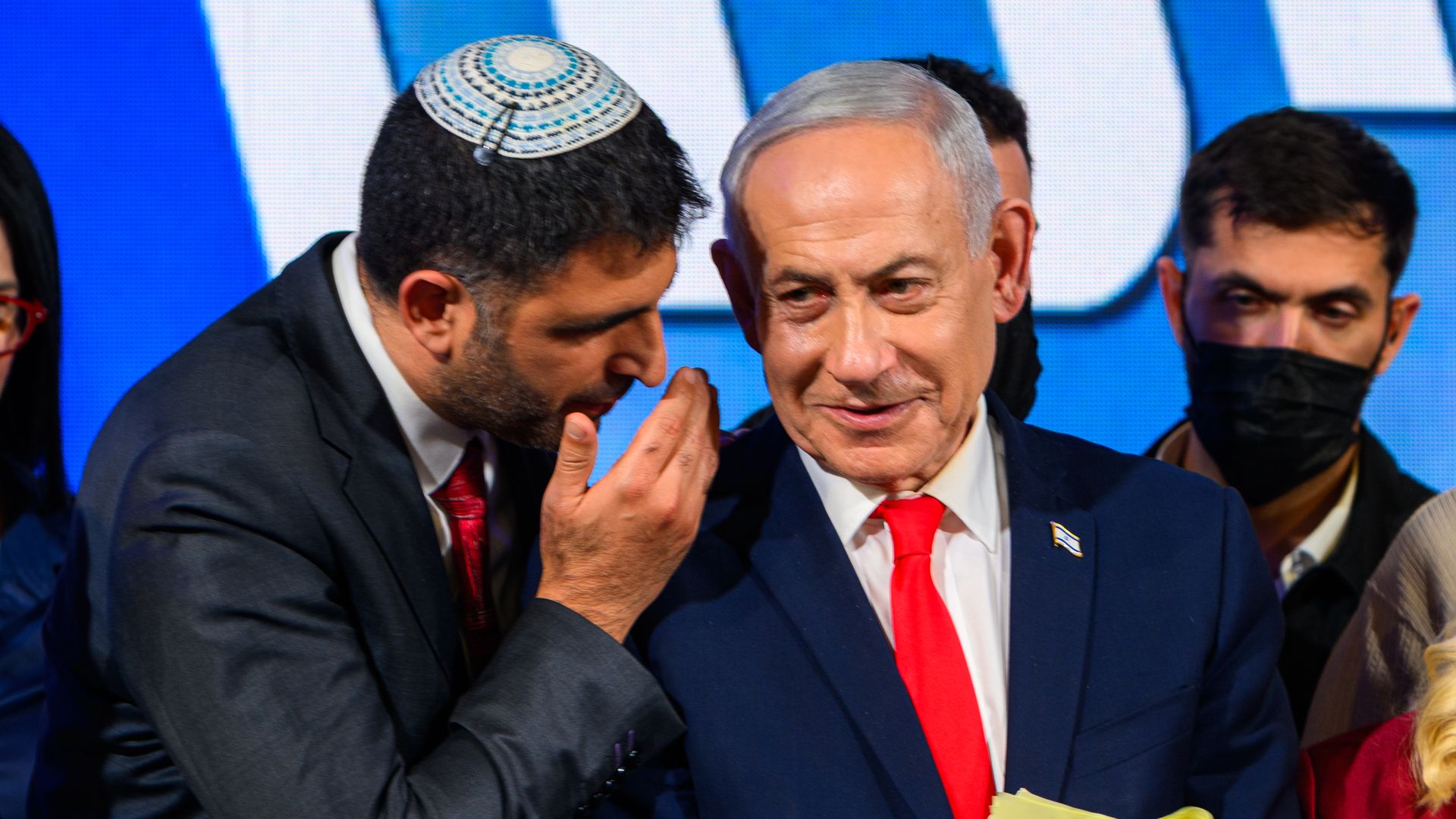
Israel's minister of communications whispers to Israeli Prime Minister Benjamin Netanyahu at an election-night event. Photo: Alexi J. Rosenfeld/Getty Images
After his far-right coalition lost 11 seats in the election, Israeli Prime Minister Benjamin Netanyahu is trying to discredit the results by claiming there was mass voting fraud in Arab communities.
Why it matters: Netanyahu appears to be trying to spook the opposition bloc out of cooperating with Arab parties to form a new government.
- But the opposition is concerned he has an even more ambitious goal: To prevent the results from being certified at all. That would block the swearing in of a new parliament, in which he would lose his majority.
Driving the news: Netanyahu and his Likud party started the campaign to delegitimize the Arab vote days before the elections.
- Half of Netanyahu's social media posts on Election Day cast suspicion on the unprecedented turnout in Arab communities, an apparent attempt to drive his supporters to the polls.
- Arab voters cast ballots in historic numbers, winning 19 seats between their two parties.
- On Wednesday, Netanyahu's Likud party issued a statement claiming the "elections were stolen" by the Arab parties through bribes and fraud.
- Its claims were based on the arrest of three activists from the Arab Ra'am party who were suspected of paying a small number of voters in one of the Arab cities.
- The Israeli police said there was no evidence to support Likud's claims of a "stolen" election.
Behind the scenes: The situation escalated dramatically on Thursday when a letter sent to the director of the Shin Bet domestic security agency was leaked to Israel's Channel 12. It was written by the supreme court judge who heads the Central Elections Committee.
- The judge ordered the Shin Bet director to immediately investigate suspicions of election interference by foreign countries and submit conclusions within a week.
- Shortly after the letter leaked, Israeli media outlets identified Qatar as the country in question. The allegation is that it funneled money to one of the Arab parties to propel turnout in their communities.
- Over the past year, several of Netanyahu's closest advisers have been investigated by Shin Bet for allegedly being paid by Qatar to improve its image among Israelis.
Zoom in: At a press conference on Election Day, the Shin Bet director, who is a far-right Netanyahu political appointee, said the elections were "safe and secure." He did not mention any suspected foreign interference.
- But the next day, the director met the head of the Central Elections Committee and briefed him on intelligence that suggested foreign countries sent money to one of the Arab parties to increase turnout.
- Later that day, the Shin Bet director briefed Netanyahu on the intelligence, but not his opponent Gadi Eisenkot.
- Eisenkot was briefed by the Shin Bet only after the letter leaked. Later on Thursday, the director also briefed outgoing opposition leader Yair Lapid.
- Sources with knowledge say the Shin Bet had the intelligence weeks before the elections. In a statement on Thursday, Shin Bet said the head of the Central Elections Committee was the only one outside of the security agency who knew about the investigation ahead of the elections.
Zoom out: Shin Bet said in its statement that the investigation is "focused and narrowly defined" and made clear it doesn't cast doubt on the vote of the Arab minority.
- "The investigation should not be used to cast suspicion on or accuse an entire sector of society that exercised its democratic and legal right to vote. Only those who acted unlawfully will be held accountable," the statement read.
What they're saying: But Netanyahu and Likud nevertheless seized on it.
- After the letter leaked on Thursday, they called it "an earthquake" and again claimed without evidence that "the elections were stolen."
- "This is an attack on democracy aimed at enabling a foreign takeover of the Knesset, the Islamization of Israel, and the overthrow of right-wing rule in order to bring about an Israeli withdrawal and the defeat of the IDF on all fronts — first and foremost in Iran," the Likud said.
- It also said that "no Zionist party should cooperate" with the Arab parties in replacing the Knesset speaker after the new parliament is sworn in or in establishing a new government.
The other side: Eisenkot said the suspicions of foreign interference in the elections must be immediately and thoroughly investigated.
- But the swearing-in of the Knesset must proceed as scheduled, he said.
- "Netanyahu is leading an illegitimate influence campaign targeting the Israeli public, aimed at delaying the publication of the election results and manufacturing a false narrative to delegitimize the new Knesset," Eisenkot said.
What to watch: The vote count ended on Thursday with the opposition parties winning 67 seats and Netanyahu's coalition winning 53.
- The results are expected to be certified next week, with the Knesset being sworn in several days later.
- The opposition plans to immediately replace the current speaker of the Knesset and start passing laws — first and foremost, establishing a national commission to investigate the security failures that led to the October 7 attacks. Netanyahu has blocked efforts to launch such an inquiry for three years.
Yes, but: While the opposition's majority will allow it to take over parliament, it's not clear whether it will be able to assemble a government.
- Doing so would require the support of the Arab parties — and not all opposition parties want to join forces with them.
