How Israel decides on a government when no one wins the election

Add Axios as your preferred source to
see more of our stories on Google.
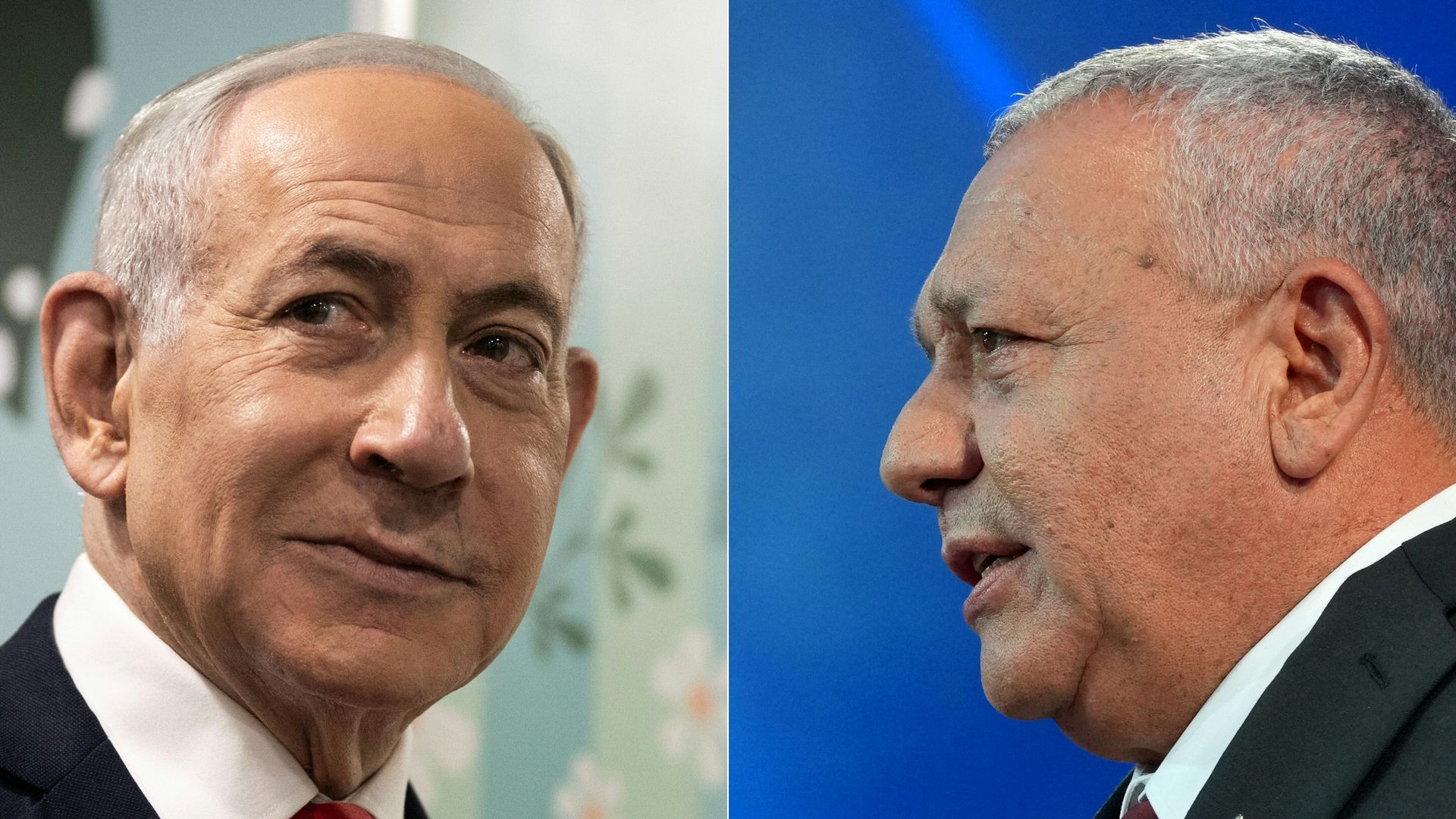
Israeli Prime Minister Benjamin Netanyahu (left) and opposition leader Gadi Eisenkot, whose rival blocs fell short of a parliamentary majority in Israel's general election Tuesday. Photo: Jewel Samad and Maya Levin/AFP via Getty Images
Israel's election left Prime Minister Benjamin Netanyahu and his political rival Gadi Eisenkot scrambling to form a government.
Why it matters: With votes still being counted, neither bloc has secured a 61-seat majority, setting up potentially weeks of negotiations over who will govern Israel.
State of play: Voting in Israel's election wrapped up yesterday with neither major political bloc securing a majority. Netanyahu's coalition is on pace to win 53 seats, Eisenkot's bloc 48 and Arab-led parties the remaining 19.
- Both Netanyahu and Eisenkot claimed victory in separate speeches.
- Netanyahu has ruled out teaming up with Arab parties to reach a majority, while Eisenkot has expressed some openness.
The deadlock could leave Israel without a new government for months — or force another election.
Here's what to know.
How Israel's election system works
How it works: Israel uses proportional representation to elect its 120-member Knesset parliament.
- A party must obtain at least 3.25% of the national vote to win representation in the Knesset.
The election determines the makeup of parliament, but coalition negotiations determine who governs.
- Once a candidate assembles a government, the Knesset must vote to approve it before a new prime minister officially takes office.
Reality check: Government formation takes between 20 and 100 days historically, per the Israel Democracy Institute. In the last two decades, it has taken at least 50 days.
What happens if no one wins the election
Israel has a formal process for resolving an inconclusive election, according to the Israel Democracy Institute.
- The president, currently Isaac Herzog, consults the elected parties before assigning a lawmaker the opportunity to form a government.
- The candidate has 28 days to form a government, with a potential 14-day extension.
- The president typically selects the lawmaker considered most likely to assemble a governing coalition, even if that person doesn't lead the largest party.
- If that fails, the president can give another lawmaker 28 days to form a government, without an extension — or declare that no viable candidate exists.
If those efforts fail, lawmakers have 21 days to back another candidate, who must secure the support of at least 61 Knesset members.
- If lawmakers agree on a candidate, that person gets 14 days to form a government.
- If it fails, parliament is dissolved and another election must be held within 90 days.
What happens next in Israel's election
Herzog, who plans to receive the official results next week, will consult the parties over government formation, AP reports.
- Official results must be published by Nov. 4, after which Herzog has seven days to select a lawmaker to attempt to form a government.
What we're watching: A Netanyahu–Eisenkot unity government has been discussed as one possible way out of the deadlock, Axios' Barak Ravid writes.
- But such an agreement appears unlikely given opposition parties' refusal to serve under Netanyahu.
Netanyahu would remain caretaker prime minister while lawmakers negotiate a new government, potentially keeping him in power for months even without a parliamentary majority.
- If a government isn't eventually formed, another election would be held in 2027.
Flashback: Israel is no stranger to repeat elections stemming from political stalemates.
- The country held five national elections between April 2019 and November 2022 due to deadlock and instability.
The bottom line: Israel is facing the possibility of yet another election in 2027 if negotiations collapse.
