Zelensky lobbies senators to press White House on alleged intel and weapons curbs

Add Axios as your preferred source to
see more of our stories on Google.
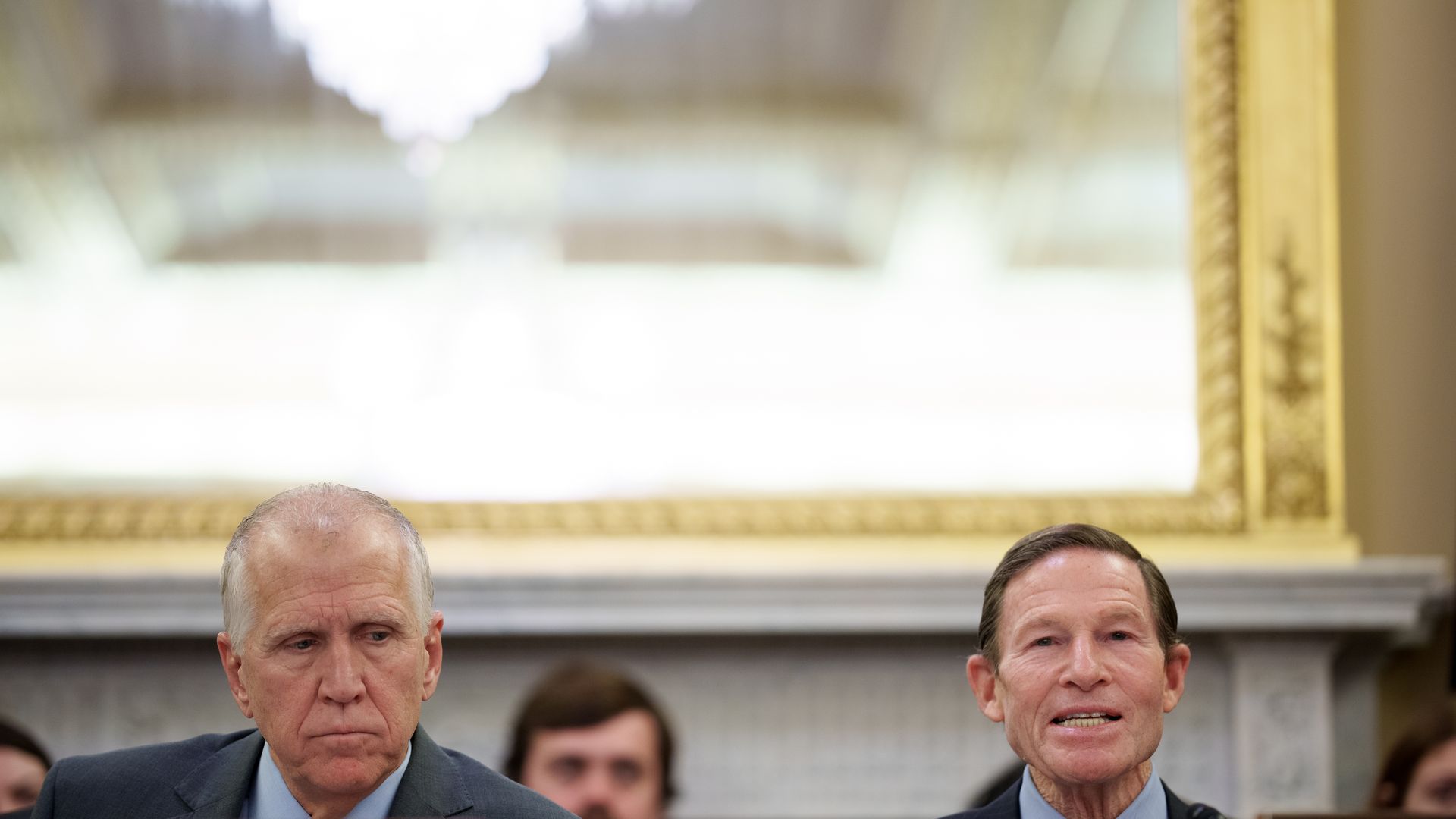
Sens. Thom Tillis (R-N.C.) and Richard Blumenthal (D-Conn.) appear at a committee hearing in February 2025. Photo: Andrew Harnik/Getty Images
Ukrainian President Volodymyr Zelensky on Monday lobbied a bipartisan group of senators to press the Trump administration to remove what he claimed are restrictions on intelligence sharing and weapons supplies.
Why it matters: Ukrainian officials say the Trump administration has quietly imposed these limits without admitting it publicly in an attempt to press Zelensky to accept a deal to end the war that includes more concessions to Russia.
- Trump and White House officials have denied for days that they've imposed any restrictions on Ukraine.
Driving the news: The crisis began 10 days ago when Trump announced a diesel deal with Russia during a round of negotiations between his envoys and Ukrainian officials in Miami.
- The Ukrainians claimed that Trump envoys Steve Witkoff and Jared Kushner threatened that Trump could cut off Ukraine from U.S. intelligence and stop selling weapons if it continued to ignore requests not to target Russian oil refineries.
- U.S. officials denied such a threat. They said Witkoff and Kushner told the Ukrainians that the U.S. was a strong partner, providing munitions and intelligence. Ukraine therefore shouldn't take actions that hurt American consumers, Witkoff and Kushner said.
Behind the scenes: During a virtual meeting with a bipartisan group of senators led by Thom Tillis (R-N.C.) and Richard Blumenthal (D-Conn.), Zelensky laid out the various problems Ukraine has been experiencing since the Miami meeting. Axios obtained a transcript from Ukrainian officials.
- Elon Musk's Starlink and the U.S. military's Starshield satellite systems remain partially restricted — despite claims by the White House to the contrary. "We still have no explanation for this. Just different strange stories we're hearing, unfortunately," Zelensky told the senators. It's hampering Ukraine's ability to shoot down Russian attack drones, he added.
- On three occasions the past week, including on Sunday, Ukraine didn't receive early warnings from the U.S. about Russian ballistic missile attacks, Zelensky said, suggesting it was a sign that intelligence sharing has been curbed. "We have received no clear explanation from Washington – why this is happening," he added.
- Zelensky said Defense Secretary Pete Hegseth is not signing off on the delivery of Patriot interceptors and AIM-9x missiles for the NASAMS air-defense system, even though NATO countries have already paid for them. "We have almost no Patriot interceptors left from the U.S. partners," he said.
- "All of this suggests that some political decision has been made to slow down support for us," Zelensky said. "We want to understand what is happening, why it's happening, and where all of this is heading."
What they're saying: Tillis said after the meeting that Congress "remains committed to standing with Ukraine and our European allies to end Russia's brutal aggression and secure lasting peace."
- Blumenthal said afterwards that "bipartisan support for Ukraine was clear and unequivocal, which we'll be expressing in upcoming action."
- "Appeasement won't work with Putin, a thug who understands only strength and force," he added.
The other side: President Trump told reporters on Monday that the U.S. is still sharing intelligence with Ukraine and said he didn't know who ordered the throttling of the Starlink satellite system. "But I am gonna find out," he said.
- "Frankly Zelensky is not helping matters much. He doesn't want to stop the war. Zelensky doesn't know what he is talking about," the president said. "Maybe it's time for Zelensky to let somebody else negotiate on behalf of Ukraine. … We have given a lot to Ukraine. They have given nothing to us."
State of play: Zelensky spoke with Witkoff and Kushner on Sunday.
- They asked Ukraine again to stop attacking Russian oil refineries, Ukrainian officials said.
- Zelensky told the senators that he proposed to the U.S. envoys that Ukraine halt strikes on refineries for 30 days. In return, the U.S. would supply Ukraine with Patriot interceptors so it could defend itself from Russian ballistic missiles during that 30-day period.
- Zelensky told the senators that Witkoff and Kushner haven't shown any openness to the idea.
What to watch: Zelensky told the senators that he'll be in Oslo, Norway next week and could meet with Witkoff and Kushner on Tuesday or Wednesday. Kushner and Witkoff could then continue on from Oslo to Moscow to meet with Putin, a source familiar with the matter said.
