The Treasury market has been acting weird lately

Add Axios as your preferred source to
see more of our stories on Google.
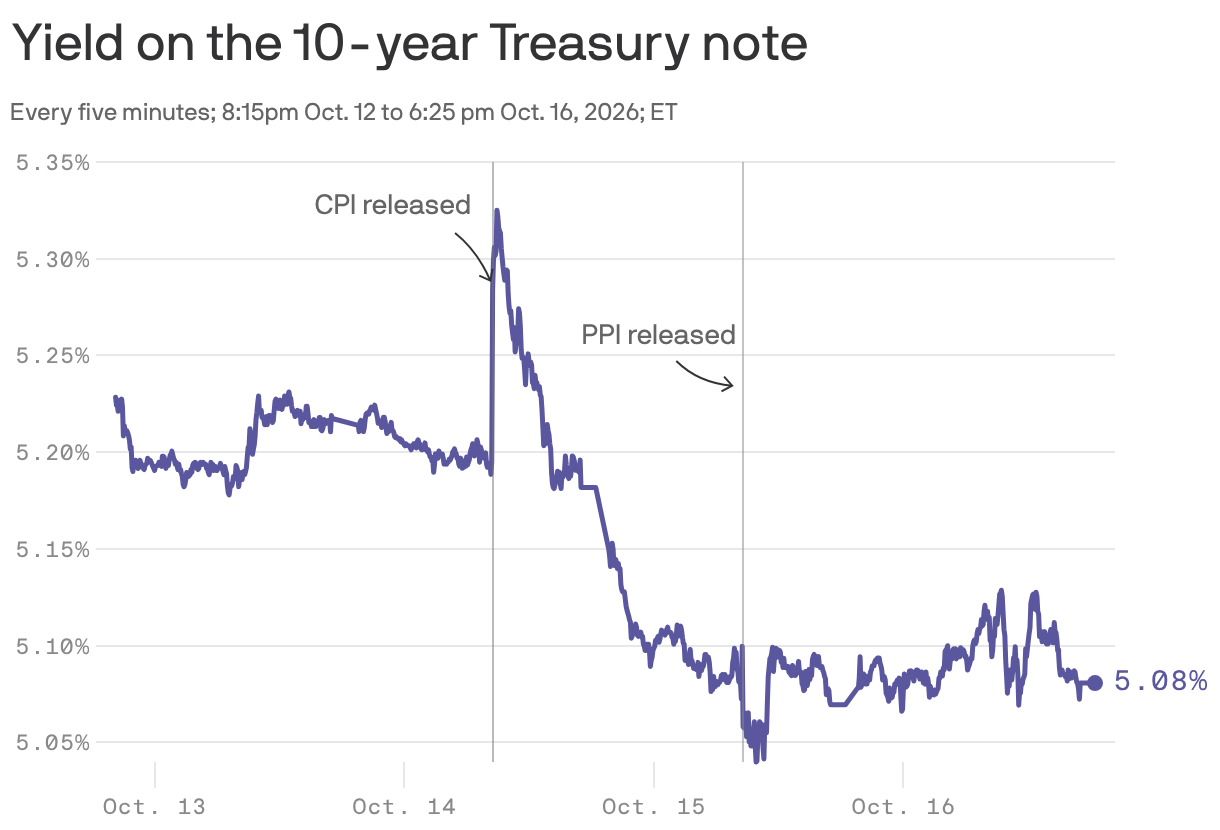
It got kind of wild in the U.S. Treasury market last week: The yield on the benchmark 10-year note swung in surprising ways as investors digested hot inflation reports and AI jitters.
Why it matters: Get used to it. Volatility could be a new normal.
Where it stands: The investors buying U.S. government bonds are different now. The share of buyers that are hedge funds, using borrowed money, has grown while foreign central banks have pulled back.
The latest: The share of U.S. Treasury securities held by official foreign entities like central banks, finance ministries and sovereign wealth funds fell to 11.8% in August, data out Friday from the Treasury Department shows.
- That's down from 40% during the financial crisis era.
- Hedge funds and other investors appear to have filled that void. The share of Treasury securities held by hedge funds hit 33.5%, up from around 10% over that period, per an analysis of the data by Adam Josephson, founder of Sakonnet Research.
Of note: He uses a commonly understood proxy to come up with that hedge fund data: financial centers' share of foreign-held Treasurys in six countries, including the Cayman Islands and Belgium. These are countries where hedge funds typically domicile their money, and it also includes other kinds of private financial actors.
The intrigue: Whereas foreign governments are less price sensitive and more likely to buy Treasurys and chill, hedge funds trade more actively, and they're using leverage to do it — that's a recipe for volatility.
- At the same time, the U.S. government is issuing more and more debt.
- "There's ever more supply, and someone has to step in to absorb it and that someone is increasingly price sensitive, highly leveraged buyers," Josephson says. "It's only natural to see higher volatility."
Catch up quick: The week started off with the yield on the 10-year Treasury note at 5.23% — a level last seen during the run-up to the financial crisis.
- A hot CPI report Wednesday briefly sent the 10-year yield up over 5.3% before it fell back to around 5.08% by Friday. (Remember that when it comes to Treasury securities, small movements carry big meanings.)
- It was the biggest weekly decline since April 2025, notes Jim Reid of Deutsche Bank this morning (aka around Liberation Day).
What's weird is that the yields fell even though the market saw two different inflation reports that showed prices heating up. Typically, that would mean yields would rise as investors adjusted to higher inflation expectations.
- Wall Street analysts said that this was a flight to safety as the AI trade wobbled — chip stocks were down for the week — and investors decided to buy less-risky Treasury notes and bonds.
- That increased demand drove up prices, which move inversely to yields.
Yes, but: This is a massive market, and no one actually knows for sure what happened.
Between the lines: More volatility in the U.S. bond market could mean higher yields over the long term, Josephson says.
- That would mean higher borrowing costs for Americans taking out loans for houses and cars.
- And for the U.S. government itself. And that could get hairy.
Case in point: The federal government paid out $1.052 trillion in interest on its debt for the 2026 fiscal year, according to the Treasury Department.
- That's the country's third-biggest outlay after Social Security ($1.67 trillion) and Medicare ($1.07 trillion).
