The barriers to realizing AI's promise in health care

Add Axios as your preferred source to
see more of our stories on Google.
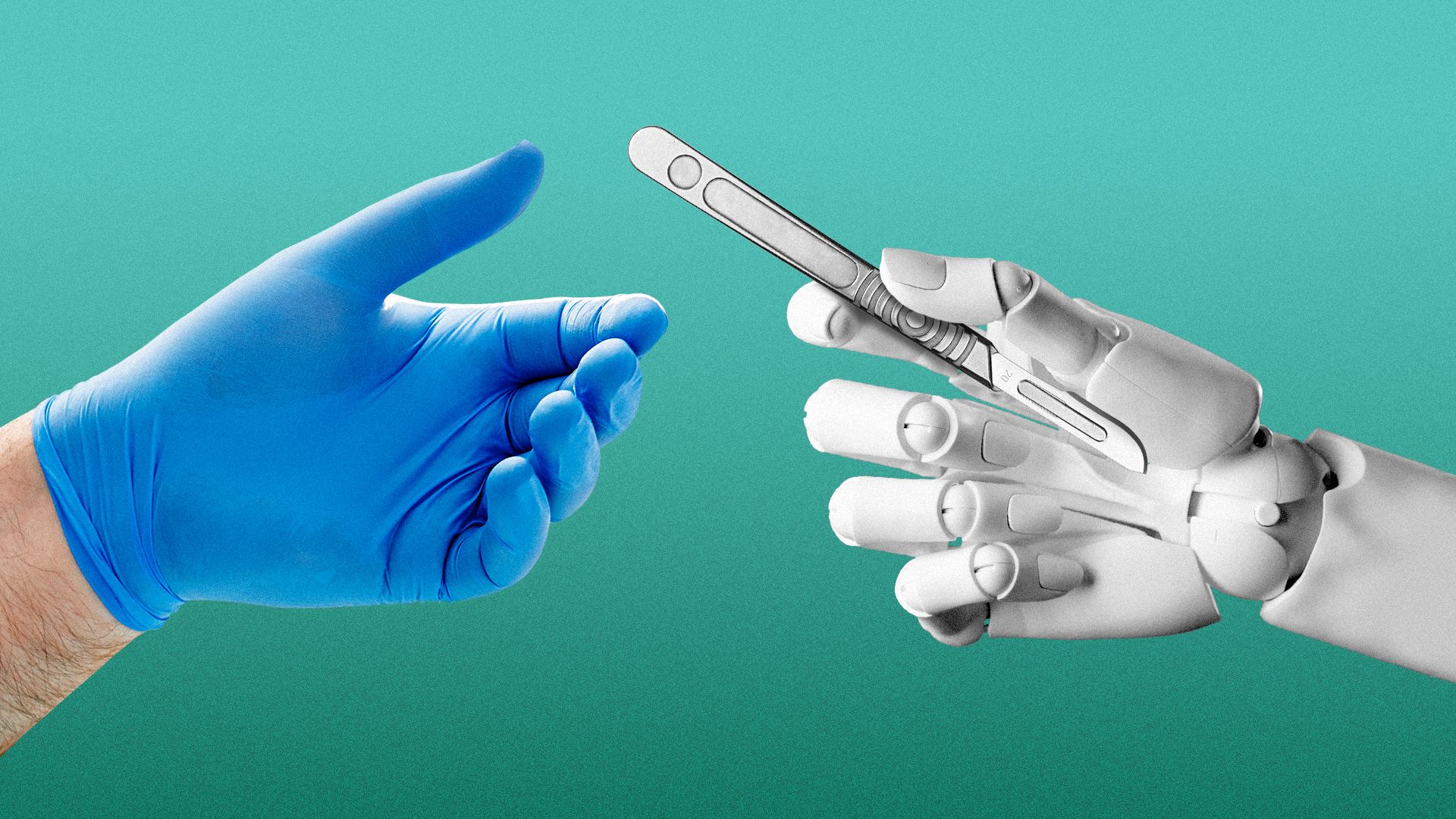
Illustration: Lindsey Bailey/Axios
The deployment of AI tools within health care could create a best-of-all-worlds system. But without coordinated intervention by both government and industry leaders, AI is likely to make the U.S. health sector even more expensive and wasteful, concludes a new Peterson Health Technology Institute report provided first to Axios.
Why it matters: The promise of AI in health care is likely to go unrealized without a radical rethinking of health care regulation and payment systems.
What they're saying: "This is meant to be a call to action," said PHTI executive director Caroline Pearson.
- "If we don't start doing something differently, we're going to layer technology on top of existing broken workflows, everything gets more expensive and we don't get the benefits we hope for."
The big picture: The U.S. health care system responds to financial incentives, and right now what's incentivized is more service volume and administrative complexity.
- So far, the use of AI has responded to those incentives, the report argues, and applications that fit well within the fee-for-service payment structure have spread most rapidly.
- Those uses are mostly administrative — like in billing and claims management — and are the ones that have received attention for spurring "bot wars" and driving up health care costs.
- Meanwhile, significant barriers stand in the way of adoption of AI in clinical care, despite the technology's potential to improve patient outcomes and reduce overall health costs.
Zoom in: The report argues that AI has the potential to improve some of health care's most stubborn, systemic problems.
- It decouples output from workforce size and capacity while allowing services to scale at lower marginal costs.
- And it enables human providers to monitor more patients, respond faster and spend more time on the uniquely human aspects of care delivery.
- AI ultimately has the potential to both improve patient outcomes and expand access to care while lowering costs — goals that have all long eluded the U.S.
Yes, but: None of this will happen without structural barriers to AI adoption in clinical care being addressed, per the report.
- Evidence standards, safety thresholds, outcome measures, performance benchmarks and post-deployment monitoring frameworks are underdeveloped. That means regulators, purchasers and users can't tell what works.
- Existing rules around technology use in health care weren't designed for AI, leaving big questions around liability, accountability, oversight and scope of practice.
- Clinical and administrative workflows weren't built for autonomous or AI-assisted processes.
- And perhaps most importantly, today's payment models weren't designed for technology that can perform clinical work.
Administrative uses of AI, by contrast, "are not regulated, and they can make money for the entities that adopt them," Pearson said.
- "So the current system incentivizes less efficient human labor because it's the only reimbursement model," she added.
What we're watching: Without a path to payment, some of AI's most promising clinical applications likely won't come to fruition — simply because the payoff isn't there to justify the investment needed to adopt and scale the technology.
The intrigue: Today's primary payment models aren't a very good fit for reimbursing for AI-provided or AI-assisted services, according to PHTI.
- The most prevalent one is fee-for-service, which pays providers for patient encounters.
- But AI's decoupling of clinical output from clinicians' time and labor, along with its enablement of long-term continuous care, makes fee-for-service a poor fit.
- Applying this kind of per-use payment system to AI use would likely cause large increases in health care spending.
But other common health care payment systems aren't great fits either, though some are better than others.
- While performance-based and capitated models shift incentives away from volume toward outcomes, they don't adequately incentivize the workflow redesign and other upfront investments of adopting clinical AI, according to the paper.
- Outcome-based payments incentivize providers to improve outcomes and reduce spending, which could create a business case for investing in AI and overcoming other barriers to adoption.
- But there's no single payment model that fits all AI uses across all clinical settings, PHTI concludes.
The bottom line: "There's obviously a big role for policymakers in terms of thinking about regulatory requirements, coverage rules, things like that," Pearson said.
- "The investors and the technology companies need to be thinking really hard about evidence generation and ongoing monitoring and guardrails."
- "And both public and private payers need to think very hard about payment models that will reward adoption but not increase spending."
