Trump's shadow docket blitz hits a new milestone

Add Axios as your preferred source to
see more of our stories on Google.
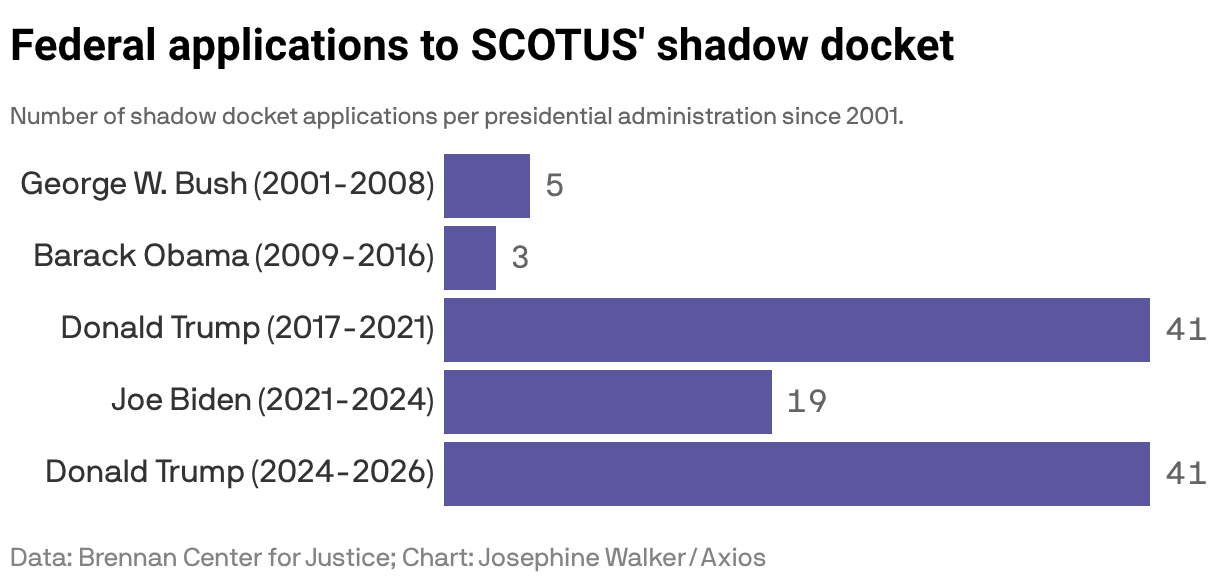
President Trump's administration on Monday filed its 41st application to the Supreme Court's shadow docket, a milestone that matches the total number of petitions it filed during his entire first term — in less than two years.
Why it matters: The record highlights how often the president has turned to SCOTUS to secure authority to temporarily revive policies blocked by lower courts.
What they're saying: "We have never seen an administration run to the Supreme Court with the speed and numbers that we're seeing out of the Trump administration this term," Stephen Spaulding, managing director of the Kohlberg Center at the Brennan Center for Justice, tells Axios.
- "Keep in mind that the shadow docket, the emergency docket, is used and should be used for actual emergencies," he says.
- "The administration continues to claim that they're going to face irreparable harm, and that this is an appropriate emergency for the Supreme Court to review, which we think, calls into question how the court's using the shadow docket in the first place."
The other side: "President Trump has faced a historically unprecedented number of injunctions by activist lower court judges," Lauren Bis, a White House spokeswoman, emailed Axios.
- "The reality is, with well over 20 Supreme Court victories the Administration's policies have been consistently upheld as lawful. President Trump will not stop implementing the America First agenda that he was elected on."
How it works: The emergency, or shadow, docket lets parties seek expedited Supreme Court intervention before a case completes the ordinary appeals process.
- The court can, for example, pause a lower court's injunction and allow a policy to take effect while litigation continues.
- The orders are often issued unsigned and without explanation, complicating how lower court judges apply the orders to future cases.
By the numbers: The second Trump administration filed its 41st emergency application Monday.
- The Biden administration made 19 requests over four years.
- The Obama and George W. Bush administrations made eight requests over their combined 16 years in office.
- Obama made three, and Bush made five.
Driving the news: The 41st application asked the court to allow the Bureau of Prisons to reimplement a policy cutting off some gender-affirming care for incarcerated transgender people.
- U.S. District Judge Royce Lamberth, a Reagan appointee, ordered the administration last month to continue providing care to people with gender dysphoria while a challenge to one of Trump's 2025 executive orders and a subsequent Bureau of Prisons policy plays out.
Zoom in: Spaulding says judges' "primary tool by which they wield power" is to "explain themselves" and why they ruled a certain way.
- They "explain their rationale, explain their judgment, and what we've seen time and time again on the shadow docket is, in many cases, the court doesn't explain itself, and as such, is not really acting like a court."
- Spaulding contrasts that with lower court judges who "have taken the time to really consider the briefs. District court judges really are on the front lines of having to evaluate the claims that litigants are bringing."
Zoom out: Justices Ketanji Brown Jackson and Elena Kagan have criticized the use of emergency docket applications to circumvent the traditional legal process.
- Jackson said Thursday during a law school speech that the frequent use of the shadow docket was "having an enormously disruptive and potentially corrosive effect" on the courts.
- Spaulding tells Axios that consistently using the docket could have "consequences for people's trust and confidence in our democracy" at a time when approval ratings of the Supreme Court are at record lows.
Go deeper: Supreme Court joins Trump, Congress in job approval slump
Editor's note: This story has been updated with comment from the White House.
