Wayve brings a new approach to robotaxi race

Add Axios as your preferred source to
see more of our stories on Google.
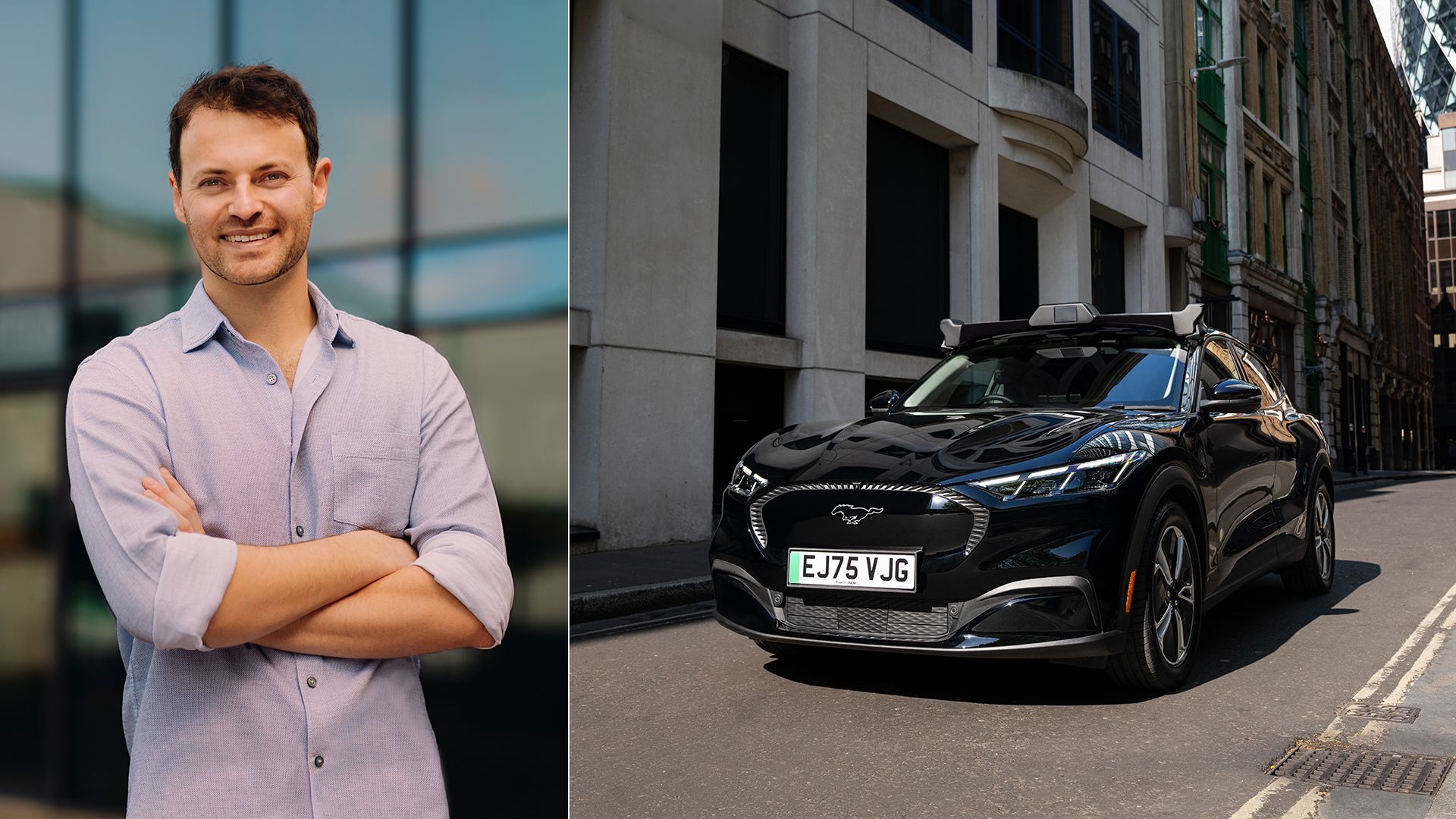
Wayve CEO Alex Kendall; Wayve's first robotaxi in London. Images: Courtesy of Wayve
Wayve spent nearly a decade developing a radically different approach to self-driving cars that others ridiculed but then eventually copied. Now comes the harder part: turning it into a business.
Why it matters: As the British startup moves from R&D to commercialization, it's pursuing an equally unconventional business model — licensing its autonomous-driving AI to automakers and fleet operators rather than building cars or running its own robotaxi network.
Driving the news: The transition is starting to become visible.
- Wayve recently launched its first public robotaxi service with Uber in London — albeit a tiny fleet with safety drivers behind the wheel — and plans to launch next in Tokyo.
- It has also signed technology deals with Nissan and Stellantis covering both personally owned vehicles and robotaxis.
- And Wayve is expected to name Waymo's former chief financial officer, Elisa de Martel, as CFO to lead its next stage of growth, Axios has learned. More executive hires are coming soon, the company says.
The big picture: Wayve cofounder and CEO Alex Kendall, an engineer and AI researcher, sees three distinct approaches to autonomous driving emerging.
- "You've got Waymo building their own fleets, Tesla building their own cars, and Wayve looking to provide the intelligence to everyone else that wants to operate fleets and vehicles," Kendall told Axios.
- "We want...to be the intelligence layer that powers all vehicles anywhere," Kendall said.
From the start, Wayve did things differently. It made an early bet on end-to-end AI, an approach in which models learn how to drive and can generalize to unfamiliar roads, rather than relying on high-definition maps and extensive hand-coding.
- Tesla would eventually pivot to the approach. And newer entrants, including Waabi, Motional and others, have as well.
Wayve's technology, however, occupies a middle ground with its competitors.
- Unlike Tesla, Wayve doesn't rely exclusively on cameras. Its AI is designed to use cameras, radar and lidar — the sensor redundancy favored by Waymo, which has been critical of tech that relies purely on end-to-end systems.
- Kendall calls that the "best of both worlds": generalizable AI without HD maps, paired with multiple sensors for safety.
Follow the money: Wayve's licensing model potentially gives it access to a vast chunk of the auto industry.
- Tesla makes roughly 1% of the world's cars, Kendall notes. Wayve wants to provide autonomous-driving software for automakers making the other 99%.
Reality check: That's an aspiration, not a market share forecast.
- Wayve faces plenty of other competitors, including Nuro, May Mobility and Mobileye, which are also pursuing a licensing model.
- But unlike Waymo and Tesla, it doesn't need to persuade consumers to use a Wayve robotaxi or buy a Wayve car.
Another big bet Wayve is making is its belief that today's driver-assistance systems can evolve progressively toward full autonomy.
- "We are seeing direct growth from L2 to L3 to L4," Kendall said, referring to the industry's various levels of autonomy.
- That's a philosophical split with Waymo, which argues that driver assistance and fully autonomous driving are fundamentally different problems.
Between the lines: That makes Wayve's consumer-car business an important part of its robotaxi strategy.
- Kendall calls it a "superpower," providing Wayve with automaker relationships, vehicle integration, driving data and revenue — all of which can accelerate its push toward driverless cars.
The bottom line: Wayve is well behind Waymo, the robotaxi leader.
- But if Wayve can prove its AI can move easily from one vehicle, city and level of autonomy to another, its late start in robotaxis could matter less than its ability to scale.
