Supreme Court strikes down USPS mail-in voting rule

Add Axios as your preferred source to
see more of our stories on Google.
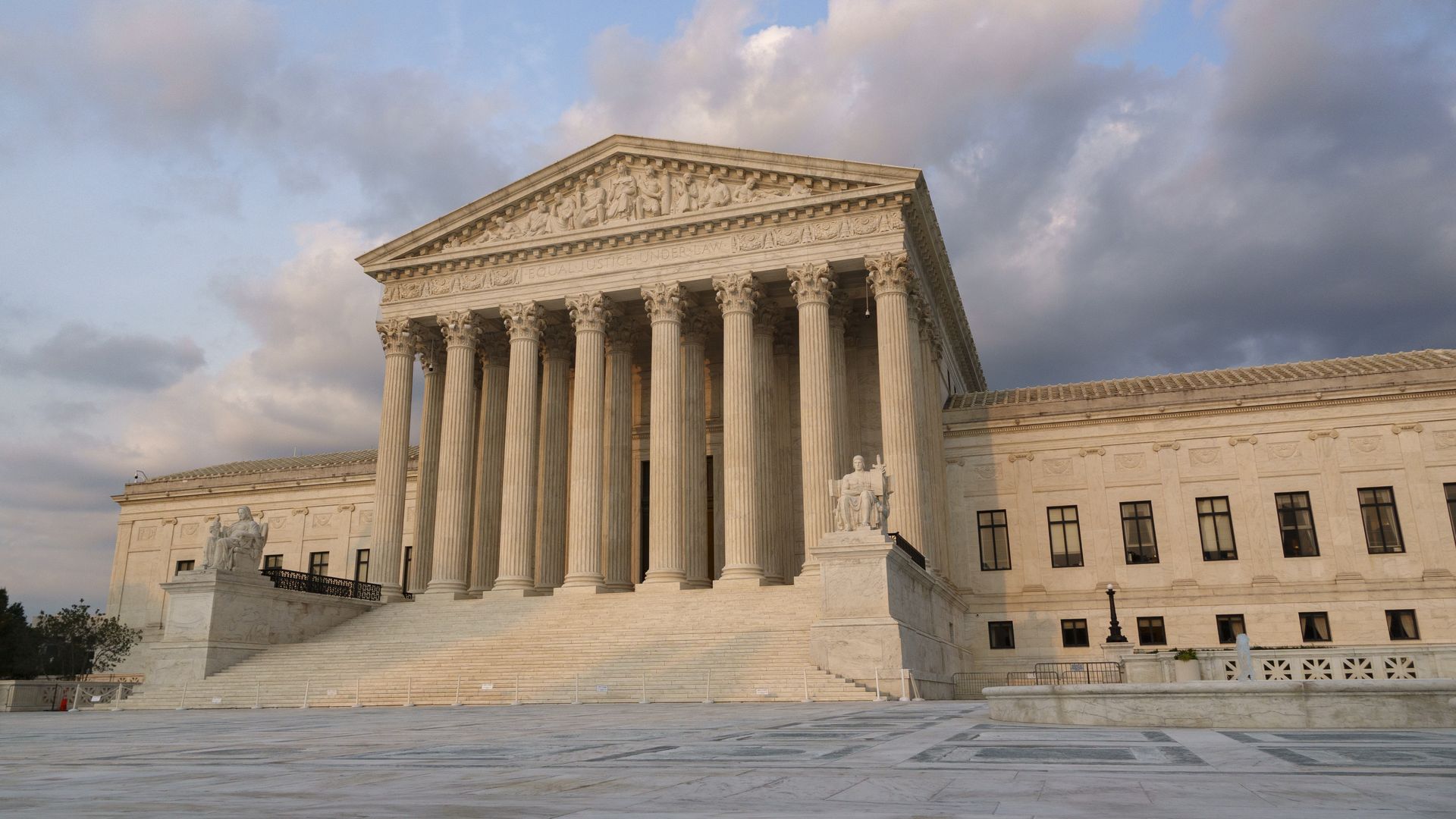
The U.S. Supreme Court is seen at sunset on August 12 in Washington, D.C. Photo: Kevin Carter/Getty Images
The Supreme Court struck down the U.S. Postal Service's rule restructuring mail-in voting Monday, halting a major Trump administration priority.
The big picture: The 7-2 decision is a major win for voting rights advocates and the states that challenged the administration's plan; it also reverses the Supreme Court's earlier green light for President Trump's mail-in voting order.
- The justices' prior unsigned order allowing the rule to proceed was not a ruling on the merits — but this time around, they decided the government is "unlikely to succeed on the merits of its challenge."
- The rule would require states to submit lists of eligible voters to USPS, and the agency would then verify that those voters were receiving mail-in ballots before sending them out. The rule also had strict requirements on envelope design.
Driving the news: While the court rejected the administration's stance, at least one concurring justice disagreed on the merits of the case.
- Justice Brett Kavanaugh wrote in a concurring opinion with fellow Justice Ketanji Brown Jackson that "there is at least a fair prospect that the final rule falls within the Postal Service's statutory authority" but that applying the proposed rules would be "arbitrary and capricious" for the midterm elections as state and local officials "do not have sufficient time to reasonably implement the rule."
- Justices Samuel Alito and Clarence Thomas dissented in a separate opinion.
- In their opinion, they called the filings claiming harm by some plaintiffs "cryptic" and that the USPS has the authority to implement a rule because Congress has empowered it to do so.
Zoom out: The decision is likely the final say on the rule during this election cycle, with even U.S. District Court Judge Indira Talwani saying from the bench earlier this month that it was unclear how the government would implement the plans with November just around the corner.
- Steven Monteith, executive vice president at the Postal Service, said in a declaration filed Sept. 3 that the agency continues to make "refinements" to the portal, which he predicted would be available for "voluntary use by sometime next week."
- He added that under Talwani's restraining order, USPS was not mandating design review for state mail but has made review available for states that want to "voluntarily submit" envelopes to ensure they comply with the rule.
- The case has been full of legal twists and turns, with Talwani blocking key parts of the rule last month and a second judge doing the same earlier this week.
Friction point: While the administration has dismissed concerns, a USPS whistleblower recently alleged that the agency defied court orders and rushed to build out the new ballot system, putting thousands of mail ballots at risk.
- The whistleblower said the Postal Service built the system in weeks, not the nine months to a year typically needed for a project of this complexity, Axios' Andrew Pantazi and Donica Phifer reported.
The bottom line: The rule is just one front in the myriad ways the administration has tried—at times, unsuccessfully—to reshape elections, as seen in attempts to obtain state voter rolls and redraw congressional maps.
- Some of those efforts have been snuffed out in the courtroom, while others could have real impacts in November.
Editor's note: This story was updated with additional information throughout.
