How Warsh can avoid a repeat of July's communications mess

Add Axios as your preferred source to
see more of our stories on Google.
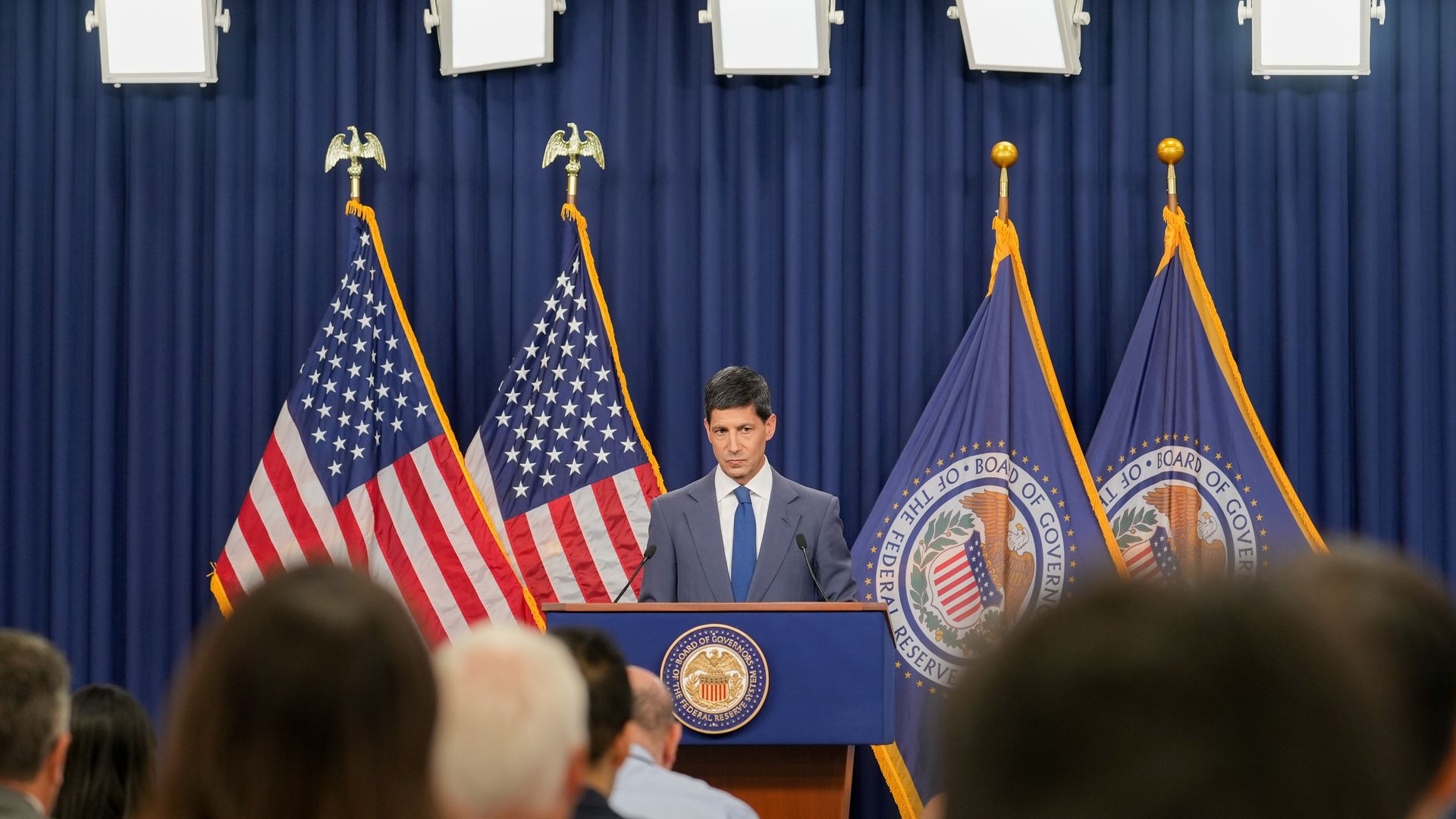
Fed chairman Kevin Warsh at a July news conference. Photo: Al Drago/Bloomberg via Getty Images
Seven weeks ago, Warsh took questions from the media, and it didn't go well. Markets sold off as he seemed vague and evasive about the reasoning behind the latest interest rate decision. Wednesday, he gets a do-over.
Why it matters: Investors will be thirsty for a more detailed explanation of the Fed's decision than the one Warsh offered in late July — even while respecting his intention not to give explicit guidance about future policy moves.
- Markets are pricing in a quarter-point increase in rates — but the why behind that likely move is more significant than the act itself, for what it says about the Fed's analytical framework under its new leadership.
- And if the Fed's policymaking Federal Open Market Committee elects to leave rates unchanged, Warsh will have an even trickier communications task, lest the bond market again start to question Warsh's willingness to use interest rate policy to keep inflation in check.
State of play: Assuming the Fed raises rates, does it reflect a belief that seemingly one-off changes to prices from tariffs and the energy shock are turning out to be more prolonged than previously thought?
- Or is AI-fueled investment creating more sustained inflationary pressure? Is it simply that the neutral interest rate is higher than it seemed?
- Not all interest rate adjustments are created equal. A "mid-cycle adjustment," like the three rate cuts enacted in 2019, or a "recalibration" or an "insurance move" imply different things from something like a "normalization" or a sustained policy tightening.
Between the lines: Of course, each of these potential answers has implications for what the Fed will do next, in tension with Warsh's deeply held desire to avoid anything resembling "forward guidance."
- Moreover, different officials on the policy committee may have different rationales for a rate hike (or for not hiking), and as chairman Warsh has an obligation to accurately describe the range of views.
- But there's a pick-your-poison dilemma he faces. If the Fed chairman fails to lay out a coherent framework and rationale for a policy move (or no move), people naturally start to wonder if there is one.
What they're saying: "We expect that he will frame the hike as a way to ensure that inflation returns to target in an acceptable timeframe," Christopher Hodge and Selin Aker at Natixis wrote in a note out this morning.
- "We also think that he will emphasize that this decision was discrete and does not pre-commit the Fed to any actions in subsequent meetings, giving him and the Committee maximum flexibility to respond to shocks."
The bottom line: They teach us in the journalism business to ask the "who, what, when, where and why." At Wednesday's press conference, the first four will already be known.
- Who = Kevin Warsh and the FOMC; what = an interest rate move or no move announced half an hour earlier; when = 2:30pm ET; where = the William McChesney Martin Jr. Building.
- That leaves "why," which is the question that traders worldwide will be most eager to hear.
