Why stocks are shrugging off rising interest rates

Add Axios as your preferred source to
see more of our stories on Google.
The escalating war with Iran and rising energy costs helped push up borrowing costs across the U.S. economy last week. Stocks largely yawned.
Why it matters: It suggests that investors think it will take more than higher interest rates to slow the engine powering much of the market.
The latest: The yield on the 10-year U.S. Treasury climbed to 4.97% Friday, near 2007 levels. A month ago, it was at 4.69%.
Zoom out: That Treasury yield serves as the foundation for borrowing costs throughout the economy, from car loans to mortgages to multibillion-dollar corporate bond offerings.
Those additional costs are a big part of the reason higher interest rates have long been seen as stock market kryptonite.
- But this year's higher rates and even the jump over the last few weeks haven't clobbered stocks — at least not yet.
- Year to date, the S&P 500 is up about 12%. Even with the run-up in yields last week, the index ended down less than 1%.
Between the lines: What accounts for the stock market's resilience? Profits, for one thing.
- S&P 500 companies have posted rip-roaring profit growth in recent quarters, including a jump of more than 50% in earnings in the most recently reported quarter, compared with the prior year.


- And what accounts for those profits? Any regular reader of Axios Markets knows the answer: It's the massive amount of capital spending for the AI boom.
Yes, but: More and more, that boom is being funded by borrowing. So shouldn't rising rates and borrowing costs throw at least some sand in the gears?
- In theory, the answer is "yes."
- But in practice, it can also be "no."
Zoom in: In competitive industries, higher rates would be something of a problem, as they would ultimately start to cut into relatively low expectations for profitability.
- If rising rates eat away deeply at those expected returns, the payoff on investing to build that business is no longer worth the squeeze.
Reality check: But AI doesn't really exist as a profitable business yet.
- So the profits are largely in the form of expectations in the minds of investors, analysts and executives.
- And as you might expect, they are sky-high.
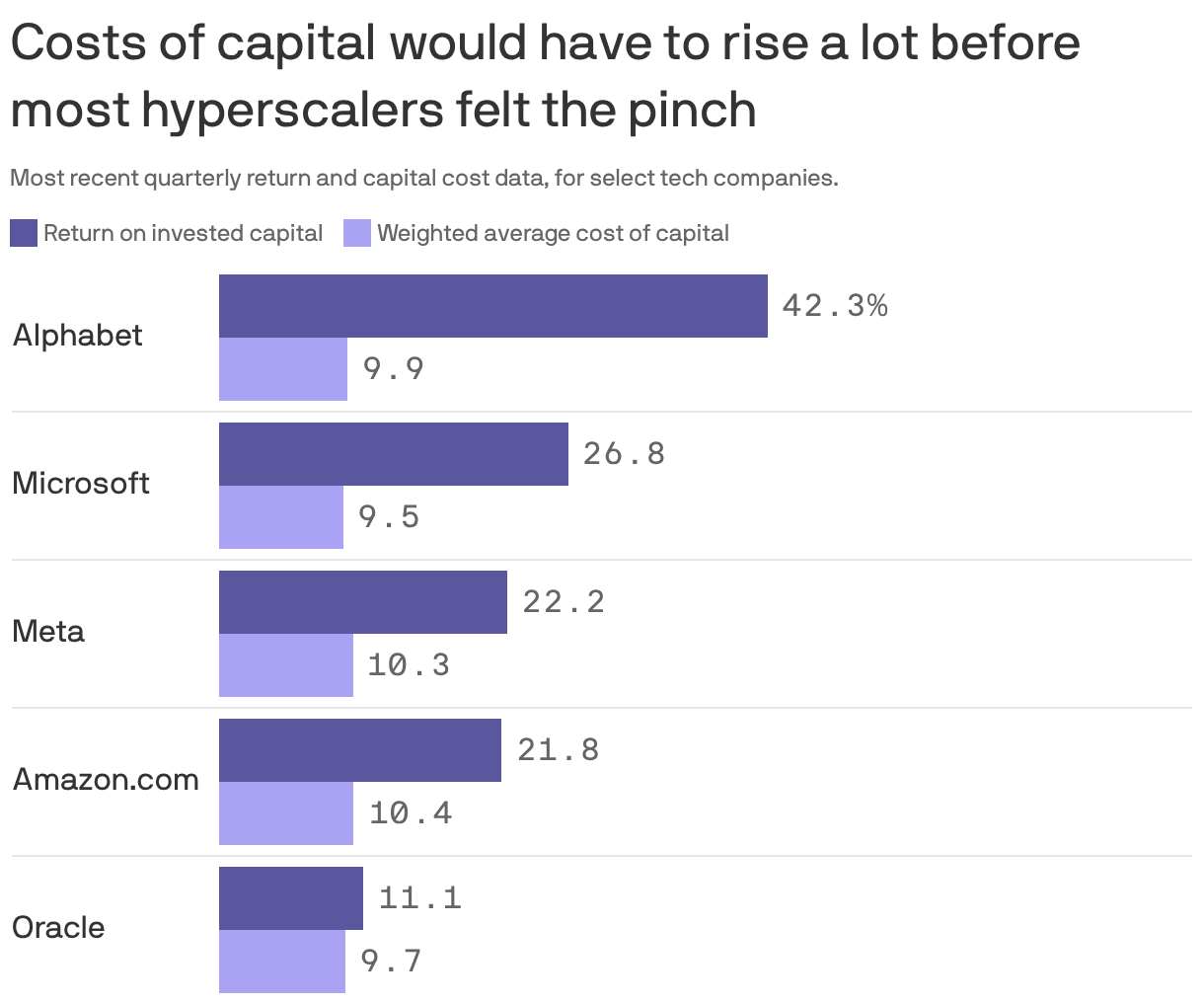
Stunning stat: A recent report from Morgan Stanley analysts estimated that hyperscalers could generate roughly $12 billion of after-tax operating profit per gigawatt of computing power, which would be a return on invested capital of roughly 30% — an unusually lucrative opportunity.
- Morgan Stanley analysts also sketched out a number of paths for hyperscalers and AI players that could lead to between 25% and 50% returns on invested capital, or ROIC. That's the key metric that everyone is watching on AI profitability.
The bottom line: When expectations for profitability are that high, it would take an enormous increase in borrowing costs to make a dent in profit expectations big enough to quell the AI boom.
What they're saying: "When you have 25%+ ROIC expectations, the sensitivity to the cost of borrowing for some of these companies is substantially less," Morgan Stanley fixed-income analyst Vishwanath Tirupattur tells Axios.
- "It doesn't mean that borrowing cost doesn't matter. It means that in a certain range, for certain issuers, it's less sensitive than some others."
The big picture: This is what happens during a market boom.
- If additional borrowing expense doesn't really matter to investors — who are willing to pay a few extra percentage points in financing for the opportunity to make life-changing returns — it sometimes means rates have to go a lot higher than people expect before things cool off.
