Why Trump can't rename New Mexico as "New America"

Add Axios as your preferred source to
see more of our stories on Google.
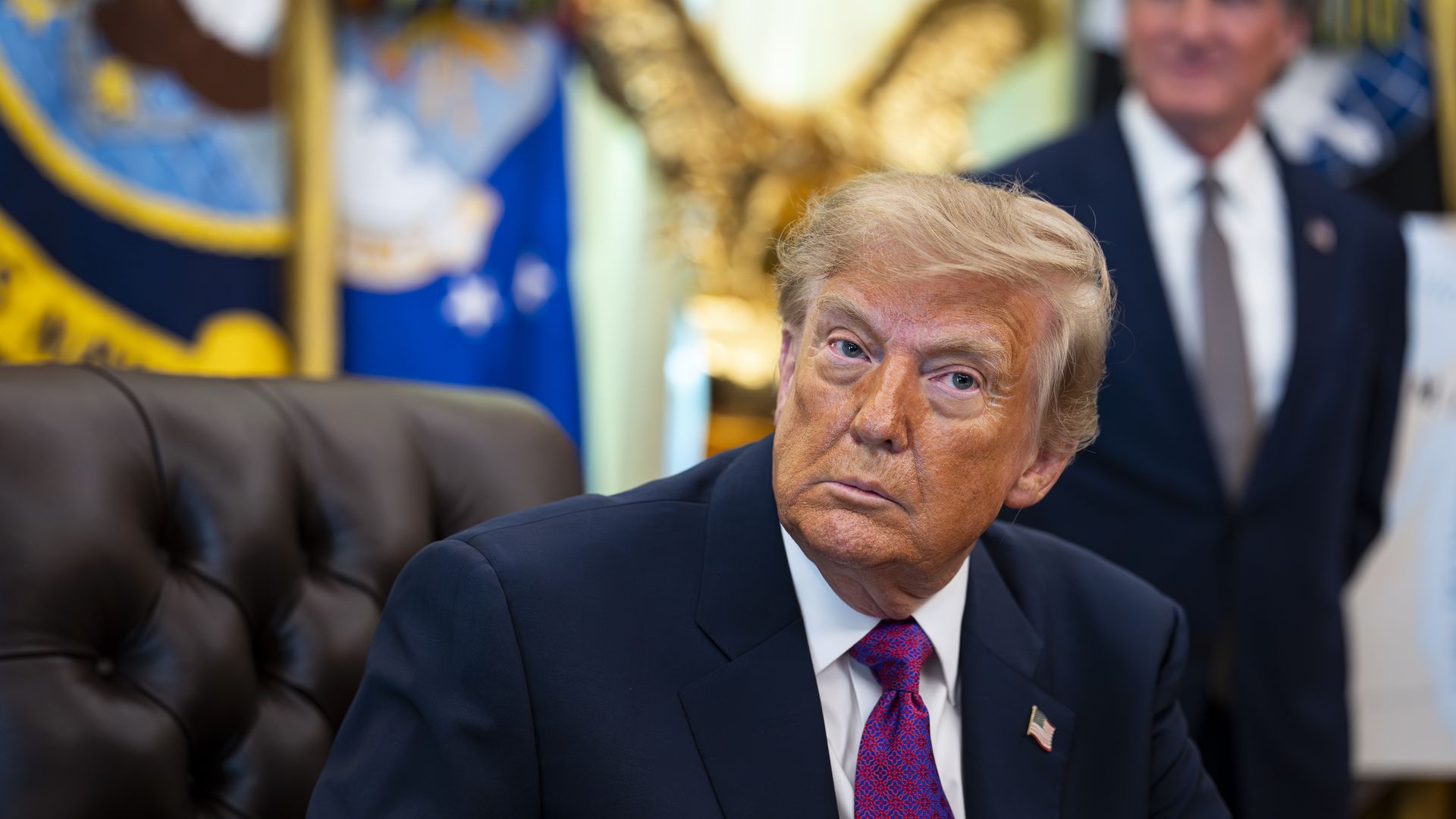
President Trump sits beside Interior Secretary Doug Burgum in the Oval Office during an event to rename Lake Ontario "Lake America." Photo: Al Drago/Getty Images
If President Trump wants to rename New Mexico "New America," it would require a legal lift that he doesn't control.
The big picture: New Mexico's name is written into its constitution, putting an official name change beyond the president's unilateral power.
- The proposal follows Trump's previous efforts to rename geographic locations in ways that invoke America.
Driving the news: Over the weekend, Trump teased multiple times renaming the southwestern state of New Mexico as "New America."
- This echoes similar moves Trump has made to rename Lake Ontario as Lake America as he did last month, and renaming "Gulf of Mexico" as "Gulf of America" in 2025.
Reality check: New Mexico's legal name
Zoom in: New Mexico's state constitution outlines the state's naming directly in Article I, titled "Name and Boundaries."
- It reads: "The name of this state is New Mexico," and then explains the state's territorial boundaries.
Changing that would require the state to amend its own constitution.
- An amendment would require New Mexico voter approval.
How New Mexico could become "New America"
How it works: For New Mexico to rename the state through an amendment, the constitution requires all elected members of each chamber of the state's lawmakers to approve the proposed amendment.
- That amendment would then go before New Mexico voters at a regular election or a qualifying special election.
- Voters would then need to approve the amendment.
Case in point: This has happened before elsewhere. In 2020, Rhode Island changed its official state name through a state constitutional amendment.
- The ballot asked voters to rename the state from "State of Rhode Island and Providence Plantations" to "State of Rhode Island." Roughly 53% of voters approved the name change.
Congress is not involved in that process. Federal law only requires congressional consent when creating a new state, splitting an existing state or combining two states.
- Creating a new state out of an existing state would require a state's legislature to approve the idea, too.
Trump's way to rename New Mexico
Yes, but: Trump could call on federal agencies to use "New America" in their references to the state.
- Federal law gives the Interior secretary and the U.S. Board on Geographic Names broad power to maintain uniform naming conventions throughout the federal government.
- Trump's Lake Ontario order relies on that authority, directing the Interior Department to use "Lake America" in federal references to the body of water.
Any federal change would not require businesses, organizations or nonfederal agencies to follow suit.
- That said, Google and Apple both changed their map apps to include the new Lake America moniker. MapQuest decided against it.
Why Lake America, Gulf of America were easier
Lake Ontario's name change was different because it was mostly a federal naming decision and did not change Canadian law or require mapmakers to follow suit.
- The U.S. Geological Survey explains the move is for federal use.
Flashback: Trump used presidential power to direct the federal government to adopt the Gulf of Mexico name change.
- There's no precedent for a president rewriting a state constitution.
The bottom line: Trump could encourage the federal government to shift how it refers to New Mexico, but that won't actually change the state's name.
Go deeper: Trump's Canada antagonism vexes Americans
