Axios interview: Altman sees revenge of "idea guy"

Add Axios as your preferred source to
see more of our stories on Google.
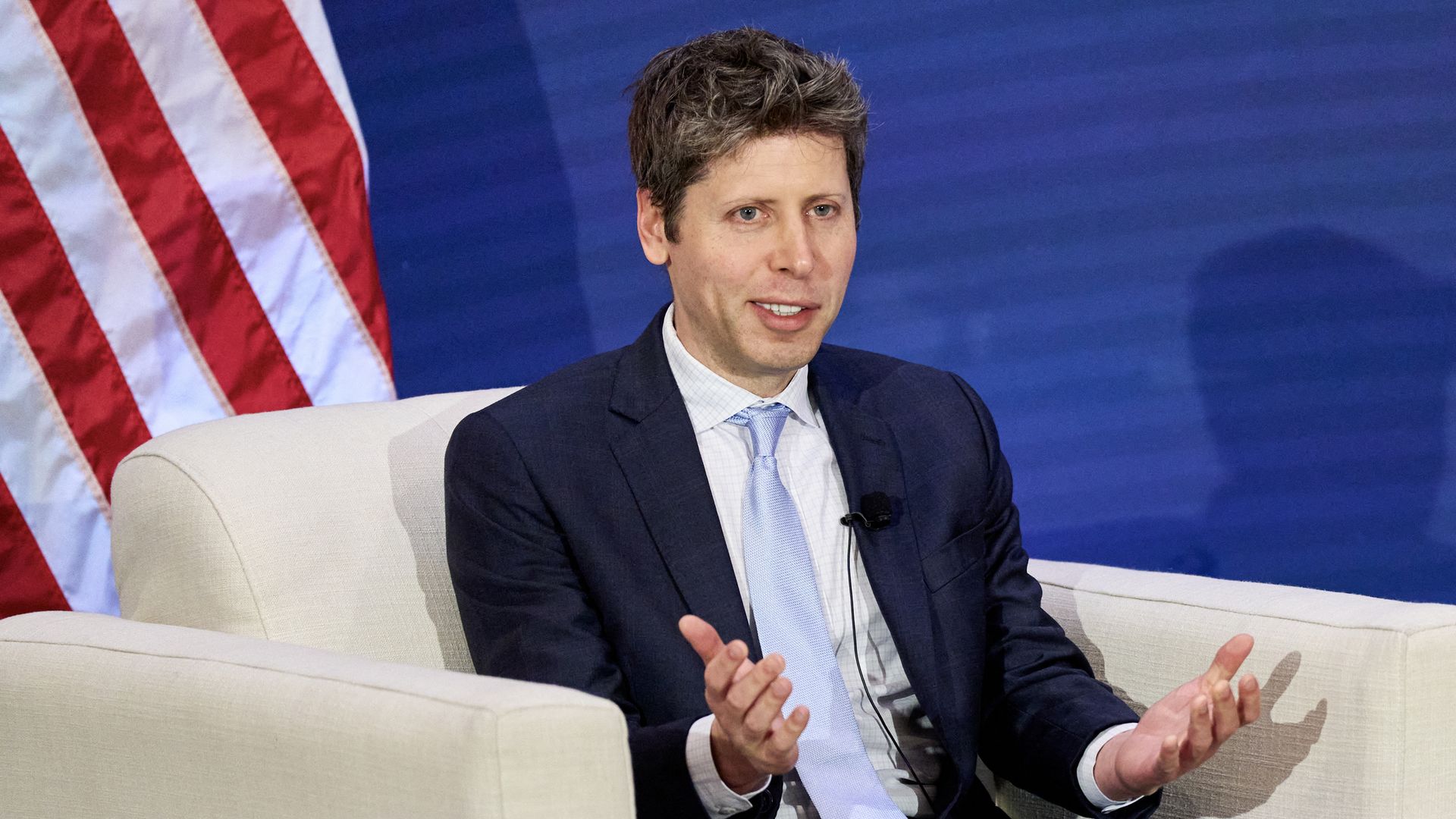
OpenAI CEO Sam Altman speaks Wednesday during the G20 Innovation Ministerial in Chapel Hill, N.C. Photo: Matt Ramey/AFP via Getty Images
OpenAI CEO Sam Altman says this era is bringing the revenge of the "idea guy" — the once-annoying aspiring entrepreneur burbling about their brainstorm with no technical chops to pull it off.
- Altman says it would be like saying: "I have a great idea for a song. I just need that guy with the guitar to make it for me."
- "It really did strike me as ridiculous," Altman told me in Chapel Hill, N.C. "But now we're watching a whole generation of people iterate on ideas faster than they ever could. The economics have been reset for what it means to make a new small business or large business."
Why it matters: Polls show most Americans think the risks of AI outweigh the benefits, with data-center rage as a bipartisan bonfire in the midterms. Altman — who's trying to sell AI into a massive backlash — wants to remind Americans that amid all the real risks, AI can equal opportunity.
- "This is gonna be the best time in the world to do a startup," Altman said recently.
Reality check: These new tools are great for idea people. But most people are doers, not dreamers, and don't feel they have the time or AI skills to spin up a startup in their spare time.
- Our experience is that AI is a real unlock for a very small percentage of people who are idea generators or problem solvers, and in a position to put that into action.
By the numbers: An American startup boom ignited during COVID and continued through this summer. Filings of new-business applications have continued to set records in the chatbot era.
- The number of new U.S. businesses formed in the first half of this year, over 3 million, is the most for a January-June stretch in Census Bureau data going back to 2005.
The backstory: I first heard Altman's "idea guy" riff last spring, when he was talking onstage with Stripe CEO Patrick Collison, who asked how traits of successful founders were changing in this era.
- "We would make fun of these [idea] people," Altman said. "They weren't that successful. And it was kind of always personally annoying to me. All of a sudden it's like the revenge of the idea guys."
- "For a long time, the most important ingredient ... in a founding team was technical talent, and that's still very important. But now people who just really deeply understand their users and can't code at all, I want to fund those people. And that's a big turnaround."
That stuck in my mind. So when I sat down with Altman, 41, last week at the Carolina Inn in a bilateral meeting room during the G20 Innovation Ministerial, I asked him how that notion could be useful for today's AI users, or for people who should be wielding AI but are skeptics.
- With GPT-6 Astra, OpenAI's powerful new model, Altman said, "you can start and run a small business effectively. ... It's like anyone who wants to have a company now has genius-level employees in every area of expertise."
Zoom in: AI makes many ideas monetizable that never would have penciled out in the past. "I met this guy recently who had used [GPT-]5.6 to make a piece of software that he had sold to 50 people for, like, $500 a month ... He was so happy."
- "This would have cost you millions of dollars if you had to pay for software engineers," Altman told me. "All of a sudden you had an idea, you had this tiny corner of this tiny industry, there's one particular kind of task, and you were able to get software written for it. And of course people will pay for that."
- "With the new model [Astra], someone made a computer game ... probably only fun or funny to people that work at OpenAI. There is real economic value in this to a few thousand people. The economics of making a full computer game for a few thousand people never possibly made sense before. And now they do."
The bottom line: "Whether it's a little thing to make your own life more convenient or a big thing that can create a business that adds huge value to other people," Altman said, "the space of viability has increased dramatically."
Disclosure: Axios and OpenAI have a licensing and technology agreement that allows OpenAI to access part of Axios' story archives while helping fund the launch of Axios into four local cities and providing some AI tools. Axios has editorial independence.
