Why the relationship between stocks and bonds broke down

Add Axios as your preferred source to
see more of our stories on Google.
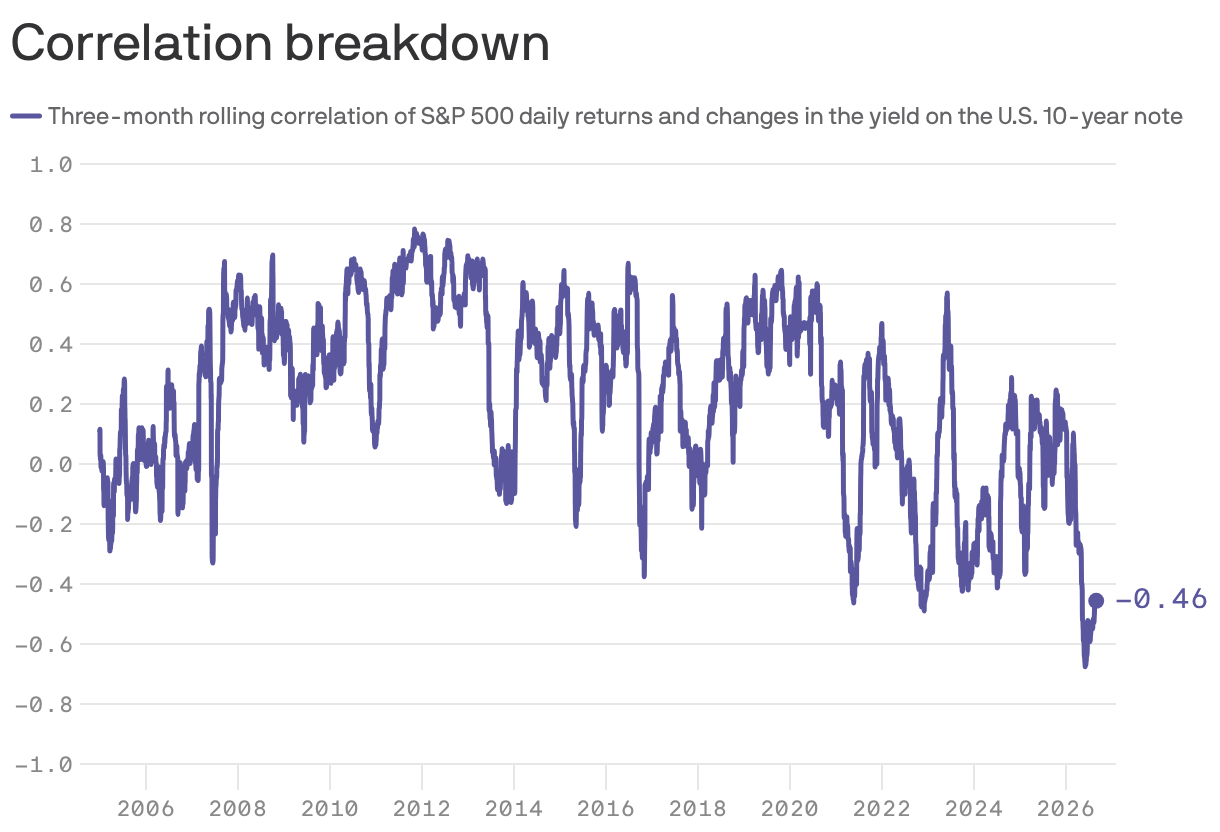
It used to be that if yields on U.S. government bonds were rising, you could pretty much assume that stocks would be on the upswing, too. Not anymore.
Why it matters: When such longstanding market relationships — known on Wall Street as "correlations" — change, it often mirrors adjustments in investor thinking that can set markets on a new course.
Big picture: For much of the last 20 years or so, it made sense that bond yields and stock prices tended to go up and down together.
- That's because bond yields were essentially being driven by the outlook for the U.S. economy.
- When yields were rising — such as during the early 2000s — it largely signaled strong economic growth. In such an environment — when corporate profits could be expected to be strong too — owning stocks makes sense. Voilà, stocks rose with bond yields.
- On the other hand, when bond yields were falling during the financial crisis, the drop reflected panic about the safety of the financial system and what that might mean for the economy. That's a bad environment for stocks. So stocks fell with bond yields.
The latest: Things have been a lot different of late.
- On days when bond yields have risen — due to the worsening war, rising oil prices, confusion over the direction of the Federal Reserve under Kevin Warsh and any other number of reasons — stocks have been more likely than not to fall.
- In fact, this negative correlation — Wall Street's term of art for markets that typically move in opposite directions — between changes in the S&P 500 and changes in the yield on the 10-year note has grown increasingly strong, with some readings of negative correlations hitting some of their most extreme levels in decades in recent months.
What they're saying: So what's going on? There are a few different interpretations.
- The correlation breakdown could reflect the new global economic reality of scarcity since the COVID pandemic hit, from the wars in Ukraine and Iran to the relentless demand for AI computing power. All result in higher pressure on prices, regardless of growth. In other words, high yields might not be saying much about whether the economy looks very strong, and therefore might mean it isn't a good time to buy stocks.
- As BlackRock chief investment strategist Wei Li put it in a recent column for the Financial Times: "What looks like a breakdown in the historical correlation between them may simply reflect a different macroeconomic regime."
- "When U.S. 10-year yields exceed 5%... the correlation tends to be negative, meaning that higher bond yields are generally associated with lower stock prices," Scotiabank analysts wrote. "This was broadly the case from the late 1960s through the late 1990s."
Growing uncertainty around U.S. government policy, meanwhile, could be playing a role in the breakdown of the relationship, Morgan Stanley analysts recently suggested.
- They spotlighted the Treasury Department's unusual recent intervention in the Treasury bond market, while doing little to control the growth of the federal debt.
- The breakdown of the yield-stock correlation was reminiscent of the market reaction to President Trump's "Liberation Day" tariffs in April 2025, when both stocks and bonds were rattled, they noted.
- "Investors began to grapple with whether the U.S. dollar and U.S. Treasuries are still safe havens," Morgan Stanley analysts wrote of the 2025 episode. "We think that investor debate is once again on the table."
