Here's what's at stake if the U.S. really is low on munitions

Add Axios as your preferred source to
see more of our stories on Google.
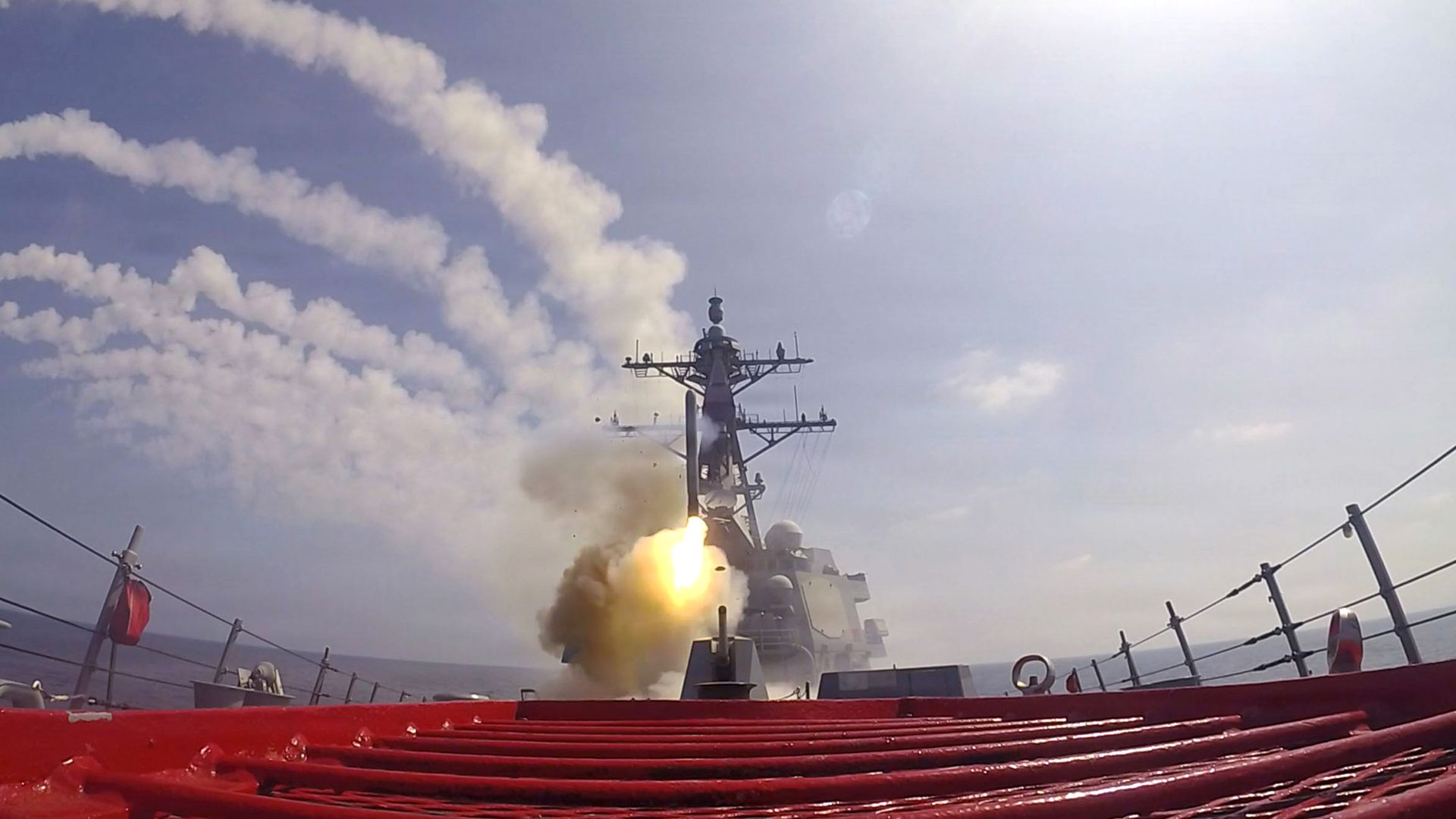
The USS Frank E. Petersen Jr. fires a Tomahawk missile during Operation Epic Fury on Feb. 28. Photo: U.S. Navy/Getty Images
President Trump is denying reports of a major U.S. munitions shortage as national security experts warn that key weapons inventories are running low.
The big picture: Depleted munitions inventories could constrain U.S. military options for years and leave American troops, bases and allies more exposed if attacked.
Driving the news: Trump said Thursday that reports on the military's low weapon stock "are actually treasonous" and inaccurate. He also suggested the U.S. has plenty of weaponry as the Iran war stretches into its sixth month.
- "We have virtually unlimited amounts of Mid to High Grade Ammunition, far more than we could ever use for this, or for any other War (which is highly unlikely!), that could improbably take place," Trump wrote on Truth Social Thursday.
State of play: The Iran war has been exacerbating a shortage of missile-defense weaponry since it began in February. The Department of Defense has made several deals to increase output, but it takes time to produce weapons, especially in the quantities the military needs.
- The Center for Strategic and International Studies has estimated the size of several U.S. weapons stockpiles and how long they could take to rebuild. Exact inventories are classified, so the figures are mostly estimates.
Here's what's facing a shortage and what it means for U.S. goals.
Patriot
What it does: The Patriot PAC-3 MSE interceptors are crucial for defending against incoming ballistic missiles, cruise missiles and most aerial threats.
The shortage: CSIS estimated in July that fewer than 840 remained as of July 27 after roughly 1,000–1,400 have been used in the Iran war.
The goal at risk: The U.S. keeps its own inventory of Patriot missiles, while also using them to help Ukraine defend against Russia. The U.S. also helps supply 17 other countries that use them.
When inventory reaches prewar levels: CSIS estimates the prewar inventory won't be met until mid-2029.
THAAD
What it does: The Terminal High Altitude Area Defense (THAAD) intercepts ballistic missiles at high altitude.
The shortage: CSIS estimated about 250 THAAD missiles remained by late July, down from about 450 before the war began.
The goal at risk: The THAAD is a crucial piece of inventory meant to protect military bases, troops and allies from attacks.
When inventory reaches prewar levels: CSIS suggests THAAD will reach prewar levels somewhere between mid- to late-2029.
Tomahawk
What it does: Tomahawks are long-range missiles launched by Navy ships and submarines aiming to hit land targets.
The shortage: CSIS suggests more than 1,000 have been used in the Iran war, with The Washington Post reporting that prewar inventory was between 3,100 and 4,500 Tomahawks.
The goal at risk: Tomahawks are critical munitions for war and "would be critical in a war against China," according to CSIS.
When inventory reaches prewar levels: CSIS estimates the U.S. won't replenish its Tomahawk inventory until late 2030 to early 2031.
ATACMS and PrSM
What they do: They are surface-to-surface ballistic missiles built by Lockheed Martin.
The shortage: Reuters reported on Aug. 4 that the U.S. had used "virtually all" of its global supply of both weapons in the Iran war.
The goal at risk: Without them, the U.S. would have to rely on attacks from the sea or air, which raises the danger level for pilots and aircraft, according to some U.S. officials.
When inventory reaches prewar levels: CSIS suggests the PrSM stock will be replenished by late 2026, especially since annual production is about 680 per year.
JASSM
What it does: The Joint Air-to-Surface Standoff Missile is a long-range missile launched from the air with precision, allowing pilots to hit targets from afar.
The shortage: CSIS suggests more than 1,100 have been used during the Iran war so far.
When inventory reaches prewar levels: CSIS estimates stocks could recover by mid-2027.
SM-3 and SM-6
What they do: These interceptor missiles, a part of the U.S. Navy's Standard Missile program, work in tandem. SM-3 can intercept ballistic missiles, while SM-6 defends against and attacks surface targets.
The shortage: Unlike other interceptors, SM-3 and SM-6 haven't been used a lot in the Iran war.
The goal at risk: The two missiles are primarily useful for creating missile defense at sea, which would help in Western Pacific conflicts.
When inventory reaches prewar levels: CSIS reports the SM-3 inventory won't be replaced until early 2029, while the SM-6 could see replenishment in late 2028 to early 2029.
