Exclusive: Bessent calls for less regulation to help small banks

Add Axios as your preferred source to
see more of our stories on Google.
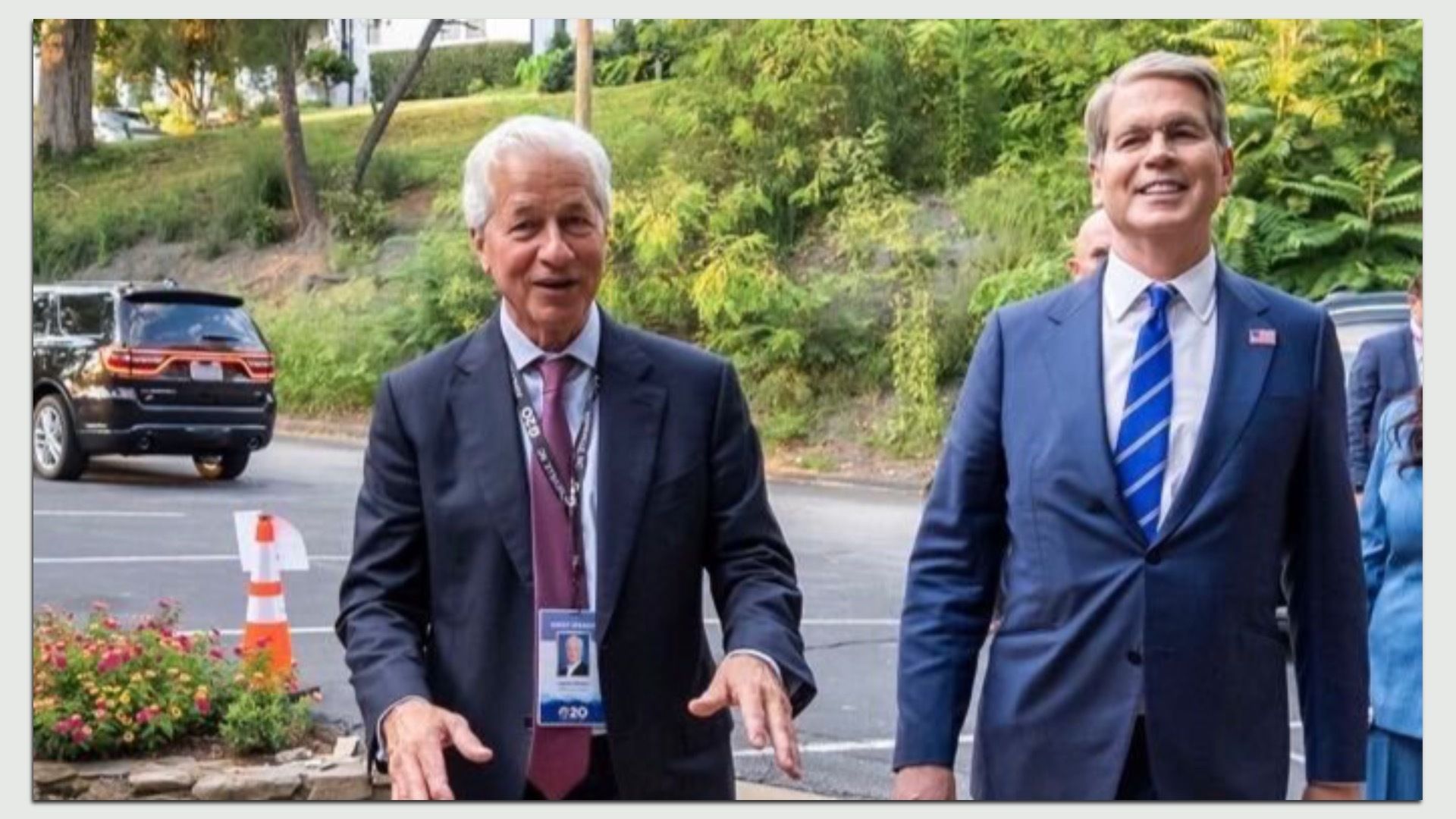
JPMorgan Chase CEO Jamie Dimon and Treasury Secretary Scott Bessent in Asheville, North Carolina. Photo: Courtesy of the Treasury Department.
Treasury Secretary Scott Bessent made a case for lighter financial regulation at the G20 finance ministers gathering Monday, arguing to CEOs that post-crisis rules have squeezed small banks, according to remarks first shared with Axios.
Why it matters: The private sector has a prominent role in the U.S.-led G20, with business leaders like JPMorgan Chase CEO Jamie Dimon and Goldman Sachs chief David Solomon participating alongside finance ministers and central bankers.
What they're saying: "To expand opportunity for all Americans, the banks that serve Main Street must have the same chance to succeed as those that serve Wall Street," Bessent told a room of executives in Asheville, North Carolina, according to prepared remarks shared exclusively with Axios.
- Bessent points to a recent easing of capital requirements for community banks — which lets qualifying banks hold less capital — that he says could "unleash tens of billions for reinvestment into small businesses and loans for families across this country."
Zoom in: Bessent says that post-financial crisis regulations have contributed to the disappearance of half of the nation's small and community banks.
- "Yet in 2023, all that supervision did little to spare our country from suffering three of the largest bank failures in its history," the Treasury Secretary said, referring to failures of Silicon Valley Bank and other regional banks. "Dodd-Frank was supposed to end 'too big to fail.' Instead, it created 'too small to succeed.'"
The intrigue: The Trump administration is using the high-profile gathering to involve the private sector earlier in the policymaking process.
- The banking session is part of a new effort under the U.S. G20 presidency to bring private-sector leaders into discussions traditionally dominated by government officials.
- "Participants have ... emphasized the importance of soliciting input as policymakers shape decisions, not after businesses absorb their effects," Bessent told the room of executives.
Among those attending were:
- Ryan Rugg, global head of digital assets for Citibank's treasury and trade solutions business.
- Bill Brown, CEO of 3M.
- David Ricks, CEO of Eli Lilly.
- Michael Lyons, incoming CEO of Truist.
- Heath Tarbert, president of Circle.
- John May, CEO of Deere.
The big picture: Trump has moved aggressively to loosen financial regulations, including requirements imposed after the 2008 financial crisis.
- That includes a broad overhaul of bank capital rules that regulators say would modestly reduce requirements for large banks and more significantly lower them for smaller institutions.
What to watch: Bessent said the financial deregulatory push is part of the Trump administration's broader strategy to boost economic growth.
- Bessent pointed to a rebound in applications to create new banks — known as "de novo charters" — as evidence that financial firms are responding to the administration's approach.
- "Confidence in the direction of travel under President Trump led to more applicants for new bank charters in the first year of his second term than those of the last administration combined," Bessent said.
- But much of that activity has come from fintech and digital asset firms — including Coinbase and Ripple — aiming to operate more like traditional financial institutions without relying so heavily on partner banks.
