America's college enrollment map is being redrawn

Add Axios as your preferred source to
see more of our stories on Google.
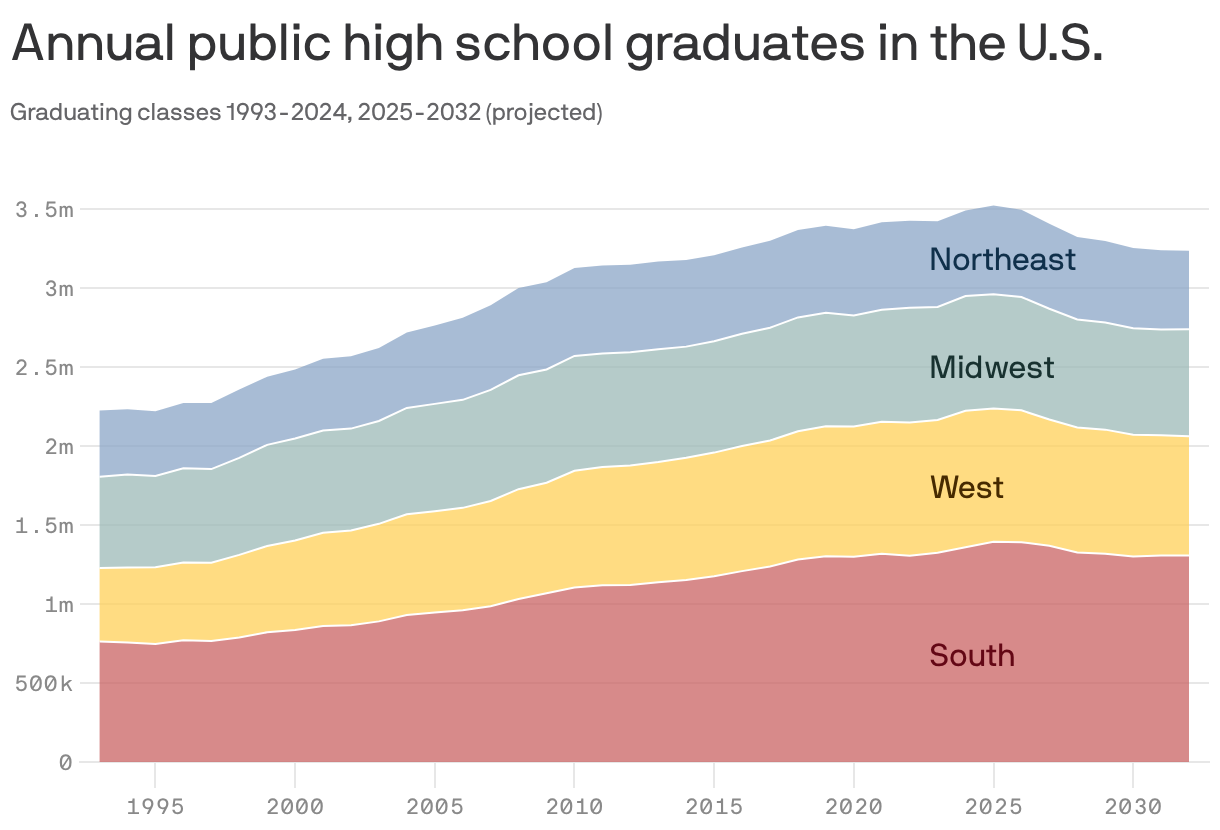
America's future college pipeline is growing in the South and shrinking across the Northeast and California.
Why it matters: America's next higher-ed reckoning won't hit regions evenly. Colleges in shrinking markets will face a fierce fight for students, while those in growing regions will have to adapt to serve an expanding, more diverse student body.
- The nation's student pipeline is also becoming less white, more Latino, more first-generation and more cost-conscious — just as colleges are operating under new legal limits after the Supreme Court ended race-based admissions.
By the numbers: America's under-18 population fell by 1.8 million from 2020 to 2025, an Axios analysis found.
- The West child population fell 5.7% and the Northeast's 4.1%, while the South added nearly 304,000 children.
Zoom in: The number of U.S. high school graduates is projected to peak in 2025 and then fall 13% by 2041, per the Western Interstate Commission for Higher Education (WICHE).
- The decline is especially steep in major college markets: California is projected to lose 29% of its high school graduates, New York 27% and Pennsylvania 17%.
- The South is projected to grow 3%.
Zoom out: The enrollment squeeze is colliding with six-figure sticker shock.
- Harvey Mudd, a small California college, lists an estimated $104,512 cost of attendance for 2026-27.
- Wesleyan lists $100,780 for sophomores, juniors and seniors.
What they're saying: "The schools in the South do tend to have sort of healthier enrollment trends right now," Andrew Gillen, a Cato Institute research fellow, told Axios.
- But regional universities are far more exposed to what happens nearby: "You're really concerned about the local demographic," Gillen said.
Between the lines: Brand-name schools can recruit nationally. Regional universities and less-selective private colleges are much more dependent on the shrinking pool of students around them.
What we're watching: Colleges in declining markets may cut jobs, humanities programs and low-enrollment majors to stay afloat.
- Southern public colleges, meanwhile, could face the opposite challenge: making room for more students if population growth translates into enrollment demand.
