Trump says he'll ask SCOTUS to reverse ballroom project ban

Add Axios as your preferred source to
see more of our stories on Google.
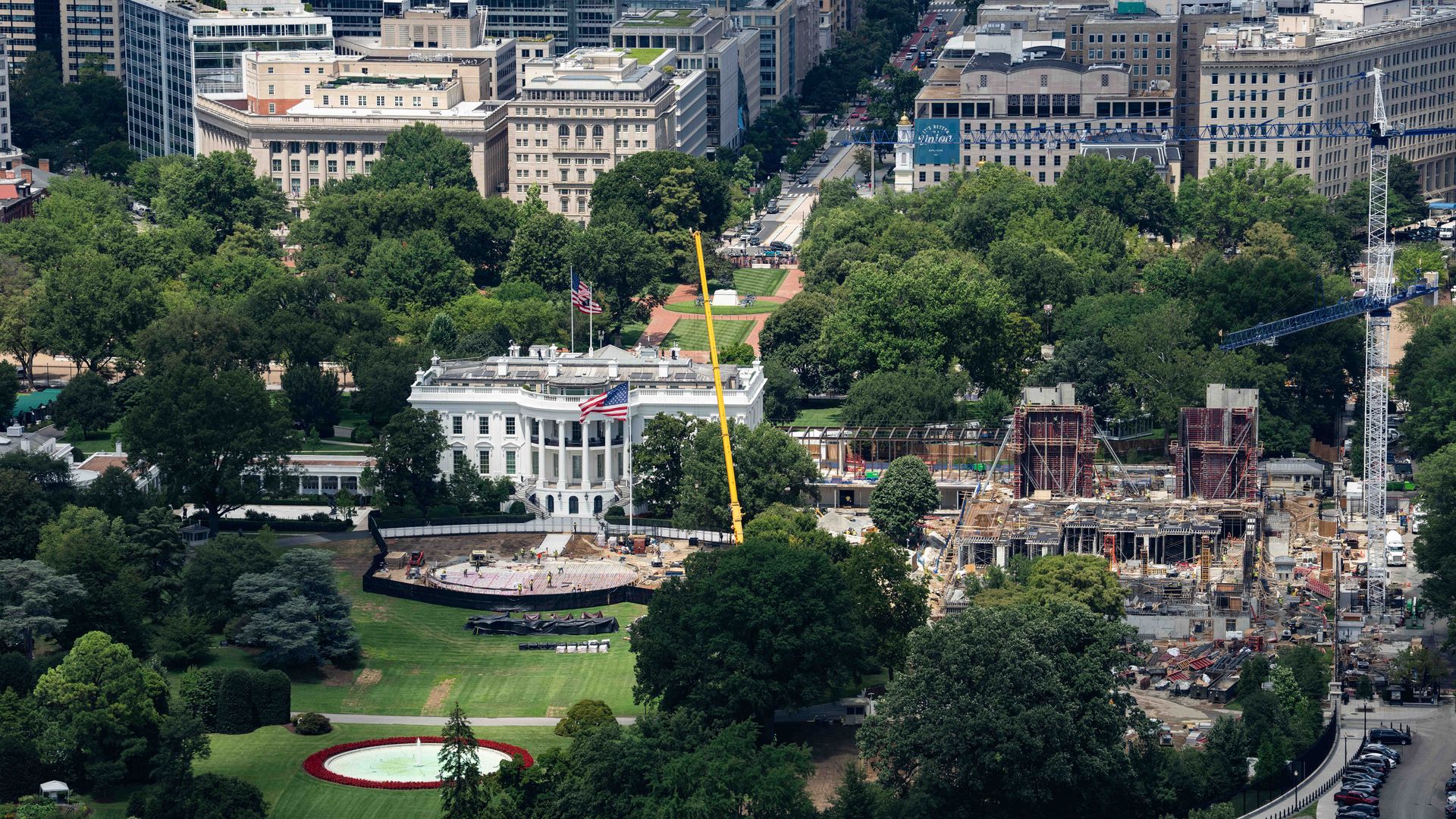
The White House helipad and ballroom under construction in Washington, D.C., on Aug. 5. Photo: Aaron Schwartz/Bloomberg via Getty Images
The Trump administration will ask the Supreme Court to reverse a block on its White House ballroom project, the president said Friday after a federal appeals court decided his plans need congressional approval.
The big picture: Trump's demolition of the East Wing and $400 million expansion project roiled Washington, sparking a legal challenge that now seems set for the nation's highest court.
The latest: Trump said in a lengthy Truth Social post that the government will "immediately" appeal the decision to the Supreme Court, slamming what he called a "horrendous, politically motivated, and unlawful ruling" as a "National Security threat."
- He described the ruling as a vote against a "desperately needed Military Center" and said "severely jeopardizes the lives and welfare" of those who work at or visit the White House.
- However, as the judges noted in their opinion, the injunction exempts construction below the ground, including the construction of medical infrastructure, bunkers and bomb shelters.
Driving the news: The divided three-judge panel of the U.S. Court of Appeals for the D.C. Circuit upheld a lower court's ruling from earlier this year that halted the administration's fast-tracked plans.
- "Whether or not a massive ballroom should be constructed is for Congress to decide and is not a matter for Executive self-help," the majority wrote, deciding the administration "very likely" lacked the authority to build the ballroom.
- Judge Neomi Rao, a Trump appointee, dissented.
- The court paused its decision for two weeks to give the government the chance to ask the Supreme Court to review it.
Catch up quick: Judge Richard Leon clarified in April that the government was barred from taking any action to develop the ballroom, but he allowed below-ground construction of national security facilities or work necessary to protect the site and the president.
- The appeals court determined that the government did not prove that Leon abused his discretion in that determination, agreeing that the White House needed congressional approval.
What they're saying: The National Trust for Historic Preservation, a privately funded nonprofit organization, challenged the project last year.
- "The White House, a global landmark that symbolizes American identity and the ideals of democracy, belongs to the American people," President and CEO Brent Leggs said in a statement celebrating the Friday ruling.
The bottom line: "This holding has nothing at all to do with whether the proposed ballroom is desirable, or not, as a matter of policy," wrote circuit judges Patricia Millett, an Obama appointee, and Bradley Garcia, a Biden appointee.
- "What it does mean," they continued, is that the government can't construct the ballroom "during the district court's expeditious litigation without securing Congress's authorization."
Go deeper: Republicans turn ballroom fight into referendum on Trump's safety
Editor's note: This story has been updated with additional information throughout.
