Trump's what's-old-is-new-again tariff tactic

Add Axios as your preferred source to
see more of our stories on Google.
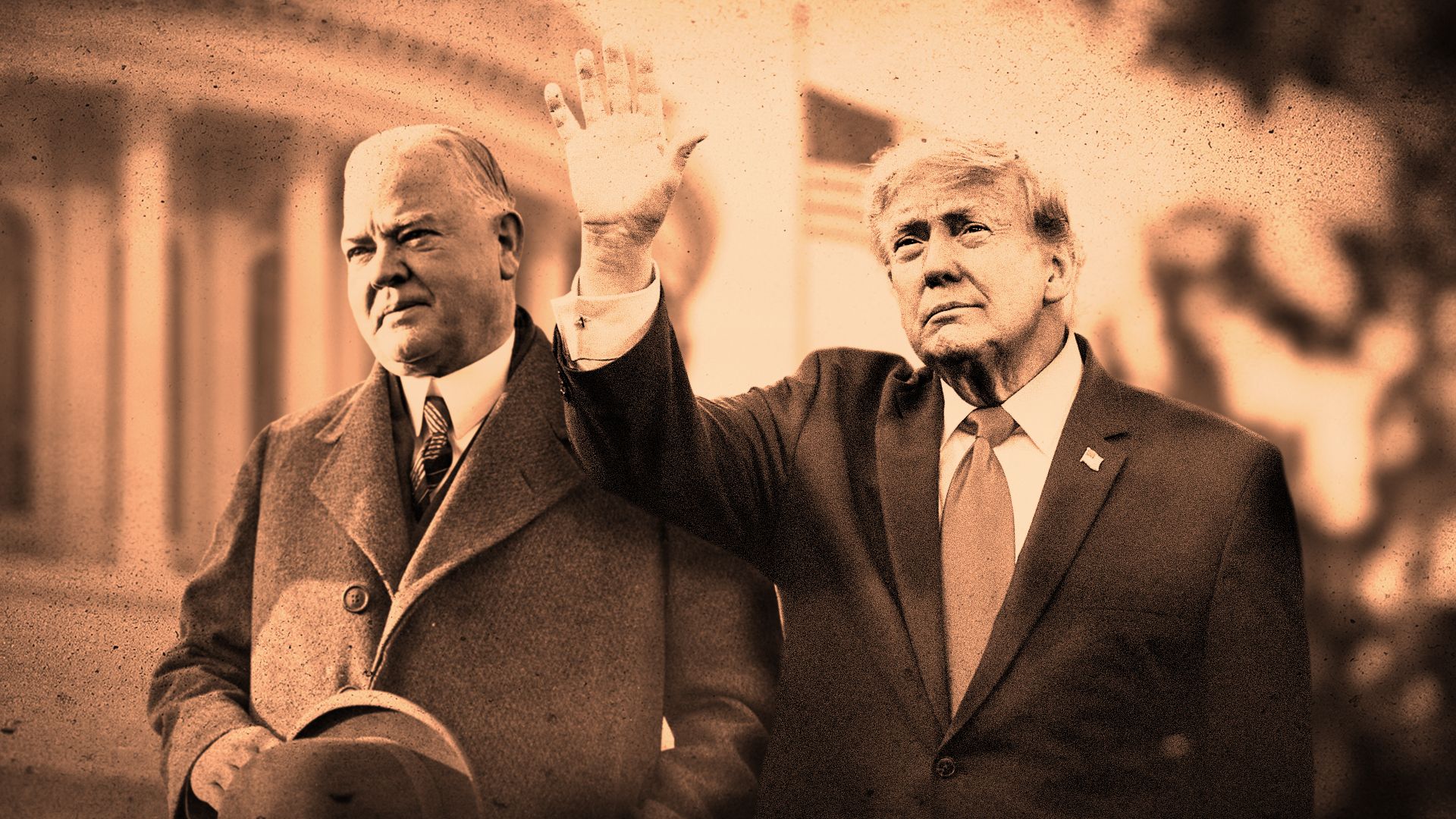
Photo illustration: Sarah Grillo/Axios. Photos: MPI and Chris Brunskill/Fantasista via Getty Images
President Trump has revived a provision from one of former President Herbert Hoover's most infamous policies: the Smoot-Hawley Tariff Act of 1930.
Why it matters: Smoot was long thought to be moot — widely considered a failure and, possibly, an exacerbating factor in the Great Depression.
- Trump has repeatedly said that he doesn't want to be associated with Hoover, who presided over the country during that economic collapse and has forever been associated with it.
- "The irony just writes itself in some sense," Douglas Irwin, an economics professor at Dartmouth and author of "Clashing over Commerce: A history of U.S. trade policy," tells Axios.
Where it stands: The White House has sought to find legal ballast for Trump's tariffs after the administration struck out with the Supreme Court.
- Hoover historians and trade economists say they weren't surprised the administration made its way to Smoot-Hawley — specifically Section 338 of the law, a never-used provision that gives the president wide discretion to impose tariffs of up to 50% to offset "discrimination" from another country.
- "Most trade lawyers and economists have been aware of Section 338 of the 1930 Tariff Act and, although rarely if ever invoked in the past, thought it might be something the Trump team might try," Irwin says.
Catch up quick: Smoot-Hawley was believed to be the high watermark of a protectionist economy. It raised the average tariff rate to 45.4% on thousands of imported products, after lawmakers piled on a bonanza of levies to protect their districts' local industries.
- "It was a monster that came out of Congress without a lot of consideration," Spencer Howard, the archivist at the Herbert Hoover Presidential Library tells Axios. "It's usually associated with Hoover in a bad way."
- Earlier this year, Trump told Axios' Marc Caputo: "I have one primary wish as president, in terms of people: I never want to be the late, great Herbert Hoover."
Zoom in: Hoover did support agricultural tariffs, but he knew Smoot was overly broad, Howard says. He was urged to veto it at the time in a letter signed by 1,028 economists.
- But he thought he had to go along with what his party wanted, Howard says.
The other side: The White House rejects the idea that Trump is following in Hoover's footsteps.
- "Comparing the President's recent executive action with the full gambit of tariffs enacted in 1930 during the Great Depression is a moronic exercise," spokesman Kush Desai wrote in an email.
- "President Trump's use of Section 338 tariffs on Canadian imports are narrow, targeted, and in response to unfair Canadian trade practices that Canadian officials have failed to change over the past year during trade talks."
Friction point: Smoot was believed to be superseded — effectively repealed — by a 1962 trade law, as lawyer and history professor Philip Zelikow argued in a post published by Hoover Institution fellow Eugene Volokh.
- Not all lawyers agree.
- Still, experts believe the Trump move is likely to be challenged on these grounds.
What to watch: While these Smoot tariffs target Canada at the moment, the administration may use them on other countries.
- "If the courts rule Section 338 tariffs are valid, we will see many more tariffs imposed under the same authority," write analysts for Standard Chartered in a note Friday.
