Ionna accelerates U.S. EV charging buildout

Add Axios as your preferred source to
see more of our stories on Google.
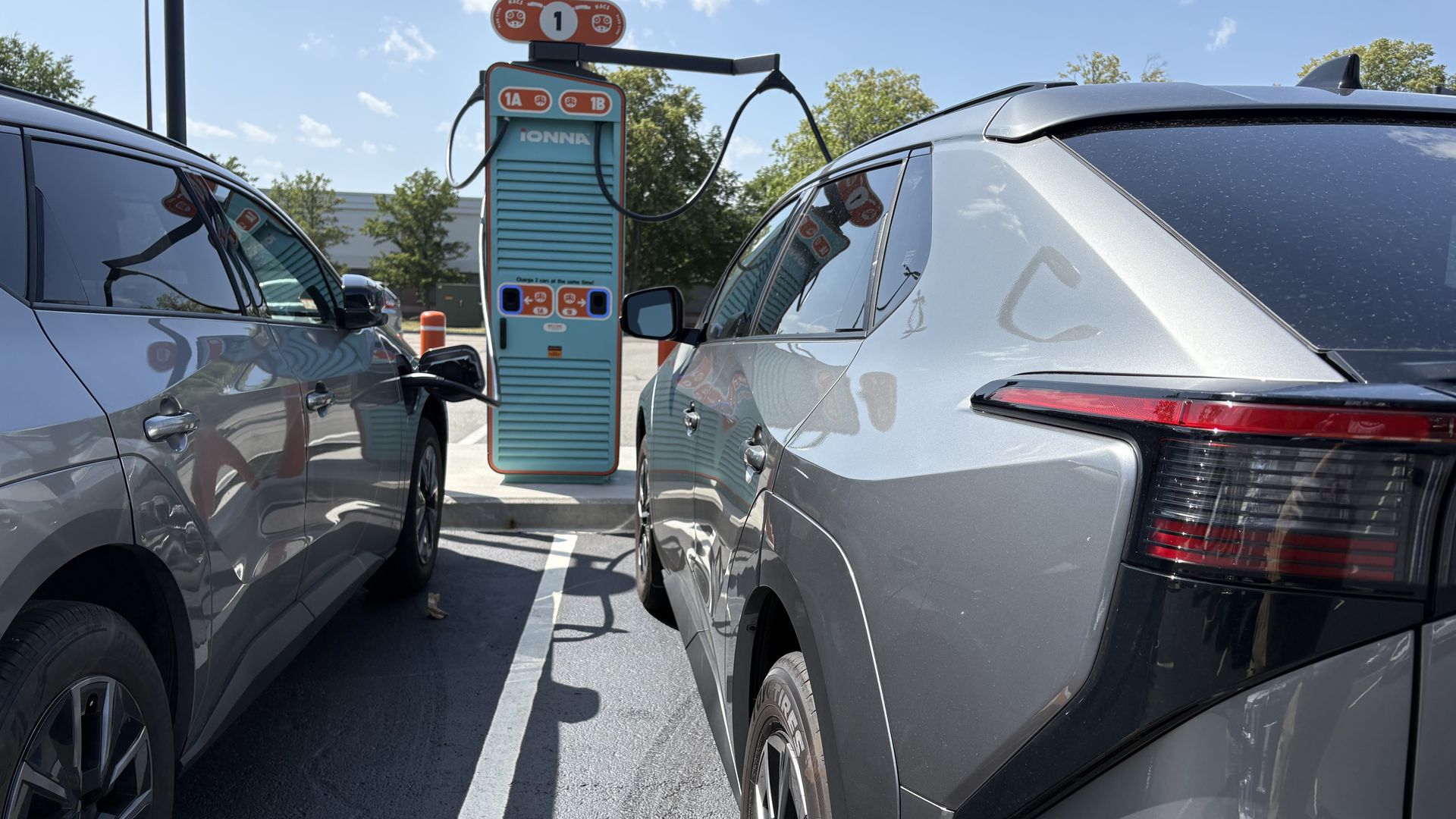
Charging at a new Ionna station was a breeze. Photo: Bill Rapai for Axios
Electric vehicle sales momentum may have slowed in the U.S., but for charging company Ionna, backed by eight carmakers, it's full speed ahead.
Why it matters: Ionna is on track to open 30,000 high-speed charging bays across the U.S. by 2030, a network its founding automakers see as a key to EV adoption.
- "The faster we can get to market, the faster we feel we can unlock vehicle sales for [automakers]," Ionna CEO Seth Cutler said.
Catch up quick: Ionna was founded in 2023 by BMW, General Motors, Honda, Hyundai, Kia, Mercedes-Benz, Stellantis and Toyota. In 2025, Rivian began partnering with Ionna, too.
- Ionna's goal is to raise the game for EV charging with convenient, affordable fast chargers and amenities like windshield cleaners, trash bins, restrooms and food.
- Its 400-kW chargers are the fastest available today in the U.S., and provide access to both NACS and CCS plugs.
State of play: Since February 2024, Ionna has opened 120 "Rechargery" locations in 31 states, with 60 more locations under construction.
- It's also partnering with convenience stores and gas stations like Sheetz, Wawa and Circle K.
💭 My thought bubble: I charged at an Ionna charger in Reading, Massachusetts, located in the parking lot of an office building, with a Longhorn Steakhouse and Market Basket supermarket within walking distance.
- I expected more: a convenience store and a protective canopy, perhaps? Cutler tells me such features will be added to many locations; the primary focus has been getting chargers in the ground.
But charging couldn't have been easier, because Ionna was integrated into my EV's app. I just plugged in and swiped to charge. (I was driving a Toyota — not all EV manufacturers have the same integration yet.)
- Ionna's charging fees are significantly less than other networks — 39 cents per kWh vs. 64 cents per kWh at Electrify America, for example — and that's before discounts offered by individual carmakers.
Follow the money: Clearly, carmakers are subsidizing the costs, but let's face it — they have a strong interest in removing barriers to EV ownership.
