The U.S. is one of only 9 countries without guaranteed vacation time

Add Axios as your preferred source to
see more of our stories on Google.
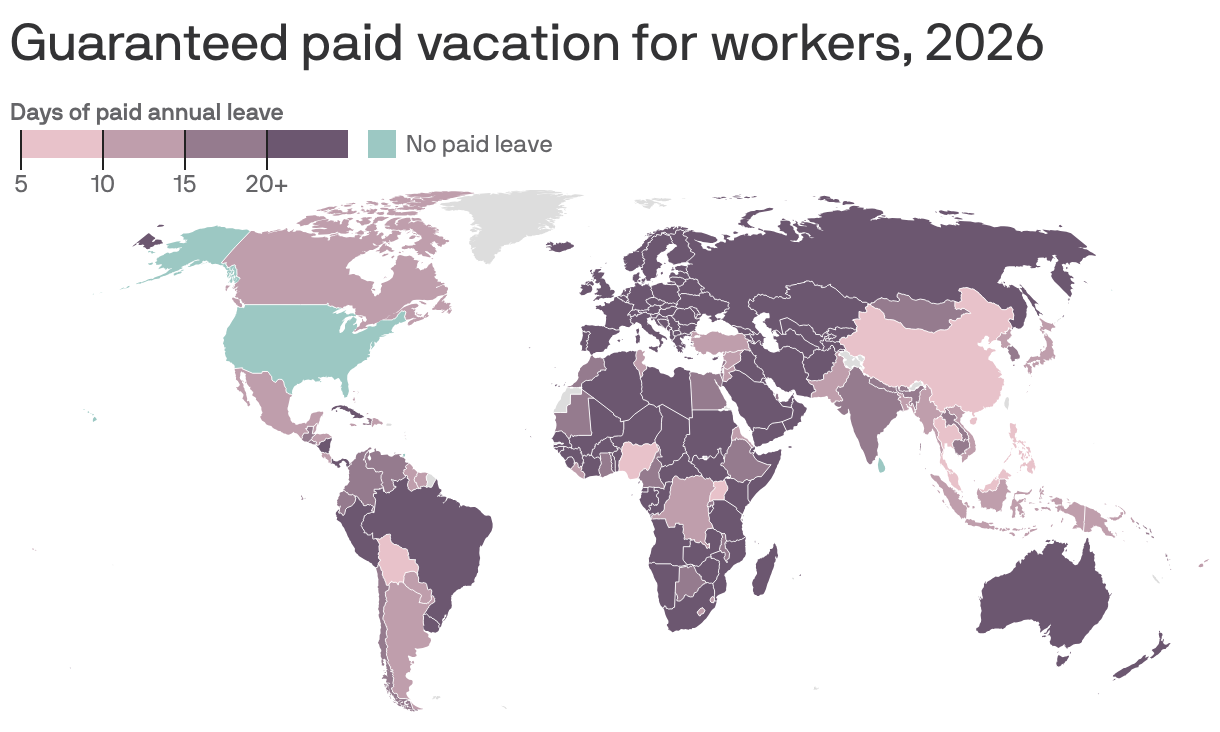
Chalk it up to American exceptionalism: The U.S. is one of only nine countries in the world that doesn't guarantee workers some kind of paid annual leave, according to a comprehensive new analysis of all 193 United Nations member states.
Why it matters: These policies have become fairly standard around the world — they're not merely some European August vacation thing — but paid vacation in the U.S. is seen more as a privilege managed privately by employers.
Zoom in: The other countries with no paid annual leave are Sri Lanka, Trinidad and Tobago and six small island nations.
- The U.S. is the only major economy in the group.
How it works: Typically, these policies take the form of legal mandates: Governments require employers to offer some minimum amount of paid time off.
- 55% of countries guarantee at least 20 days of paid vacation each year.
- Some require that people work for some amount of time with an employer before getting paid leave.
Yes, but: The analysis doesn't look at whether workers are actually able to take their time off. That's an ongoing issue, particularly in the U.S., where many don't take all the time off they're given.
Where it stands: In the U.S., 83% of the top quarter of wage earners get paid vacation time, compared with 57% for the lowest quarter, per Labor Department data.
Between the lines: Paid annual leave isn't simply a matter of giving people time to frolic at the beach. People also use it to do things like move, handle emergencies, see family, manage chores or child care — especially in the summer.
- The report notes that workplace injuries tend to rise for those on longer, consecutive shifts and that workers globally are facing rising levels of stress and burnout.
What to watch: There's a new conversation bubbling up about how businesses should adapt time-off policies for the AI era.
- If the new technology truly advances worker productivity, some argue that should mean that people get to work less — say, through four-day workweeks.
The bottom line: Around the world, paid time off is treated as a legal right — in the U.S. it's considered to be a voluntary job benefit.
