Supreme Court ruling sets up next trans sports fight

Add Axios as your preferred source to
see more of our stories on Google.
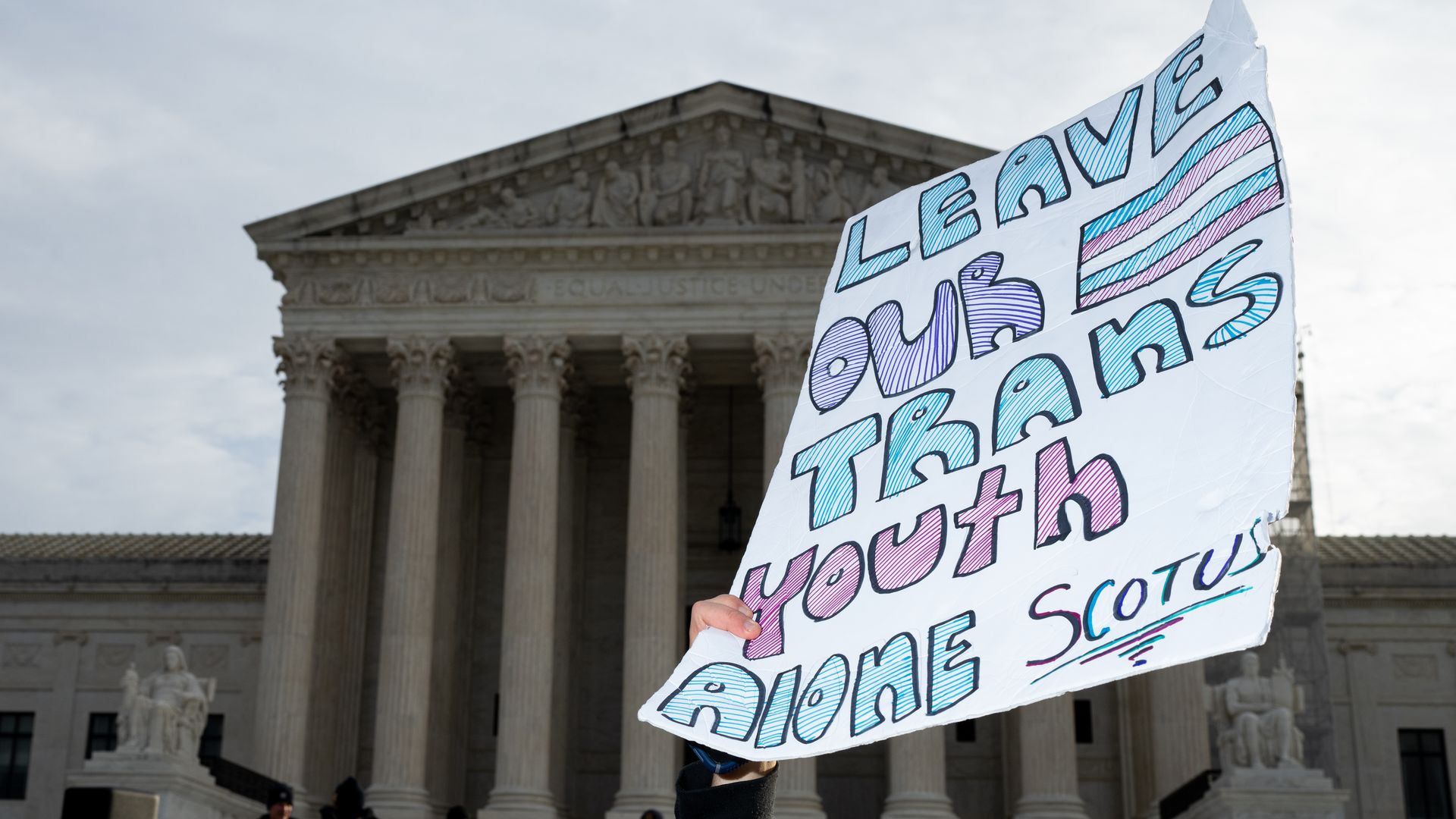
Activists for and against trans rights protest outside the U.S. Supreme Court on Wednesday, December 4, 2024. Photo: Bill Clark/CQ-Roll Call, Inc via Getty Images.
The Supreme Court on Tuesday declined to impose a nationwide ban on transgender athletes while upholding state laws barring transgender girls from girls' sports teams, setting up the next legal fight over trans-inclusive policies.
Why it matters: The ruling leaves transgender-inclusive policies in some states intact for now, shifting the next legal battle to states and schools defending those policies against legal challenges and pressure from the Trump administration.
Driving the news: In West Virginia v. B.P.J. and Little v. Hecox, the court upheld bans in Idaho and West Virginia on transgender girls participating on sports teams, declaring that the bans survive Title IX and equal protection challenges.
- All nine justices agreed the bans do not violate Title IX protections, though they split on the constitutional question.
What they're saying: "I think we will see our opponents trying to use this decision to say that inclusive policies violate Title IX," Carl Charles of Lambda Legal, which helped litigate one of the cases, tells Axios.
- "I don't think we've quite seen it happen yet… but I think it is important to say that the court didn't give it to them in this decision."
The other side: White House spokesperson Allison Schuster said that "today's Supreme Court victory proves that the President's agenda is rooted not only in common sense but in the law."
- "The Trump Administration continues to repeatedly win the legal fight for fairness and protecting girls' safety, and we look forward to many more victories in any future challenges on the matter."
State of play: A total of 27 states have blocked transgender women and girls from participating in girls' sports.
- The Trump administration and conservative groups have pushed schools to roll back protections for transgender youth, casting restrictive executive orders as the law of the land and threatening to withhold federal funding from states that do not comply.
- "This administration has sort of a loose relationship with the law," Fatima Goss Graves, the CEO of the National Women's Law Center, tells Axios.
- "It moves with sort of a brute force that in many cases people just comply, but … the administration can't just change the law with the stroke of its pen."
Case in point: The NCAA changed its rules in 2025 after one of President Trump's executive orders, restricting women's competition to athletes assigned female at birth.
- "It's fair to suspect that some other athletic organizations may make a similar choice, especially if the administration starts to wield this opinion as defense for their political viewpoint," Charles says.
Zoom in: Instead, civil rights advocates are encouraging states with protections for trans people to call out their opponents' "bluff," Charles says.
- He points out that Trump attempted to kill Maine's protections by withholding federal funds for a child nutrition program, but the state ultimately prevailed in that legal challenge because of its state human rights law.
- And in Minnesota, after a women's sports group tried to invalidate that state's inclusive law, they failed to prove the law intentionally discriminates against cisgender athletes.
- Charles says advocates will continue helping states defend their interpretation of Title IX through legal support and amicus briefs.
The bottom line: Goss Graves says the bans rely on stereotypes about what it means to be a girl or woman — stereotypes that often target women of color and women who do not conform to conventional expectations of femininity.
- Cisgender athletes such as tennis legend Serena Williams and NBA star Brittney Griner have faced false accusations of being transgender.
- "What you can expect is people to challenge whether or not girls are girl enough to play, whether it is invasive sex testing or some sort of body surveillance … but I promise you, lots of girls are going to be caught up in it," she says.
Go deeper: Supreme Court lets states ban trans girls from girls' sports
Editor's note: This story has been updated with comment from the White House.
