The Fed's independence is still on the line

Add Axios as your preferred source to
see more of our stories on Google.
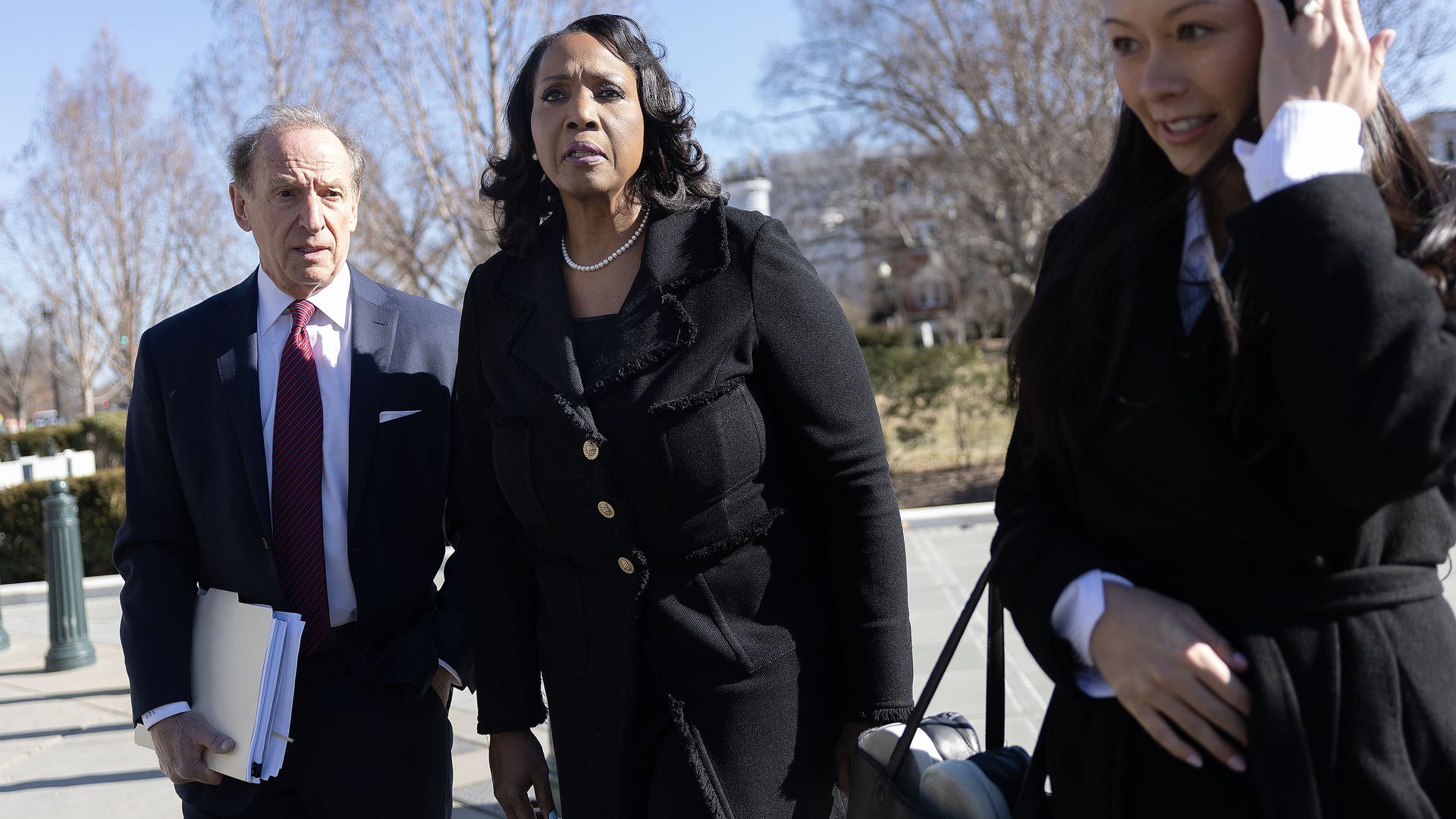
Federal Reserve governor Lisa Cook at Supreme Court oral arguments in January. Photo: Kevin Dietsch/Getty Images
On the surface, Monday's Supreme Court ruling that keeps Lisa Cook in place as a Federal Reserve governor for now was a win for believers that the central bank works best when insulated from the day-to-day control of the president. The details aren't so clear.
The big picture: The court punted on several key questions that will determine how much ability President Trump and his successors have to fire Fed governors.
- Moreover, the decision was closer than many court watchers anticipated, with four of six conservative justices dissenting.
- Another key ruling Monday grants the president broad latitude to fire heads of independent agencies that aren't the Fed, contrary to a 91-year-old precedent. It shows deep skepticism among the conservative majority about the constitutionality of Congress insulating agencies from presidential control.
- Fed independence is hanging by a narrow legal asterisk citing America's long, tenuous history with central banking.
State of play: Cook will remain on the Board of Governors following the ruling. But the Supreme Court gave little guidance on how high the bar is for a president to fire a Fed governor for cause, nor did it indicate what procedures a president must follow to overcome that bar.
- In Monday's Trump v. Cook decision, Chief Justice John Roberts, writing for the 5-4 majority, rejected both the Trump administration's arguments that a Fed governor can be fired over mere concerns about their integrity and the argument made by Cook's attorneys that she can be fired only for "inefficiency, neglect of duty, or malfeasance."
- "Having rejected both parties' positions, we need not fully demarcate the contours of 'cause' today."
Of note: The court similarly suggested that Cook was entitled to some due process to establish cause, rather than to be fired on presidential whim. But it declined to lay out exactly what that should be.
- "At minimum, Cook was entitled to some explanation of the evidence at issue, some avenue for a response, and a deadline by which a response would be due."
- But Roberts then wrote that the court can only assess the "validity and sufficiency of such charges" after the president sets up this legal process and Cook has responded.
What they're saying: "The court is now in the position of procrastinators everywhere: let's let future SCOTUS handle that one," quipped Peter Conti-Brown, the University of Pennsylvania legal scholar.
Between the lines: Cook's role as a governor has been in legal limbo for 10 months now, and we still don't know exactly what the standard is for the president to fire her or how he can legally do so.
- If anything, the majority opinion seemed to bend over backward not to prejudge those issues. That raises the possibility that a president has wide latitude to fire Fed governors for pretext so long as they dot a few more i's and cross more t's than Trump did in the Cook case.
- If Trump or a future president wants to fire Fed governors over policy differences, it raises the possibility they can find any ticky-tack rationale, convene a legal process run by sycophants and achieve the same goal.
Reality check: The original sin here is that Congress, in establishing the Fed, left things vague as to what would constitute "cause" for a president to fire a Fed governor and how that cause should be properly adjudicated.
- The Federal Reserve Act says only that governors' terms are 14 years "unless sooner removed for cause by the President" without giving more detail.
The bottom line: If Congress wants to create clearer guardrails around the firing of Fed governors, it will need to pass legislation. In the meantime, the protections offered by the courts are limited, and still unresolved.
