How friends and foes are converging on the Philippines

Add Axios as your preferred source to
see more of our stories on Google.
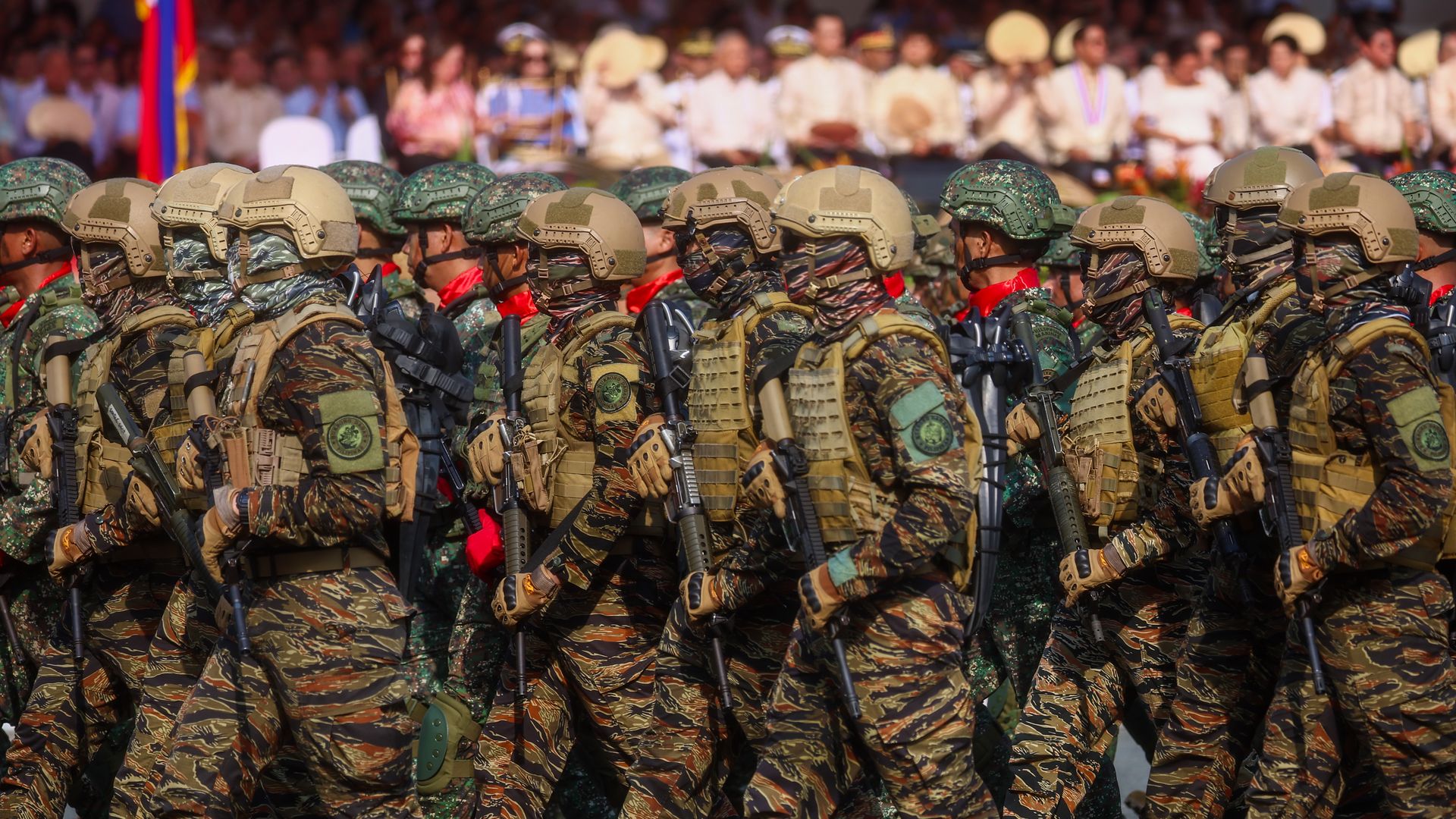
Filipino troops march in a parade in Manila on June 12. Photo: Daniel Ceng/Anadolu via Getty Images
China's extraterritorial aggression under Xi Jinping is hardening the resolve of the Philippines and pushes Manila and its neighbors closer together every day, Defense Secretary Gilberto Teodoro told Axios.
Why it matters: It pays to have friends in the Indo-Pacific, a place so big, so complex and so vital to the interests of two nuclear-armed powers.
- While Beijing and Washington are playing nice right now, no one in the region is blind to the possibility of the next great conflict kicking off there.
The intrigue: China sanctioned Teodoro this month for "repeatedly made irresponsible remarks" that it said undermine international relations. The defense chief is now barred from Hong Kong and Macao.
- The slap may have backfired, though.
- "The sanctions will not affect Philippine defense policy," Teodoro said. If anything, it "concretizes Philippine defense policy, because it makes more obvious that what we are doing or saying is contrary to what they want."
Driving the news: In an hourlong interview Friday, Teodoro discussed with Axios recent Scarborough Shoal standoffs, South China Sea skirmishes, military drills alongside the U.S. and more.
- One term kept resurfacing: "convergence."
- "China is a country that is not easy to deter. No one country can do it alone," Teodoro said. "All the countries in [the Association of Southeast Asian Nations] are busy building up their own armed forces."
State of play: The Philippines already boasts relationships with Australia, South Korea, Indonesia and Vietnam addressing shipbuilding, counterterrorism, industrial buildup, maritime patrol and search-and-rescue.
- Its relationship with the U.S. is long-standing and treaty-bound, through the Enhanced Defense Cooperation Agreement.
- That pact grants American troops access to a growing number of bases in the Philippines and the ability to preposition supplies. (Some of the bases are quite close to Taiwan.)
Zoom in: Particularly critical for the Philippines is the security relationship with Japan, where a nascent rearmament is drawing Beijing's ire.
- "We operate on a proverbial one-theater concept. We share the same threats," Teodoro said.
- "We help each other surmount these threats and deter these threats from ripening."
Follow the money: The Philippines is interested in buying Japanese Type 88 surface-to-ship missiles. They were fired from the Philippines this year, during the Balikatan exercise that also involved U.S. troops and their Typhon-Tomahawk combo.
- Manila has received a handful of coastal surveillance radars from Tokyo and is also anticipating the transfer of Abukuma-class destroyer escorts to beef up its navy.
- "It is natural that we would welcome the evolution of a mature defense industry in Japan," Teodoro said. (He also welcomed the same growth from South Korea.)
The bottom line: America's attention may be elsewhere today. But its friends in the Indo-Pacific are banding together for tomorrow.
More from Axios:
Taiwan tests Lockheed launchers in China's direction
Senator pitches Chinese AI questions in Hegseth letter
Trump admires China's Xi as "very smart" with "great stature"
