Juneteenth stands as DEI retreats


Add Axios as your preferred source to
see more of our stories on Google.
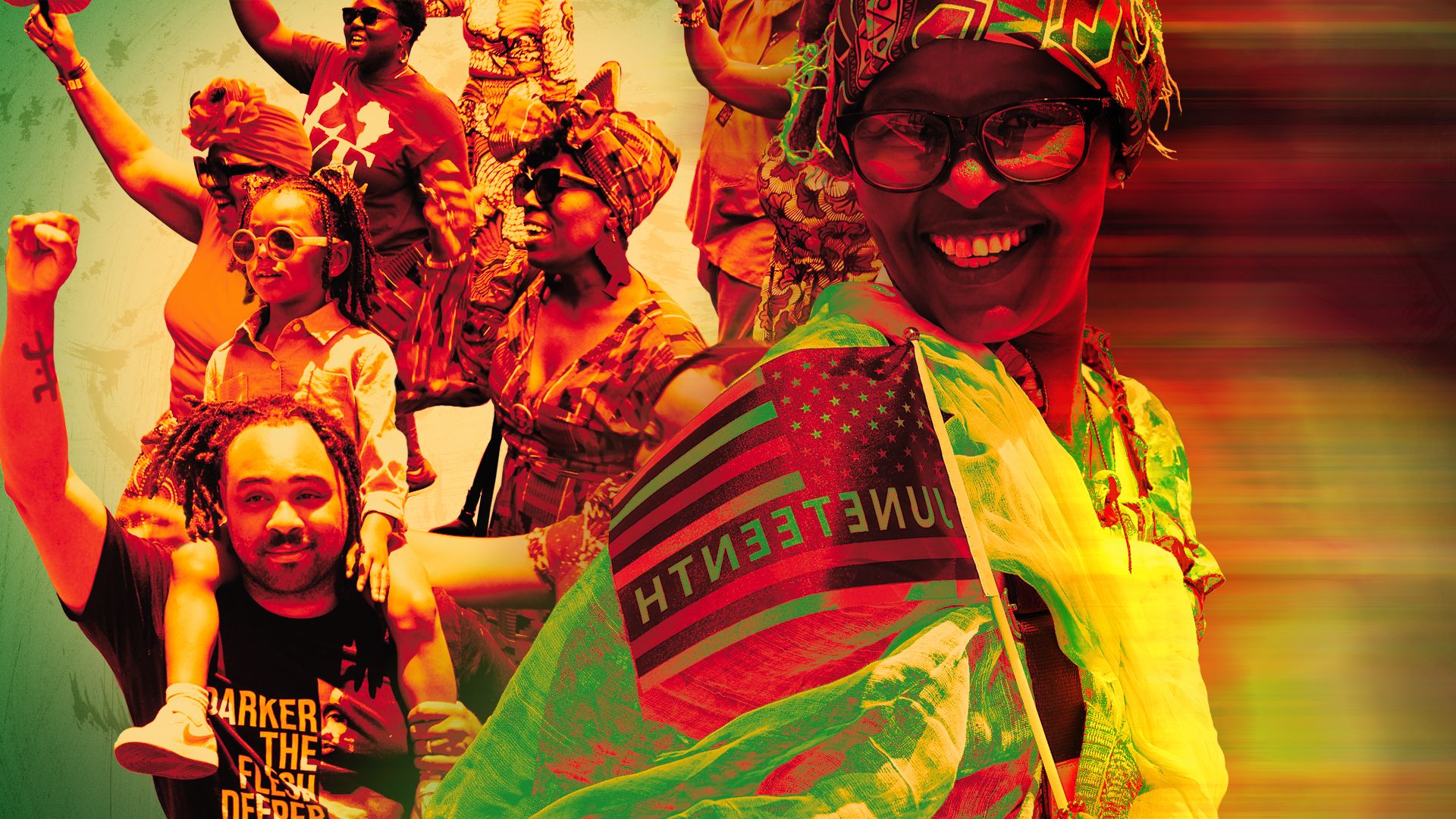
Photo illustration: Sarah Grillo/Axios. Photos: Sarah Reingewirtz/MediaNews Group/Los Angeles Daily News, Bastiaan Slabbers/NurPhoto, and Tayfun Coskun/Anadolu via Getty Images
Juneteenth is surviving the corporate DEI backlash, even as American institutions pull back from the promises that helped elevate it.
Why it matters: The holiday's staying power shows how Black history can be absorbed into calendars, payroll systems and public rituals even as the post-2020 commitments that gave it renewed force are renamed, narrowed or abandoned.
- The holiday is enduring by becoming quieter, more internal and routine.
- Juneteenth remains a federal holiday, and President Trump cannot cancel it unilaterally despite his attacks on it.
Catch up quick: President Biden signed Juneteenth into law in 2021 after Congress passed the measure with broad bipartisan support.
- Legal experts say only Congress can undo a federal holiday it created.
Yes, but: Trump has moved to make the holiday less prominent symbolically.
- He declined to issue a Juneteenth proclamation in 2025, posting on Truth Social that America has "too many non-working holidays."
- His administration also removed Juneteenth and Martin Luther King Jr. Day from the National Park Service's 2026 free-entry calendar. Instead, Trump made June 14 a free day for "Flag Day/President Trump's birthday."
Between the lines: Juneteenth celebrations last year were scaled back, canceled or moved in places including Colorado Springs, Scottsdale, West Virginia and San Diego amid sponsorship losses, reduced city funding, dissolved DEI offices and rescinded arts grants, per the AP.
- Denver's Juneteenth Music Festival was scaled back in 2025 after corporate sponsors pulled support, per the Denver Post.
- This year, it is expanding again to three days in Five Points — a sign of resilience, but also a reminder that Black cultural celebrations now depend on funding streams that have become more politically fragile.
Zoom in: Target is an example of the corporate split screen.
- The retailer made Juneteenth an official annual company holiday in 2020, saying the day would give employees space to honor the commemoration in their own way.
- Target has since said it would stop external diversity-focused surveys and conclude its REACH racial equity initiative.
- A Target spokeswoman tells Axios its headquarters is closed on Juneteenth and workers at its open stores are paid as if it's a holiday.
The other side: Nike still publicly frames Juneteenth around Black history and culture and says U.S. operations close for the day.
Zoom out: Juneteenth is still being added to government calendars.
- At least 33 states and Washington, D.C., will mark Juneteenth with a paid day off for most state government workers in 2026, according to Pew Research Center.
- Most states that made Juneteenth a permanent legal holiday did so after 2020 — showing how quickly the holiday moved from Black community tradition to government infrastructure.
What they're saying: "Our celebration of Juneteenth is the fact that we are here and we continue to build this country and will continue to do so," Patrice Willoughby, the NAACP's chief of policy and legislative affairs, told Axios.
- For Willoughby, Juneteenth is less about looking backward than protecting democratic gains.
- "The freedom that we have — the proof of its value has already been shown," she said.
The bottom line: For companies and governments, Juneteenth can become a low-risk way to acknowledge slavery and emancipation without taking a public position on present-day racial inequities.
- For Black communities, the tension is sharper: Juneteenth is more visible than ever, but the infrastructure supporting Black-led events, businesses and institutions can be more fragile than the post-2020 surge.
