Boom in ETFs tied to shares of Elon Musk's SpaceX

Add Axios as your preferred source to
see more of our stories on Google.

Illustration: Sarah Grillo/Axios
If you think buying a stock on the first day it trades is risky, check out leveraged ETFs: There are about a dozen tied to SpaceX that are teed up to launch in the wake of the company's expected stock market debut on Friday.
Why it matters: It's an extreme example of the risk-maxxing mindset that's swept through the formerly staid world of exchange-traded funds — and through the investing culture writ large with the rise of prediction markets and other kinds of gambling.
By the numbers: There are 25 SpaceX ETFs that have registered with the Securities and Exchange Commission, per data from Bloomberg Intelligence.
- Of those, 12 are either specifically "2x long" or "2x short" — inverse ETFs. There are even two filings for 3x funds, though it's likely the SEC won't approve them, says James Seyffart, a senior ETF research analyst at Bloomberg Intelligence.
- It's an unusually large number and a reflection of the SpaceX fever in the market.
The big picture: Traders "love" these levered ETFs, Seyffart says. But they are costly and not meant as buy-and-hold investments.
- "We call them power tools because you can really injure yourself if you don't understand how these things work."
Catch up quick: ETFs started out decades ago as a simple and ultra-low-cost way for investors to buy funds that track the big stock indexes. The biggest one, Vanguard's VOO, simply tracks the S&P 500.
- ETFs are now so popular that they outnumber public companies, or, as Apollo Global Management's Torsten Slok recently put it, "there are now more ways to trade the market than there are stocks in the market."
The intrigue: In recent years, and especially after the SEC formalized some rules in 2022, ETFs have become more exotic — weird even. You can buy one that purports to invest in stocks that would benefit if the government confirms that aliens exist, as WSJ's Jason Zweig recently noted.
Zoom in: Around 27% of the ETFs launched over the past year were leveraged, and three-quarters of them single stock, according to a June report from JPMorgan.
- They've seen explosive growth — assets under management in levered ETFs totaled more than $190 billion, as of mid-May, per the bank.
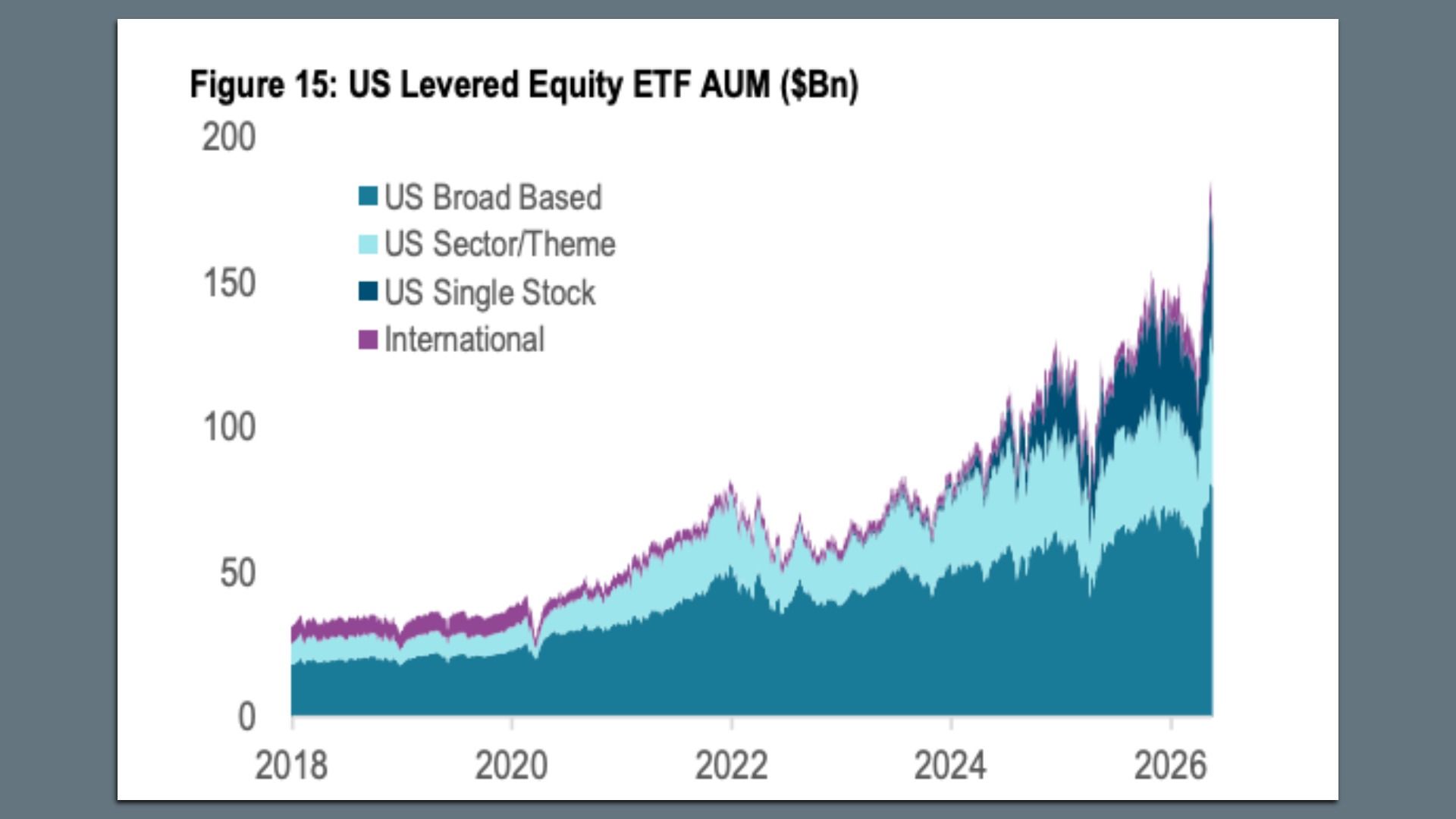
How it works: A single-stock leveraged ETF doubles or even triples a stock's single-day performance. So if you invest $1,000 on a SpaceX 2x long ETF and the stock jumps 10% on day one, you're up 20% to $1,200.
- The catch is, it rebalances every day: If on day two, the stock falls 10% — you'd lose $240 (or 20% of $1,200).
- Suddenly, you have $960, a 4% loss. If you'd just bought normie stock, you'd be basically flat for the two days.
Friction point: Because of that daily rebalancing, these things are for day traders. They're popular for retail investors who like volatility and risk, or others who need to hedge risk.
Follow the money: Leveraged ETFs are not cheap; they have higher fees than the index ETFs and hidden costs that eat into returns, as research from Hendrik Bessembinder, a finance professor at Arizona State University, has found.
- Basically, the ETFs don't typically buy any stock. Instead, they buy what's called a swap from a bank, which then hedges its own risks often by buying shares or futures.
- The bank charges for that, and that gets passed along to the investor.
- The upshot is, returns don't always pencil out the way you'd think.
Zoom out: None of that seems to bother the traders piling in. For many, it's all about what Bessembinder calls "keeping the dream alive."
- "We all like to dream about the possibility of being rich."
