EVs might one day shore up the ailing power grid

Add Axios as your preferred source to
see more of our stories on Google.
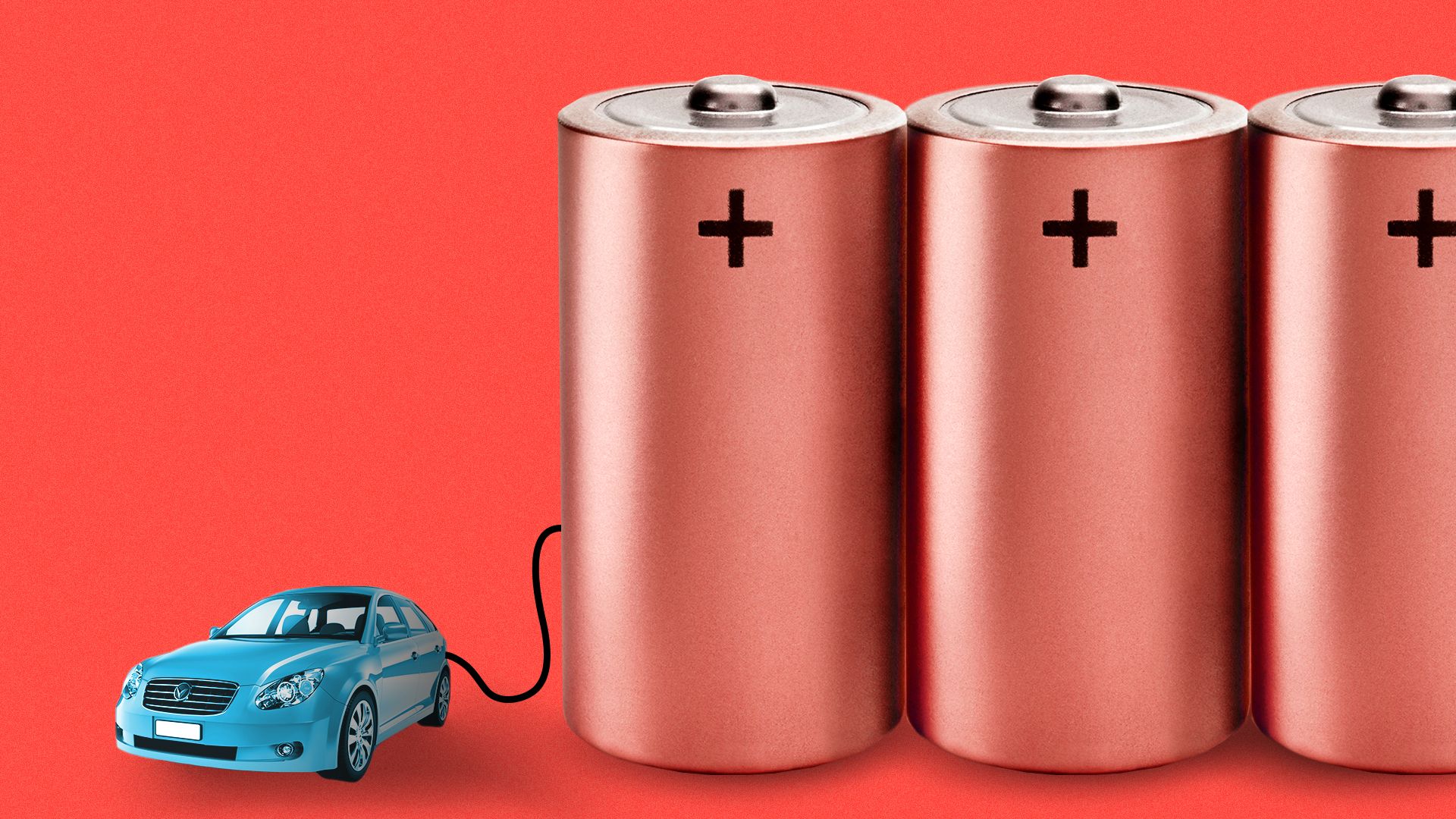
Illustration: Annelise Capossela/Axios
Most people worry that electric vehicles are going to further strain America's aging power grid, but the opposite is true, says the head of California's largest utility.
Why it matters: A parked EV can be an extension of the grid, a distributed energy storage asset that can send power back when it's needed most.
- "Our grid desperately needs EVs," Patricia Poppe, CEO of PG&E, said at a GM media event in San Francisco Tuesday.
Driving the news: General Motors is trying to prod the idea along as part of a broader energy storage strategy it introduced this week.
- GM already has more than 250,000 bidirectional EVs on the road, meaning they're capable of both drawing and distributing power.
- Some of those EV owners have installed GM's vehicle-to-home energy system, which lets them use their car to power their home during a blackout.
- Now GM is releasing a software update that allows those home energy customers to feed electricity to the power grid as well.
Yes, but: This so-called vehicle-to-grid (V2G) technology only works if consumers can be convinced to sign up — and it's unclear whether the idea will be popular with drivers.
- Most EV owners aren't aware their car can power their home, much less the grid.
- Those who are aware might prefer to keep their car fully charged at all times, even though it's parked all day, regardless of how much they could save on their energy bill.
Between the lines: That's where cooperation from utilities becomes important. For V2G to scale, utilities will likely need to educate customers about access and provide the right incentives to get them to enroll.
- One specific challenge is the fragmented nature of the energy business. The U.S. has roughly 3,000 regional electric utilities, so there's no unified effort behind V2G.
- GM released an "open letter" to utilities and regulators, urging them to get on board with V2G and to provide meaningful incentives to EV owners.
State of play: The two-way capability is still mostly in the pilot phase, with utilities in California, Texas and Michigan leading the way.
- In Michigan, GM is partnering with utility DTE Energy on a vehicle-to-grid pilot with 30 GM employees.
- In California, which faces ongoing concerns about wildfires along with soaring demand for electricity, PG&E is leaning heavily into V2G through pilots with multiple automakers.
- "It's the first flexible demand there ever has been," said Poppe.
What we're watching: GM says it has "thousands" of vehicle-to-home customers today who are now also eligible for V2G, but declined to provide a specific figure.
- By 2030, the company expects to have 52,000 bidirectional EVs contributing to the grid in PG&E's northern California service area.
- Beyond cutting-edge California, the slog will be slower.
