The looming China pharma choke point

Add Axios as your preferred source to
see more of our stories on Google.
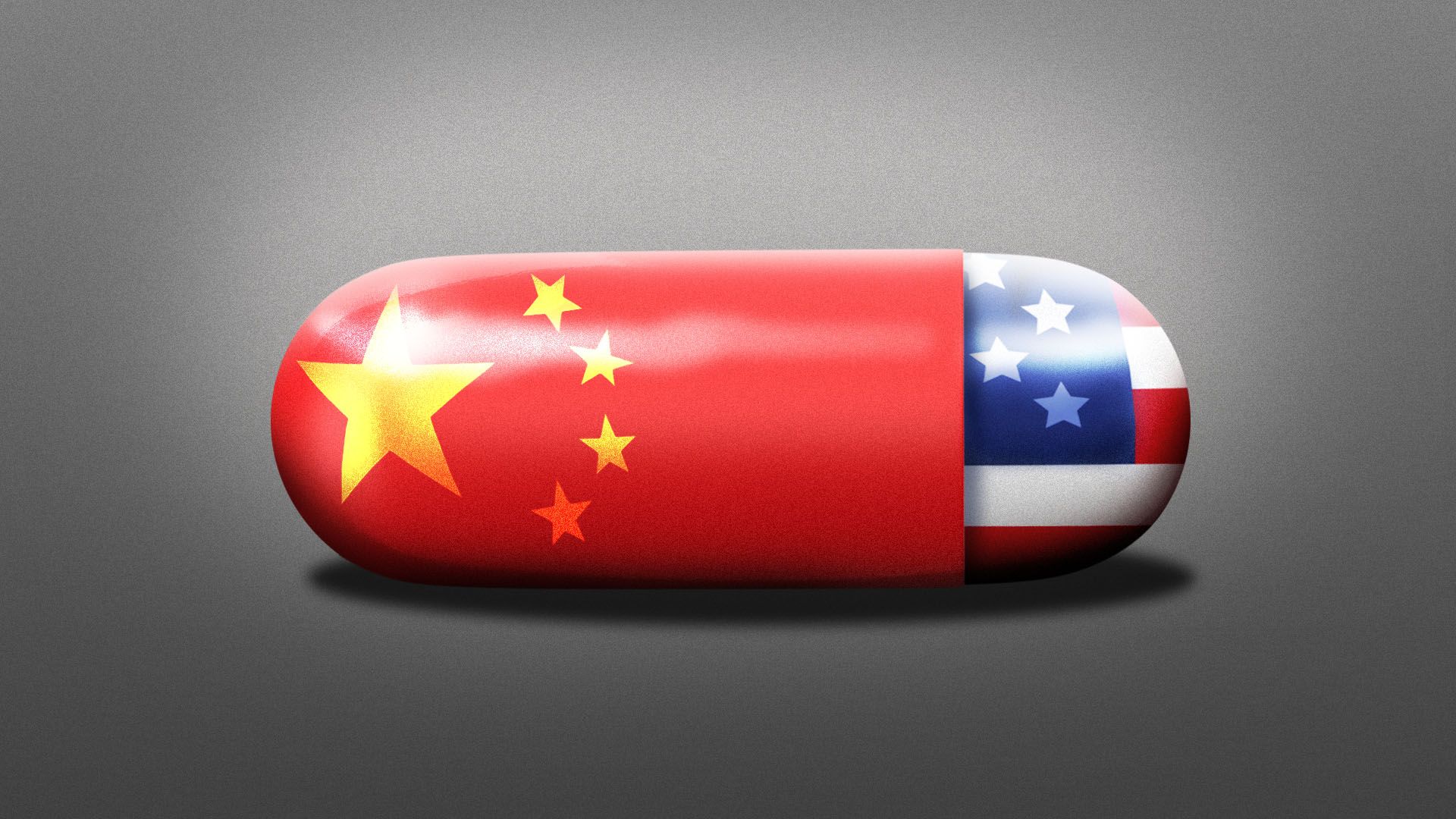
Illustration: Sarah Grillo/Axios
U.S. drug development is heavily dependent on China — and Washington is not keeping up with the whole-of-government response many experts say is needed to change that.
Why it matters: The U.S. is being held back by vulnerabilities like fragile supply chains for generic drugs and the lack of a cutting-edge biotech infrastructure.
- A new Council on Foreign Relations report argues that while policymakers have become increasingly aware of U.S. dependence on China in pharmaceuticals, little has changed to alter the competitive dynamics.
Driving the news: The Department of Defense this week listed WuXi AppTec — a major drug development and manufacturing company — as a company associated with the Chinese military, making it subject to controls under a law Congress passed late last year.
- That could mean a U.S. biotech that contracts with WuXi to manufacture its product for clinical trials won't be able to receive federal funding for the effort, according to a Capstone analyst note.
- The listing of WuXi should incentivize biotechs to look outside of China for help sourcing ingredients and testing and manufacturing drugs.
- WuXi disputed its inclusion on the list.
House Select Committee on China Chair John Moolenaar (R-Mich.) recently introduced legislation that would require the Treasury Department to review U.S. pharmaceutical licensing deals, joint ventures and equity investments with Chinese companies.
- This would be the same scrutiny that's required for semiconductors, quantum information technology, and AI.
What they're saying: "We can't ban our way out of this problem," said CFR senior fellow Thomas Bollyky, one of the report's authors.
- "It really will need to be a combination of measures to improve U.S. innovative capacity in the biotech space combined with sensible security restrictions on Chinese firms," Bollyky said.
- "My worry is ... we will just look at ways of cutting off clinical trial data from China or precluding use of certain firms and call it a day, and the reality is that is not going to work," he added.
Details: The CFR report makes the case that the dependence on China falls into three buckets, and that "the true scope of U.S. vulnerability is systematically underestimated and often poorly understood."
- The first is the best known: dependence on China for generic drugs and, more importantly, the materials used to make them.
- The reliance on China then moves into drug manufacturing, development and clinical trials, which has been created through what the report calls "systemic competitive erosion" and is essentially making the private sector dependent on China to develop new treatments.
- The third bucket is the lack of an underlying U.S. foundation that will yield future biotech breakthroughs — including the kinds that could be used in warfare.
Between the lines: Generic drug production, clinical trials and manufacturing have all moved to China in large part because it's cheaper there.
- Costs and lighter-handed regulation have also drawn brand-name drug manufacturers, who are striking billions of dollars in new licensing deals.
- Reducing American pharmaceutical dependency on China will thus inevitably cost money — a potentially tough pill for the public to swallow when health care costs are already a huge concern.
The bottom line: "U.S. pharmaceutical supply chain security and resilience ... demands the same urgency and level of resources that the United States is devoting to reducing dependence on China for critical minerals and rare earths," the report concludes.
