AOC takes more steps toward 2028 run for president


Add Axios as your preferred source to
see more of our stories on Google.
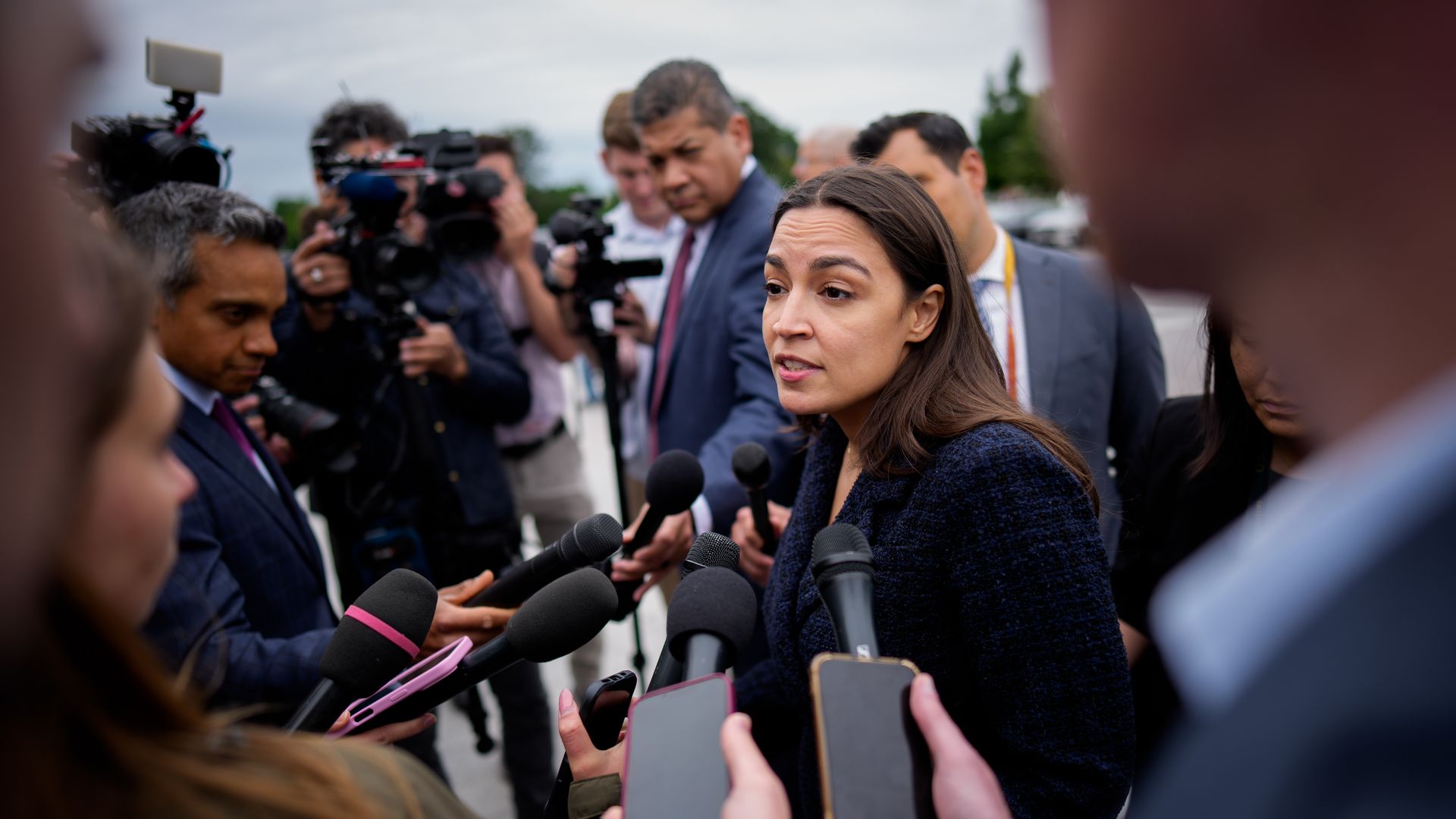
New York Rep. Alexandria Ocasio-Cortez speaking to reporters outside the Capitol on Thursday. Photo: Andrew Harnik/Getty Images
Alexandria Ocasio-Cortez says she hasn't decided whether to run for president, but the New York congresswoman is making new moves toward a possible White House bid.
- Ocasio-Cortez launched a national tour in recent weeks — without calling it one.
Why it matters: Whether AOC jumps into the race is one of the biggest X factors in the 2028 Democratic primary.
- Democratic operatives expect she would easily raise $100 million just from small-dollar donors, mobilize many supporters of Vermont Sen. Bernie Sanders' past campaigns, and command attention as few other candidates could.
Driving the news: Just in May, Ocasio-Cortez has:
- Rallied voters in Philadelphia for a left-wing congressional candidate in a competitive primary.
- Spoken at a rally in Montgomery, Ala., about voting rights.
- Addressed the historic Ebenezer Baptist Church in Atlanta with Georgia Sen. Raphael Warnock. (Democrats note that Warnock, the church's senior pastor, doesn't always allow visiting politicians to speak at this church. Former Transportation Secretary Pete Buttigieg didn't speak when he visited in March.)
- Met with the Rev. Martin Luther King Jr.'s daughter at the King Center in Atlanta to talk about data centers and voting rights.
- Visited Morehouse School of Medicine, also in Atlanta, to discuss Black maternal health.
- Rolled out several endorsements in races across the country.
This week, Ocasio-Cortez will travel to Missoula, Mont., to campaign for congressional candidate Sam Forstag, a smokejumper and union leader who spoke at a rally with AOC and Sanders last year.
AOC also has raised eyebrows by attending meetings with Democratic Party powerbrokers.
- In April, she attended the Power Rising Summit in Chicago — an event that bills itself as "a space for Black women to turn power into action and create an actionable agenda to be implemented in their communities, and nationally."
- The summit was founded by influential Democratic operative Leah Daughtry.
Between the lines: It's not just where Ocasio-Cortez is going, it's what she's saying that signals her ambitions go well beyond her New York City district.
- During her speech in Philadelphia, she approvingly quoted an activist who recently said that "MAGA is the last dying breath of the confederacy."
- She added: "In response to a confederacy, we have this moment here of liberation, abolition, and revival of the values that make this country actually great."
- She also waxed poetic about how the "founding of our nation introduced a radical new idea into the world that all people were created equal."
At Ebenezer Baptist Church, Ocasio-Cortez brought the congregation to its feet when she said, "I'm here today, brothers and sisters, with a simple message: We stand together and we are not going back."
- She continued: "What happens in Georgia happens to New York, what happens to Tennessee happens to California, what happens to Louisiana happens to all of us, Ebenezer, because this is America. We are not divided by state, we are united by our humanity and common citizenship."
The other side: Ocasio-Cortez recently said that speculation about her running for president assumes that her "ambition is positional," but "my ambition is way bigger than that. My ambition is to change this country."
- A person close to AOC told Axios that she is still genuinely undecided on whether to run for president. She's also considering a Senate bid in 2028.
- "The way she will evaluate the decision is really around where she believes she can make the most change," the source said.
- Ocasio-Cortez also is skeptical of early 2028 primary polls that are positive for her, including one this month showing her first among possible contenders, the source added.
Flashback: Presidential politics have a long history of potential candidates denying White House ambitions only to reverse course.
- In January 2006, then-Illinois Sen. Barack Obama said: "I will serve out my full six-year term." Pressed on whether he would run for president or vice president in 2008, he said: "I will not."
- Ten months later, Obama said that "given the responses that I've been getting over the last several months, I have thought about the possibility" of running for president.
- In 1990, then-Arkansas Gov. Bill Clinton also committed to serving for four years, and said only "a plane crash or something" would prevent that.
- After a listening tour through Arkansas in 1991, he changed his mind — and won the presidency in 1992.
