Why health officials are worried about containing the Ebola outbreak

Add Axios as your preferred source to
see more of our stories on Google.
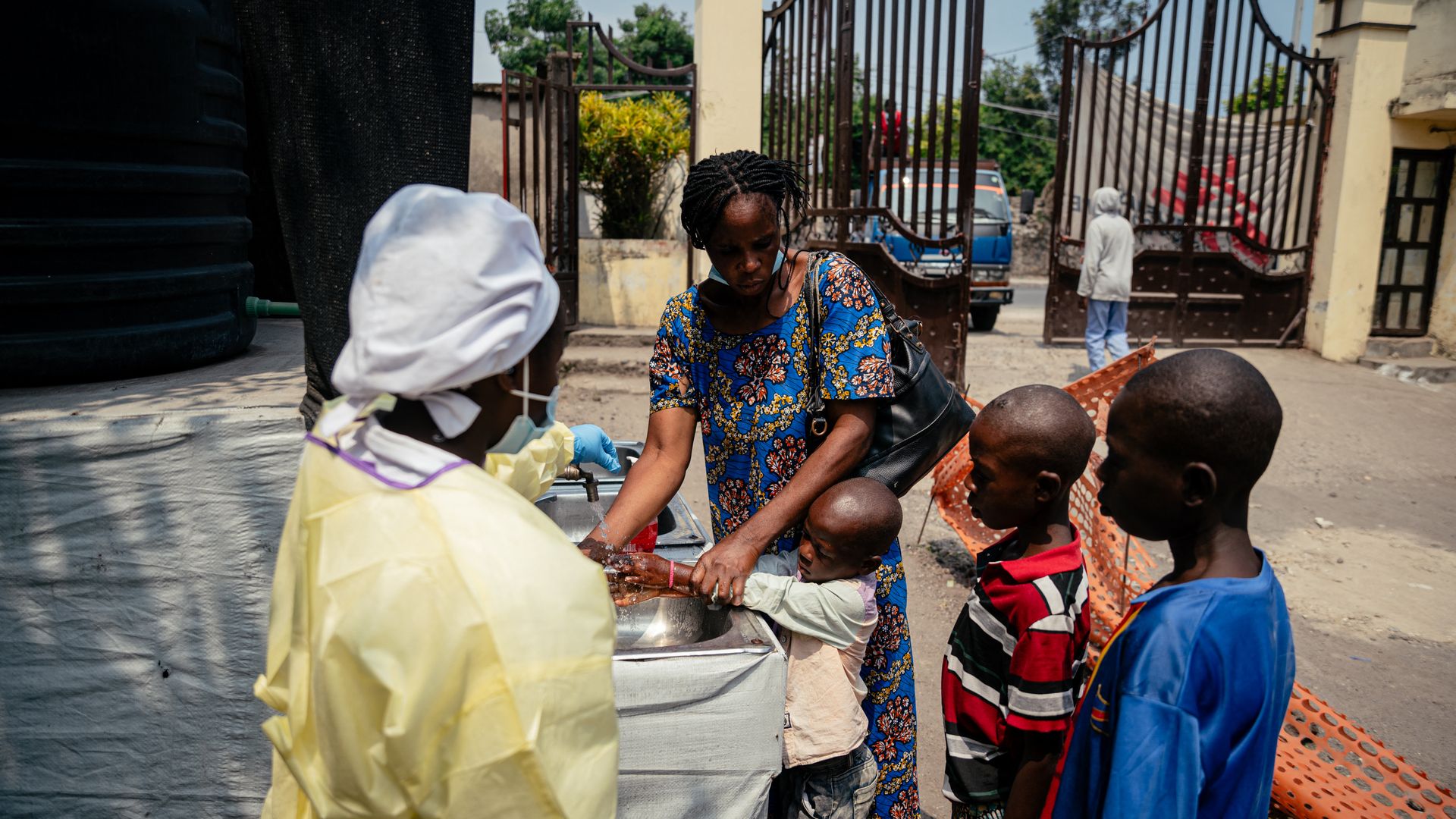
A mother helps her children wash their hands before entering Kyeshero Hospital as part of Ebola prevention measures in the Democratic Republic of Congo on May 18. Photo: Jospin Mwisha / AFP via Getty Images
The ongoing Ebola surge has public health experts anxious about the world's capacity to contain its spread.
The big picture: Ebola epidemics aren't new, but the current outbreak has been identified as the rare Bundibugyo strain, which has no vaccine, and is located in a populated, mobile and conflict-stricken part of the world.
- Thirty cases have been confirmed in the Democratic Republic of Congo (DRC), while two confirmed cases, including one death, have been recorded in Uganda from people who traveled from the DRC, World Health Organization Director General Tedros Adhanom Ghebreyesus said Tuesday.
- There are more than 500 suspected cases and 130 suspected deaths, he said. One American working in the DRC tested positive and is being taken to Germany for treatment, the CDC confirmed Monday. The American was identified Tuesday as Peter Stafford, a doctor working as a medical missionary in Congo.
- The WHO has deemed the outbreak a public health emergency of international concern.
Context: Nasia Safdar, an infectious diseases physician and professor at the University of Wisconsin-Madison, tells Axios that Ebola concerns her more than the recent hantavirus outbreak, noting the cruise ship environment where it spread is very different than the outside world.
- Only one hantavirus strain is known to spread human-to-human, but four Ebola strains cause illnesses in people, per the CDC. Hantavirus rarely spreads among people, but public health experts pointed to the recent outbreak as evidence that more research is needed into its spread.
- Once spillover to humans occurs, the Ebola virus is challenging to contain and regularly leads to the most life-threatening cases of viral hemorrhagic fevers. A 2014-2016 surge in West Africa infected more than 28,600 people and killed 11,325, per the WHO.
- The fatality rates in the past two Bundibugyo outbreaks have ranged from 30-50%.
What they're saying: This particular Ebola outbreak is troubling, says Jennifer Nuzzo, the director of the Pandemic Center at Brown University School of Public Health.
- "Many people are worried that we could have another 2014 situation on our hands. That was the largest, deadliest outbreak of Ebola on record, and the conditions on the ground and the lack of tools to combat this particular Ebola virus make people very worried that we could see similar circumstances happen again," Nuzzo says.
- There was also an apparent delay in health authorities acknowledging the spread.
- "We actually don't know how large the situation already is, but it's certainly poised to become much, much larger," she says.
Reality check: The risk to the American public remains low, but travel restrictions for those without U.S. passports coming from Uganda, DRC and South Sudan were announced Monday, along with enhanced port health protection response strategies.
Friction point: While neither the Ebola or hantavirus outbreaks have been labeled pandemics, general public health reforms have not kept up with the rising pandemic risk, a report released Monday by the Global Preparedness Monitoring Board, co-convened by the WHO and World Bank, warned.
- Nuzzo is concerned about what dismantling USAID, which had helped lead past international responses to disease outbreaks, means for on-ground support for contact tracing and other efforts that she says "are really the only tools we have at this point to stop the spread."
- She added: "Trying to combat these very serious emergencies with a gutted public health workforce, and with fewer tools — it's like we're basically leaning into them with both hands tied behind our backs."
Go deeper: Why we don't talk about COVID anymore
Editor's note: This story has been updated to identify the one known American who tested positive for Ebola.
