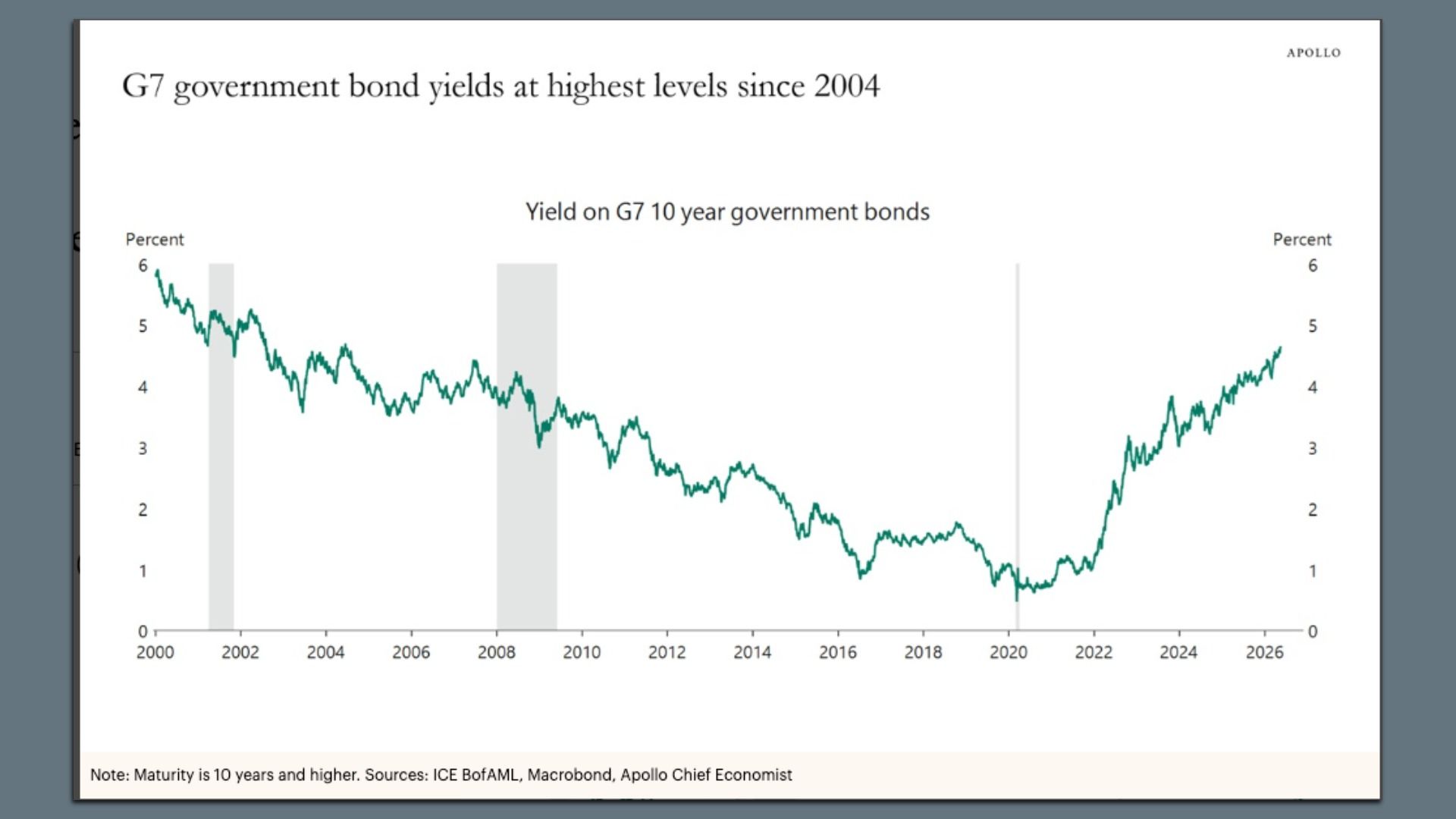
Government borrowing costs are at 22-year highs


Add Axios as your preferred source to
see more of our stories on Google.
Illustration: Aïda Amer/Axios
Government bond yields around the world, including in the U.S., are hitting multi-decade highs as investors price in higher for longer inflation due to the Iran war.
Why it matters: The interest rates, or yields, that governments pay on their debt can drive the global economy — when rates are low, countries can spend more freely and drive economic growth.
The big picture: But high rates are a constraint. When governments pay more to borrow, so do companies and regular people who take out mortgages, car loans, etc.
Between the lines: Higher long-term borrowing costs will make it much harder for incoming Federal Reserve chair Kevin Warsh to cut interest rates, as President Trump has been gunning for.
Where it stands: Yields have been rising for weeks, but the gains accelerated Friday after Trump's meeting with Chinese President Xi Jinping in Beijing.
- Going into the talks, investors hoped Xi would play the role of peacemaker, leading to an end to the Iran conflict and easing the inflation pressures caused by the closure of the Strait of Hormuz.
- It didn't turn out that way.
By the numbers: Government bond yields across the G7 nations, for debt that matures in 10 years or longer, are at their highest levels since 2004, closing in on 5%, Apollo Global Management chief economist Torsten Slok wrote in a note Sunday. (See chart below.)
Zoom in: In the U.S., the biggest moves have been in the bonds with the longest duration, as investors are betting that inflation will be sticking around for a while.
- On Friday, the 30-year Treasury yield closed at 5.12%, the highest since June 2007 (not exactly a banner year for finance, if you recall).
State of play: It's not just the war. Governments worldwide are running higher deficits — and need to borrow more or issue more bonds.
- As trade wars and actual wars cause tensions, investors are demanding higher premiums for taking on government debt "amid deglobalization and increased geopolitical fragmentation," Slok wrote.
- "Rates will stay higher for longer, and investors should plan accordingly."
Flashback: Treasury Secretary Scott Bessent spent months putting America's bond market at the center of the White House's promise to bring down borrowing costs.
- The pitch: "Lower Treasury borrowing costs mean lower corporate borrowing costs, lower mortgage rates, and lower car payments — which all translates to greater affordability for all Americans," Bessent said in a speech last fall at the New York Fed.
Yes, but: In the U.S. rising rates are, perhaps counterintuitively, partly a result of a strong economy.
- Typically, higher oil prices slow economic growth and keep inflation from rising too much. But in the U.S., the AI boom is offsetting the slowdown risk, Evercore analysts wrote in a note Friday.
- "U.S. economic data have pointed to resilient demand and especially to an AI-related capex boom that lower the risk of a significant slowdown in activity, let alone a recession."
What to watch: Stock markets, which had been basically ignoring the conflict for weeks, appear to be waking up.
- Both the S&P 500 and Nasdaq fell Friday, breaking a nearly seven-week streak of gains.
- "A lack of progress on the conflict has folks throwing in their towels as it relates to the possibility for tighter interest rates," José Torres, senior economist at Interactive Brokers, wrote in a note Friday.
- Bonds will likely be on the agenda at the two-day G7 finance ministers' meeting that kicks off Monday in Paris, writes Jim Reid at Deutsche Bank.
The intrigue: Higher borrowing costs make it potentially harder for governments to spend their way out of crisis — at a moment when a crisis is bearing down on many countries because of the war.