Trump upends Democrats' strategy on Iran war powers

Add Axios as your preferred source to
see more of our stories on Google.
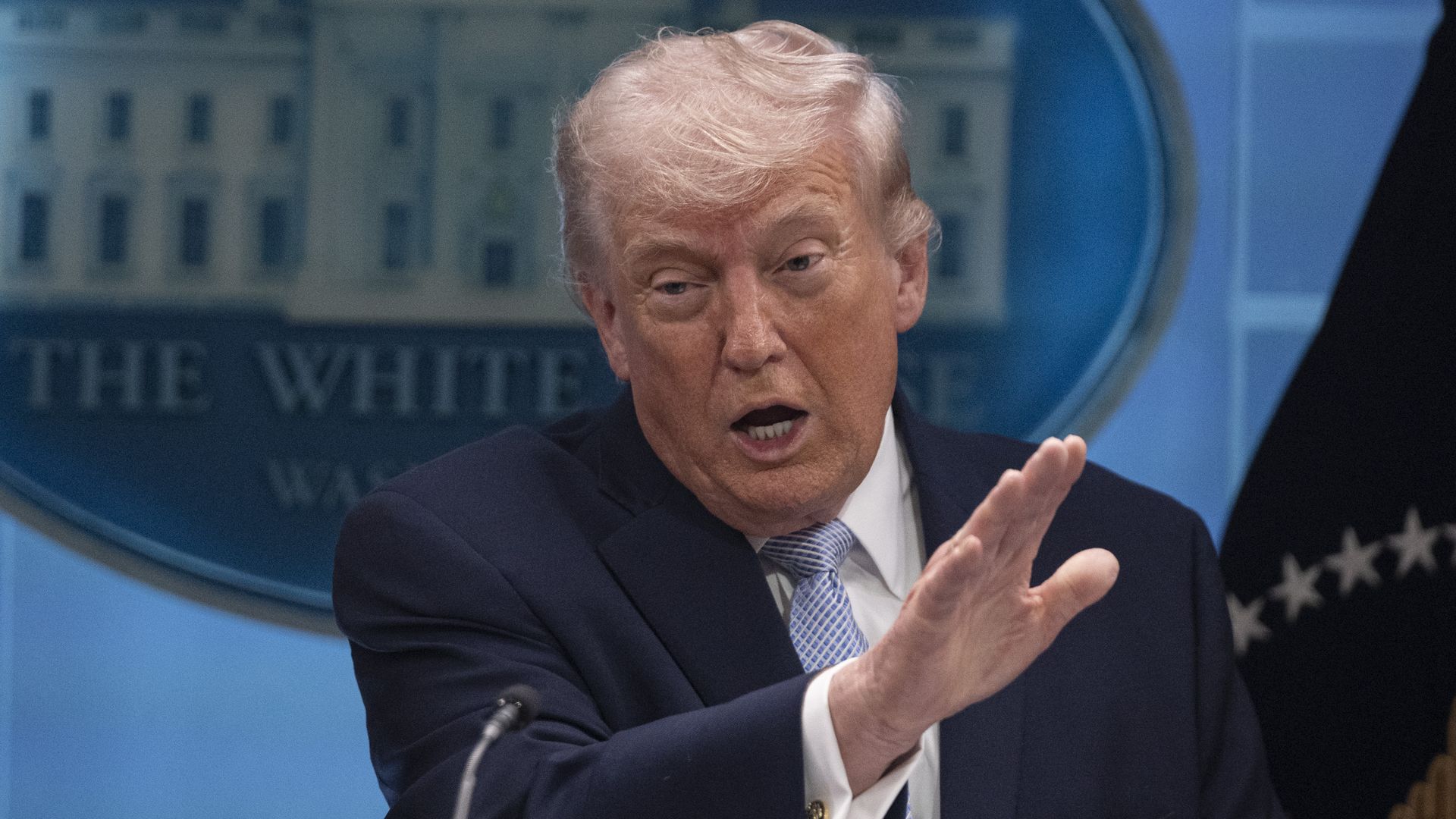
President Trump holds a press briefing at the White House on April 6. Photo: Celal Gunes/Anadolu via Getty Images
President Trump's declaration that hostilities with Iran are "terminated" has thrown Democrats' strategy around congressional war powers into turmoil, Axios has learned.
Why it matters: House Democrats, led by the Congressional Progressive Caucus, had been planning to force a war powers vote every day. It is now unclear whether that will — or even can — happen.
- Lawmakers involved in the war powers effort have been quietly reassessing how to approach the matter when Congress returns next week, according to multiple aides and lawmakers familiar with the matter.
- "There's a lot to happen between now and next week," one senior House progressive told Axios. "Who knows how many times Trump could change his position between now and then."
- The latest: The U.S. launched airstrikes on Iran's Qeshm port and the coastal city of Bandar Abbas on Thursday but does not see the operation as restarting the war or breaking the ceasefire, an American official told Axios' Barak Ravid.
Driving the news: Trump sent Congress a notification last week stating that, "The hostilities [with Iran] that began on February 28, 2026, have terminated."
- Trump cited the ceasefire he brokered with Iran on April 7, writing that there has "been no exchange of fire between United States forces and Iran since" then.
- Democrats roundly rejected that framing of the situation, pointing to the U.S. military's blockade of Iranian vessels in the Gulf of Oman.
- "With an active blockade and shooting, plus threats of resuming bombing at any moment, I don't know anyone who takes that argument seriously," Rep. Jared Huffman (D-Calif.) told Axios.
Between the lines: The notification was Trump's way of bypassing a War Powers Act requirement that he seek congressional approval for continued operations in Iran within 60 days of the conflict's inception.
- But some Democratic lawmakers fear it may also be used by Republicans as a pretext to shut down their efforts to force votes to on war powers resolutions.
- A spokesperson for House Speaker Mike Johnson (R-La.) did not respond to a request for comment on the matter.
What we're hearing: "The majority could try and say, 'we're not going to put this on the floor because there ... are no hostilities within the meaning of the War Powers Resolution,'" a second House Democrat told Axios.
- The lawmaker, who spoke on the condition of anonymity to offer candid analysis on a situation that is still the subject of internal discussion, said the matter would likely go to the House parliamentarian.
- "That would be a pretty tough way for [Republicans] to go," the House Democrat said, but "anything can happen."
What to watch: Spokespeople for several of the House Democrats who introduced war powers resolutions in recent weeks either did not respond to questions about whether their bosses still plan to try to force those votes or declined to give a definitive answer.
- "We'll see if there's any reconsideration of strategy when we get back," Huffman told Axios.
- A spokesperson for Rep. Jason Crow (D-Colo.) noted that he and Rep. Seth Moulton (D-Mass.) introduced a war powers resolution even after Trump's declaration — potentially signaling plans to forge ahead.
